


Emotional Cues in Healthcare: How to Recognize, Interpret, and Assess Them in Clinical Training
Emotional cues in healthcare are verbal or nonverbal signals that reveal a patient’s emotional state, concerns, or life context. These cues may appear as direct statements, subtle hints, tone shifts, or body language. In clinical training, recognizing emotional cues transforms communication from intuition into observable, assessable professional behavior.
For healthcare students and educators, EC are not abstract psychological concepts. They are observable clinical data. When clinicians notice, interpret, and respond appropriately, they strengthen the therapeutic alliance. When they miss them, communication fractures.
Understanding emotional cues is therefore central to structured communication, feedback, and assessment in OSCEs, EPAs, simulation, and supervision.
What Are Emotional Cues in Clinical Encounters?
Emotional cues (EC) are direct or indirect expressions that provide insight into a patient’s feelings, fears, values, or social context. Research on patient clues and physician responses demonstrates that patients frequently introduce emotional material during routine visits.
These cues may be verbal. A patient might say, “I’m alone,” or “I’m just so tired.” However, the emotional content often lies beneath the surface. Tone, hesitation, facial tension, silence, and posture also function as EC.
Paul Ekman’s work on emotional expression shows that facial and bodily signals communicate affect even when words do not. In clinical encounters, microexpressions, voice shifts, and gaze aversion provide additional data.
Importantly, emotional cues can be categorized:
- Verbal cues: Statements that express fear, frustration, anger, grief, or uncertainty.
- Nonverbal cues: Changes in posture, eye contact, breathing, or facial tension.
- Indirect patient clues: Hints that require interpretation, such as references to loneliness, stress, or family conflict.
For students, the key shift involves moving from feeling empathy internally to identifying EC externally as observable behavior.
Why Emotional Cues Matter for Clinical Outcomes
Emotional cues influence clinical outcomes. A systematic review of the patient clinician relationship demonstrates that relational factors affect measurable health outcomes. Similarly,empathy in general practice correlates with improved patient satisfaction and adherence.
When physicians recognize emotional cues and respond with empathic communication, patients disclose more information, adhere better to treatment, and report higher trust. Conversely, missed EC can undermine the therapeutic alliance.
Halpern argues that detached concern may prevent physicians from engaging emotional information that shapes clinical reasoning. When clinicians ignore EC, they risk misunderstanding patients’ motivations, values, and readiness for care.
Therefore, EC are not peripheral to biomedical care. They shape diagnostic clarity, shared decision making, and ethical reasoning.
For trainees, this reframes communication as a measurable contributor to patient safety and quality of care.
Emotional Cues as Observable Clinical Data
Emotional cues become clinically meaningful when they are treated as data rather than impressions. In the study of patient clues and physician responses, over half of routine visits included at least one emotional cue. However, physicians frequently shifted topics or responded inadequately. This pattern reveals that EC are not rare events. They are recurring behavioral markers embedded within everyday encounters.
For training environments, this distinction is critical. Students often report that they “felt something was wrong.” Yet assessment requires more precision. Educators must ask:
- What exactly did the patient say?
- What nonverbal behavior occurred?
- What did the student do next?
By operationalizing emotional cues, programs can create structured observation frameworks. For example, assessment rubrics can include:
- Recognition: The student identifies a verbal or nonverbal emotional cue.
- Acknowledgment: The student explicitly names or validates the emotion.
- Exploration: The student invites elaboration without prematurely redirecting.
- Integration: The student incorporates emotional information into clinical reasoning.
This approach aligns with models of empathic communication in the medical interview. Emotional cues therefore become observable anchors within OSCE checklists, EPA entrustment decisions, and workplace-based assessments.
Furthermore, treating emotional cues as observable clinical data prevents reduction of empathy to personality traits. Instead, communication becomes a reproducible, trainable competency.
How Students Can Improve Recognition of Emotional Cues
Recognition of emotional cues requires deliberate cognitive strategies. First, students must slow the interactional tempo. Research on emotional reasoning shows that strong affect can produce rigid certainty in both patients and clinicians. Therefore, pausing allows the clinician to differentiate observation from interpretation.
Second, students must refine perceptual awareness. Emotional cues frequently emerge in:
- Voice modulation
- Sentence fragmentation
- Delayed responses
- Changes in breathing
- Shifts in posture
Training exercises should include micro-analysis of brief encounter segments. In simulation debriefings, educators can replay 10- to 20-second clips and ask learners to identify the exact moment an emotional cue appeared. This strengthens attentional discipline.
Third, learners must practice structured responses. Rather than offering premature reassurance, students can use a three-step method:
Observation statement: “I noticed you hesitated when discussing the surgery.”
Emotion hypothesis: “It sounds like this feels overwhelming.”
Open invitation: “Can you tell me more about what worries you most?”
This sequence prevents topic termination and supports emotional exploration. Importantly, it also produces observable behaviors that examiners can score during OSCEs.
Finally, reflective review consolidates learning. When students watch recordings of their encounters, they frequently notice missed emotional cues that were invisible in real time. This reflective process deepens clinical judgment and strengthens interprofessional collaboration during supervision.
Using Video to Assess Emotional Cue Recognition in OSCEs and EPAs
Video transforms emotional cues from fleeting moments into analyzable sequences. In live encounters, subtle signals pass quickly. However, recorded consultations allow repeated review of the cue-response cycle.
A structured analysis model may include:
- Cue emergence
- Clinician response
- Patient reaction
- Shift in emotional tone
- Impact on decision making
This model supports both formative feedback and summative assessment.
In OSCE stations, standardized patients can be trained to introduce specific emotional cues. Examiners can then score whether the candidate:
- Identified the cue without prompting
- Avoided immediate biomedical redirection
- Demonstrated empathic acknowledgment
- Maintained structured communication
For EPAs involving independent patient care, supervisors can review recorded cases to evaluate whether the trainee integrates emotional cues into shared decision making. Entrustment decisions become more defensible when grounded in observable communication behavior.
Additionally, video supports interprofessional debriefing. Nurses, physicians, and allied professionals may perceive cues differently. Reviewing the same interaction creates shared understanding of how emotional communication influences team dynamics.
When institutions embed video recording in healthcare education, emotional cues shift from subjective impressions to measurable competencies. This strengthens both learner development and patient safety.
Common Errors in Interpreting Cues
Students and clinicians may fall into predictable errors.
- Concretization occurs when emotional distress leads to rigid certainty. Halpern describes how unprocessed emotion can distort reasoning.
- Projective identification may transmit emotional states between patient and clinician. This can narrow attention and reinforce hopeless narratives.
- Excessive detachment can silence emotional information under the guise of objectivity.
Recognizing these errors strengthens emotional reasoning and protects against biased interpretation.
Practical Checklist for Clinical Training
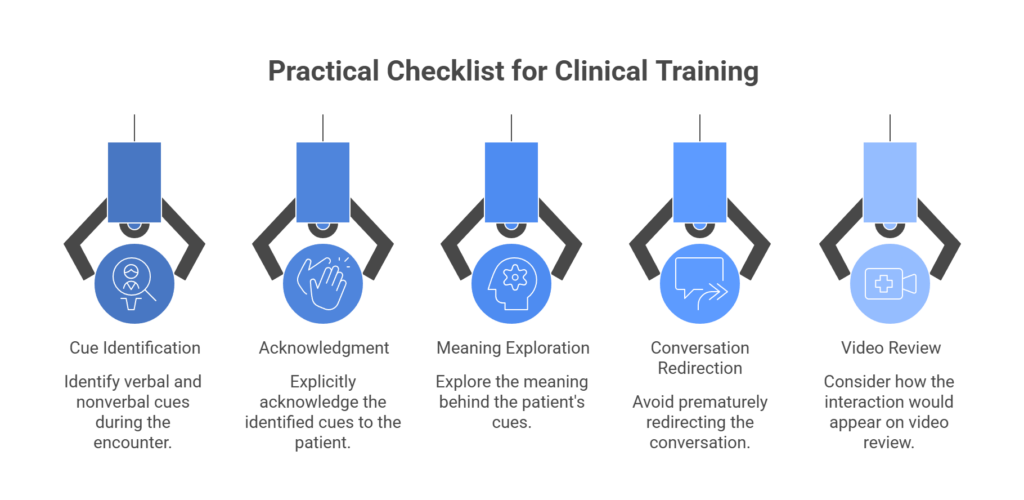
During clinical encounters, ask:
- What cues are present?
- Are they verbal or nonverbal?
- Have I acknowledged them explicitly?
- Did I explore their meaning?
- Did I prematurely redirect the conversation?
- How might this interaction appear on video review?
Embedding this checklist into simulation, OSCEs, and supervision integrates emotional cues into structured communication training.