

The real issue isn’t synchronous vs asynchronous learning
Most debates about synchronous versus asynchronous learning in healthcare start in the wrong place. The problem usually isn’t that educators picked the wrong format. It’s that formats get treated as strategies, rather than tools that serve different purposes.
In healthcare and teacher education alike, learning often gets scheduled around availability rather than outcomes. If a slot opens on the calendar, a live session gets booked. If schedules clash, the content moves online and gets labelled “asynchronous.” Neither decision says much about how people actually learn or change their practice.
This gap is easy to see in practice-based education. Learners are meant to build judgment, communication skill, and a professional identity, all while juggling placements, workload, and emotional pressure. More live time does not automatically produce better learning, and more flexibility does not guarantee depth or engagement.
Research from the rapid shift during COVID-19 made the pattern visible. Both synchronous and asynchronous approaches supported learning, just in different ways. Alzahrani et al. found that students valued synchronous sessions for interaction, while asynchronous formats gave them more control over time and workload. The finding was never about which format wins. It was about fit.
So instead of asking which format is better, ask a narrower question: what problem is this specific learning activity meant to solve? Once that’s clear, the choice between synchronous and asynchronous usually follows on its own.
When live interaction is worth the cost
Live sessions pull their weight when learning depends on shared sense-making rather than one-way information transfer. Real-time interaction matters most when learners need to test their reasoning, surface hidden assumptions, or check their thinking against someone else’s.
In healthcare education, this plays out in clinical reasoning, ethics, communication skills, and interprofessional collaboration. Mao et al. describe synchronous learning as enabling direct interaction between teachers and students, which clarifies nuanced topics and reduces misunderstanding. The value sits in the dialogue itself, not in delivering content.
The same pattern holds in teacher education. Live discussion works for classroom management scenarios, ethical dilemmas, and feedback conversations, where tone and timing matter as much as content. Immediacy lets learners ask a question they didn’t know they had, or notice that a colleague read the same situation completely differently.
Live interaction still comes at a cost, though. It demands coordination, sustained attention, and emotional presence. Alzahrani et al. found that learners rated synchronous sessions as more interactive, but also reported more pressure on their time and schedules than with asynchronous formats. That tradeoff is the reason live time should be spent deliberately, not booked by default.
Synchronous time adds the most value when alignment, clarification, or social calibration is the actual goal. Scheduled just because it feels more “real,” it tends to crowd out reflection and wear down learners and educators alike. Spotting the difference is one of the harder design skills in healthcare and teacher education.
When does stepping back improve learning more than being present?
Asynchronous formats matter when learners need time to think, revisit the experience, and connect feedback to what they’ll do differently next time. That’s less about convenience and more about giving reflection room to happen.
A comparative study of synchronous and asynchronous online teaching in medical education backs this up. Both formats improved learning outcomes and student satisfaction, with no meaningful gap between them. What differed was how learners engaged, not how well they performed. Asynchronous formats took the time pressure off and let learners set their own pace, which favors understanding over quick response.
The effect carries over to clinical reasoning, communication, and professional judgment. Reflecting after the fact lets learners spot patterns, admit uncertainty, and actually absorb feedback instead of just hearing it. Research on remote asynchronous training and feedback found that delayed, structured feedback still improves performance, as long as learners can review their own recordings and revisit that feedback more than once.
Asynchronous formats also strengthen assessment quality. Written reflections, recorded artefacts, and documented feedback leave a trail of evidence that a fair evaluation can point back to. That distinction carries the most weight in healthcare and teacher education, where assessment decisions have to survive scrutiny. Videolab’s overview of reflective practice in healthcare training breaks down how structured reflection turns asynchronous learning into something accountable, not just convenient.
Stepping back isn’t disengagement here. It’s often the point where learning actually settles and a professional identity starts to take shape.
The balance between synchronous and asynchronous learning
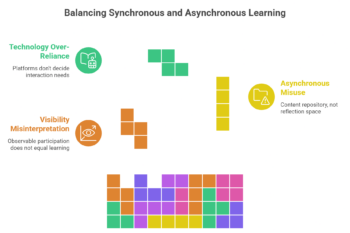
Despite the growing evidence, plenty of education programs still get the balance wrong. The issue is rarely a lack of tools. It’s usually about how institutions read visibility, engagement, and control.
Live sessions feel productive because you can watch them happen. Attendance gets tracked, interaction is visible, teaching feels tangible. But visibility isn’t the same thing as learning. A study comparing synchronous and asynchronous formats in nursing education found no meaningful difference in outcomes, even for a domain as complex as ethical decision-making. That’s a direct challenge to the assumption that real-time always wins.
Asynchronous learning gets misused just as often, in the opposite direction. Instead of being built for reflection and consolidation, it turns into a content dump. Motivation drops, and the learning that happens is shallow. Studies in healthcare education find that learner self-regulation and the quality of the instructional design predict outcomes more than the delivery mode itself does.
A related mistake is treating the platform as a stand-in for pedagogy. Software scales content, but it doesn’t decide when learners need interaction versus reflection. Get that wrong in healthcare education and the risks are real: too many synchronous sessions pile on cognitive and scheduling load, while a poorly designed asynchronous track undermines feedback and weakens how defensible an assessment is.
Programs built around purpose instead of format avoid both traps. They reserve synchronous time for alignment and sense-making, and build in asynchronous time deliberately for reflection, documentation, and growth. That shift from format-first to intention-first design is what separates an effective program from a merely busy one.
A design rule educators can actually use
Once synchronous and asynchronous stop being framed as opposites, design decisions get a lot easier. The useful question isn’t which format to pick. It’s what kind of learning you’re trying to enable right now.
A workable rule of thumb: match the format to the intent. When the goal is shared understanding, synchronous time is worth spending. Live discussion surfaces assumptions and builds a common frame of reference, which is why case discussions, ethical dilemmas, and communication exercises tend to work best in real time.
When the goal is insight or consolidation, asynchronous time tends to win. Learners do better when they can step back, revisit the experience, and reflect without a clock running. Research comparing the two approaches keeps finding no meaningful gap in outcomes when the design is intentional, which suggests pacing matters just as much as interaction does.
When the goal is accountability or a defensible assessment, asynchronous workflows aren’t optional. Recorded artefacts, written reflections, and documented feedback provide the traceability that fair evaluation and accreditation depend on. This is the same principle behind many feedback models in healthcare education, where assessment decisions need to stay transparent. Our overview of feedback models in healthcare training shows how documented feedback strengthens both the learning and the governance around it.
A practical checklist for choosing between synchronous and asynchronous learning
Before scheduling a session or designing a module, one question helps prevent misalignment: What should learners be able to do differently after this activity?
If the answer involves insight, judgment, or transfer, asynchronous components deserve just as much attention as the live ones. The table below shifts the conversation away from formats and toward intent.
In healthcare education, the distinction shows up in ordinary scenarios. Take a case discussion around diagnostic uncertainty: when learners need to compare reasoning paths, challenge assumptions, and hear how others read the same information, that’s a job for real-time dialogue. It surfaces misunderstandings quickly and helps a group align on how a decision actually gets made. The value there comes from shared sense-making, not from delivering content.
Compare that to learning that follows performance, like reviewing a recorded patient consultation or reflecting on a clinical handover. Asynchronous review usually comes out ahead there. Learners can step back, revisit the interaction, and connect the feedback to their own thinking without any pressure to respond on the spot. That matters most for communication skills, where the real insight often only shows up once emotions settle and the context becomes clearer.
Comparison Table: Synchronous vs Asynchronous Learning
| Design need | Synchronous learning works best when you need to | Asynchronous learning works best when you need to |
|---|---|---|
| Learning intent | Build shared understanding and align perspectives | Support reflection, consolidation, and sense-making |
| Type of engagement | Real-time dialogue and immediate interaction | Thoughtful, self-paced engagement over time |
| Cognitive demand | Work through ambiguity, disagreement, or ethical tension | Reduce time pressure and allow deeper processing |
| Skill focus | Practice communication, discussion, or interaction live | Review performance, analyse decisions, and refine skills |
| Learner experience | Create social presence and group calibration | Give learners space to revisit material and feedback |
| Time and scheduling | Coordinate learners at the same moment | Fit learning around busy or unpredictable schedules |
| Feedback approach | Provide immediate clarification and coaching | Offer structured, documented feedback that can be revisited |
| Assessment needs | Explore understanding in the moment | Create traceable evidence for assessment and progression |
| Best use in practice | Case discussions, debriefings, alignment sessions | Reflection, portfolios, follow-up work, longitudinal learning |
Scheduling and cognitive load matter too. Healthcare learners are juggling education with clinical duties, which makes it hard to stay sharp through frequent live sessions. Asynchronous formats absorb that pressure by letting engagement happen when learners are actually ready for it. That doesn’t lower accountability. If anything, structured asynchronous activities, like written reflections, annotated video review, or feedback logs, leave more traceable evidence than a live session ever does.
Blended designs tend to work best when the learning goal spans both understanding and application. A live simulation debrief, for instance, gets everyone aligned on expectations and key moments. Follow-up asynchronous reflection then lets each learner analyse their own performance, revisit feedback, and track improvement over time. That sequence covers both the social side of learning and the reflective side.
Using the table as a design check makes these choices more deliberate. Once the mode matches the purpose, synchronous and asynchronous stop fighting each other for attention and start reinforcing the same outcome: understanding that holds up once the learner is back on the ward.
Designing learning with intention, not habit
The line between synchronous and asynchronous learning was never really technical. It’s a design decision that shapes how learners think, reflect, and build professional judgement. The problems start when institutions pick a format out of habit or availability instead of purpose.
Live interaction earns its place when learners need alignment and shared understanding through dialogue. Asynchronous work earns its keep when they need insight, consolidation, and accountability instead. Learning gets better when educators choose between the two on purpose, not interchangeably.
Well-designed asynchronous learning isn’t optional anymore. It supports reflection, documentation, and continuity in ways a live session simply can’t. Synchronous learning still matters just as much, whenever learners need to build meaning together rather than absorb information on their own.
The strongest programs never ask which format to choose. They ask what kind of learning they’re trying to produce, then build the format around that answer. That question is what turns synchronous and asynchronous from rivals into two tools doing different jobs.