

Across healthcare education and clinical training, video recording has become institutional infrastructure, not a supplementary teaching tool. Universities and teaching hospitals lean on it for communication skills training, simulation, assessment, supervision, and research. Once it supports assessment, appeals, or real patient encounters, its procurement classification changes too.
At that point, video stops behaving like optional educational content and becomes regulated institutional data, with legal, security, and governance implications attached. As usage scales across undergraduate and postgraduate programs, the procurement decision stops being a department-level call and turns into a faculty-wide, multi-year commitment.
Institutions that select Videolab usually get there through a structured internal review involving IT security, data protection officers, legal counsel, and academic leadership. From a procurement standpoint, the real comparison was never about feature parity. It’s about risk distribution, architectural intent, and long-term institutional exposure.
This lines up with broader guidance on clinical video use, which notes that governance requirements shift the moment video captures real interactions instead of simulated ones.
Video as regulated institutional data
From an IT and procurement perspective, the real difference between generic video platforms and Videolab comes down to how the video data itself is classified and governed.
Generic video tools treat recordings as files sitting in a multi-tenant environment built for collaboration or content distribution. Access control, retention, and deletion end up depending heavily on user behavior and whatever an administrator configured. In healthcare education, that accumulates risk over time, especially once recordings involve real patients, identifiable learners, or high-stakes evaluations.
Videolab starts from a different assumption: that clinical video is regulated institutional data from the moment it exists. Recordings get encrypted at the point of capture, access requires explicit authorization, and deployments run in institution-specific environments rather than a shared customer space. Hosting location, retention policies, and role definitions stay under the institution’s own control.
This architecture reflects the GDPR requirement for data protection by design. Article 25 of Regulation (EU) 2016/679 states:
“The controller shall implement appropriate technical and organisational measures… designed to implement data-protection principles… in an effective manner.”
Videolab leans on technical measures for compliance instead of relying mainly on procedural controls and hoping users follow them.
Relative risk exposure under typical institutional use
The table below compares relative risk exposure under common institutional usage patterns. It doesn’t claim to eliminate risk entirely. It highlights structural differences in how that risk gets distributed and managed.
| Risk category | Generic video tools | Videolab |
| Data breach probability | Medium to high when used for clinical video due to local device residue, and user-managed permissions | Low due to encryption at capture, isolated deployments, and enforced access control |
| Device loss risk | High: recordings often remain cached locally on phones, laptops, or SD cards | Low: encrypted streams deleted from devices immediately after upload |
| Insider misuse risk | Medium: broad access permissions and downloadable files | Low: role-based access, no uncontrolled file exports |
| Legal defensibility | Weak: fragmented evidence, unclear custody chain | Strong: encrypted storage, access logs, traceable evaluations |
| Audit readiness | Manual and time-intensive | Built-in audit trails and review workflows |
Data ownership and exit risk
Many generic platforms reserve broad rights over stored content, or build in technical dependencies that make migrating away difficult. Even when the contract says the institution owns the data, operational control often stays constrained by the vendor’s own infrastructure and roadmap.
Videolab deployments are institution-specific instead. Ownership stays with the institution, and in many configurations with the creator of the recording, inside the institution’s own governance framework. Codific does not access, reuse, or monetize customer data. Institutions can run Videolab on whichever cloud provider they prefer, or on hospital-managed servers, which cuts long-term dependency on a single vendor.
That matches how public-sector procurement usually thinks about this: controllability and exit readiness matter more than convenience.
Security architecture aligned with healthcare threat models
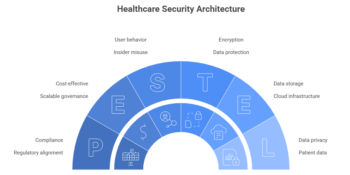
Healthcare institutions face a distinct threat landscape: device loss, unauthorized access, insider misuse, and accidental exposure during otherwise routine workflows.
Videolab’s answer is to stop relying on manual enforcement. Its recording applications encrypt streams immediately and strip local files after upload, so a lost or stolen device has no recoverable patient data on it. Centralized identity management and role-based access close off most of the remaining misuse paths.
CloudControl extends the same safeguards into skills labs and simulation environments by intercepting and encrypting camera and microphone streams right at the source, cutting both human error and exposure to outside attack.
The underlying logic is standard healthcare threat modeling: prevent the systemic failure before it happens, rather than clean up after it does.
Operational efficiency that scales with governance
From a procurement standpoint, efficiency gains only count if governance holds up as the system scales.
Videolab removes the need for physical presence, dedicated recording hardware, and manual data handling. Evaluators review recordings asynchronously instead, and feedback, evaluation, and documentation live in one controlled environment rather than scattered across multiple tools.
That cuts the indirect costs of travel, scheduling, hardware maintenance, and duplicated systems. Several faculty-wide deployments in the Netherlands and Belgium run Videolab across multiple specialties and training stages, which is the real test: efficiency gains that scale without a parallel governance structure bolted on.
Cost drivers under extended institutional use
The comparison below reflects common cost drivers seen in EU university and teaching hospital environments. Actual figures vary by institution and deployment model.
| Cost driver | Generic tools (extended use) | Videolab |
| Recording hardware | €1,500–€5,000 per room for legacy recorders, plus maintenance | Existing devices supported; CloudControl replaces dedicated hardware |
| IT support overhead | High: ad hoc troubleshooting, permission errors, data recovery | Lower: standardized workflows and centralized control |
| Compliance management | Ongoing legal review, DPIAs, workaround documentation | Early institutional review with stable architecture |
| Tool sprawl | Multiple systems for video, feedback, evaluation, storage | Single integrated platform |
Integrated assessment and auditability
For accreditation bodies and legal stakeholders, auditability isn’t negotiable.
Videolab builds structured evaluation forms directly into the video workflow, syncs results with LMS or portfolio systems, and keeps feedback histories time-stamped, traceable, and reviewable.
In assessment contexts like OSCEs, that adds up to a defensible evidentiary record. When an appeal comes in, institutions can point to the recorded interaction instead of relying on recollection or partial notes.
What typically gets approved
Across EU universities, procurement outcomes follow a consistent pattern, although local constraints vary.
In our experience, several academic medical institutions collaborated on clinical training and communication skills education, with video recordings of real consultations and supervised encounters at the center of training, feedback, and research. Recordings started out handled locally within each institution, moved between sites through ad hoc methods like manual file exchange and physical media. That created delays, duplicated data, and a custody chain nobody could fully trace.
As the collaboration grew, the problems surfaced together rather than one at a time. Data protection officers flagged the risk of loss, theft, and uncontrolled duplication of sensitive audiovisual data. Educators hit friction coordinating feedback and supervision across institutions. Research and training timelines slowed because secure sharing simply didn’t scale with how many people were involved.
At that point, procurement and IT governance stopped treating video as a local teaching artifact and reclassified it as regulated institutional data needing dedicated infrastructure. Videolab came in to centralize secure capture, encrypted storage, controlled access, and cross-institution collaboration in one system.
Three things drove the approval. Risk exposure dropped once local copies and physical transfers were gone. Collaboration got faster because authorized users could reach material without duplicating it. Governance improved because access, review, and retention all became auditable.
What still needs checking
Even once procurement approves dedicated video infrastructure, local validation still matters.
Institutions still need to work through jurisdiction-specific DPIA requirements, especially where real patient interactions are recorded. Hosting models need review too, on-premise versus cloud, national data residency constraints, and so on. Integration effort with identity management, LMS, or portfolio systems needs a realistic scope. Contract terms covering duration, exit procedures, data export formats, and post-termination deletion need a legal read as well.
None of this decides whether video infrastructure belongs in the institution. It decides how that infrastructure gets governed locally.
The broader lesson from large-scale Videolab deployments holds here too. Portfolio systems manage educational progression. Video infrastructure manages regulated clinical evidence. Keeping those two responsibilities separate is what makes approvals both faster and more durable.