
This Blog is a practical Guide for CPD (Continuous Professional Development in the field of medicine), based on the WFME-Standards-for-Continuing-Professional-Development, which is very helpful if you want to become an expert on the topic, but also quite dense to read through.
If you’re a doctor, chances are you’ve heard the phrase continuous professional development more times than you can count. CPD is everywhere: in emails from regulators, reminders from employers, conference flyers, and online portals asking you to “log your learning.” And yet, despite its importance, CPD often feels confusing, bureaucratic, or disconnected from real clinical work.
This blog provides a clear explanation of what CPD in the medical field really is, what counts, and how to approach it without stress.
What Is Continuous Professional Development in Medicine?
Continuing Professional Development in medicine is a commitment to lifelong learning, which all doctors subscribe to, regardless of whether you are a clinician, public health physician, laboratory-based doctor or working in education. It encourages professionals to actively seek opportunities to learn new things, refresh their existing knowledge, develop skills, and stay current with changes in their field.
CPD goes beyond traditional continuing medical education (CME). While CME often focuses narrowly on clinical updates, CPD reflects the full complexity of modern medical practice. It recognises that doctors work within multidisciplinary healthcare systems and must continuously adapt to changing clinical, ethical, organisational, and societal demands.
At its core, CPD:
- is tailored to individual learning needs
- builds on initial education to support both current and future roles
- extends learning beyond conference rooms into everyday clinical practice
- includes clinical and non-clinical domains such as communication, ethics, professionalism, leadership, teamwork, quality improvement, and use of technology
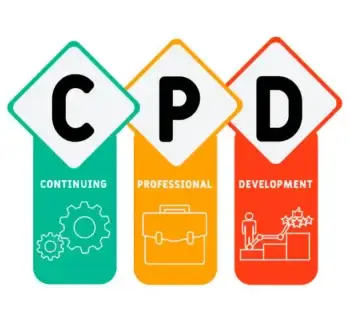
The Two Types of CPD: Planned vs Unplanned
One of the biggest misconceptions about CPD is that it only happens in classrooms or conferences.
In reality, CPD comes in two equally valuable forms.
Planned CPD is often accredited and easier to document, which is why systems tend to focus on it and unplanned CPD is rather spontaneous, yet extremely important.
Planned vs Unplanned CPD
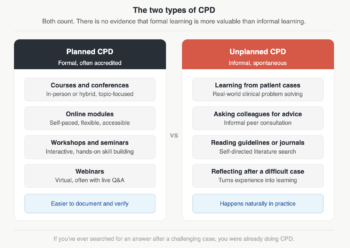
Both types count.
There is no ideal ratio, and no evidence that formal learning is more valuable than informal learning.
If you’ve ever searched for an answer after a challenging case, then you were already doing CPD.
Different Methods of CPD Learning
There is no one-size-fits-all approach to Continuing Professional Development. Therefore its recommended to combine different CPD formats. Not every doctor will benefit from the same activities, due to everyone’s individual interests and daily activities. But structurally speaking, structured and active learning should form a significant part of CPD, with the remaining learning balanced across reflective and self-directed activities. Here is a detailed breakdown of the individual activities.
Training Courses
CPD training courses are one of the most familiar learning formats. They can range from a single day to several weeks and usually focus on a specific topic or skill area. Courses may include lectures, seminars, or workshops and can be delivered in person, online, or through a hybrid model.
Seminars
Seminars are typically short, focused learning sessions lasting a few hours to one day. They usually involve small groups and encourage interaction through discussion, group activities, and shared experiences. Seminars also offer valuable opportunities for networking and peer learning.
Workshops
Workshops are highly interactive and practical, often running over one to three days. Compared to seminars, workshops focus less on theory and more on hands-on learning, such as exercises, breakout sessions, and role play. This format allows participants to apply knowledge directly in a practical context.
Webinars
Webinars are virtual learning sessions designed to deliver concise, up-to-date information. They often include interactive elements such as live Q&A, polls, or shared resources. Because they are online, webinars allow for flexible and international participation without the need for travel.
Events and Conferences
CPD events include conferences, panel discussions, keynote presentations, and industry forums. These events often combine multiple learning formats and allow participants to explore topics in depth while engaging with experts and peers. Trade shows may also incorporate CPD learning through talks or educational sessions.
Online Courses
Online CPD courses continue to grow in popularity due to their flexibility and accessibility. They allow learners to engage with content at their own pace and fit learning around professional and personal commitments. Many online courses are spread over time rather than requiring attendance on specific dates.
Who Is Responsible for CPD?
CPD is often described as “self-directed,” and therefore, doctors bear a lot of the responsibility to continue practising. But doctors don’t operate in isolation, and both employers and Official regulators have to play their part in the system.
The Doctor
CPD is primarily self-directed, meaning the majority of responsibility lies with the individual doctor. In practice, that comes down to three things. Recognising your own learning needs is harder than it sounds, since most doctors overestimate their competence in familiar areas and underestimate gaps in adjacent ones. Honest self-assessment, ideally with peer input, is the starting point. Then choosing what and how to learn matters just as much. A cardiologist in a rural setting needs different CPD than a hospital-based subspecialist, and structured programs rarely account for this. Then there’s reflection, the part most often skipped because it’s the least measurable. Without it, you accumulate years rather than expertise.
Employers and Institutions
Healthcare organizations either enable CPD or quietly obstruct it. The supportive ones make three things available: protected time, so CPD isn’t squeezed into evenings and weekends; access to resources, including journal subscriptions, online learning platforms, and simulation facilities; and financial or logistical support for course fees, conference travel, or paid study leave. Institutions that treat CPD as the individual’s problem tend to end up with staff doing the minimum to maintain licensure rather than genuinely developing. The WFME standards are clear on this: institutional support is a structural requirement of any functional CPD system, not an optional extra.
Regulators and Professional Bodies
Regulators and professional bodies define the framework everyone else operates within. Depending on the country, they set minimum requirements expressed in hours, credits, or points; link CPD compliance to licensing or revalidation; and specify how learning is documented and audited. Most of the bureaucratic burden in CPD originates here. So does most of the variation between countries. There’s no single global standard, and that’s by design. CPD systems are built to adapt to local healthcare structures and the realities of practice in different settings.
So if you feel like one of the institutions mentioned above is not fulfilling its role sufficiently, it is important to send a formal complaint. Furthermore, it’s important to understand that there is no single global CPD model and that flexibility is intentional, since CPD systems are meant to adapt to local contexts, resources, and realities of practice.
CPD, Licensing, and Credits: What Actually Matters
In many countries, CPD is linked to ongoing licensure or professional progression. This often involves:
- minimum hours
- credits
- points systems
To understand your local system, it is recommended to look at the individual webpages for your specific country. For example, in the UK, the regulations fall under the General Medical Council, and in the USA, they fall under the American Medical Association (AMA), in Europe each country has its own rules, usually set by the chamber of medicine, but the EU promotes cross-border CPD through the European Accreditation Council for Continuing Medical Education (EACCME).
How to Document CPD Without the Headache
One of the most common questions healthcare professionals ask isn’t what they should do for CPD, but how they are supposed to track it all. While the learning itself is the priority, maintaining a robust record is the “safety net” for your professional standing.
Finding a Format That Works for You
There is no “one-size-fits-all” requirement for your CPD log. The most important rule is convenience. If the system is too clunky, you won’t use it. Depending on your personal preference can use:
- Physical Folders: A classic binder for certificates, handwritten notes, and workshop programs.
- Digital Records: Spreadsheets, cloud-based folders, or dedicated online CPD tools. These include CPDme, myCPD Portal, Physicians’ CPD App and many more, depending on your country and special use case.
- Employer/Professional Frameworks: Many bodies provide their own templates, which can be a great starting point.
While it might be tempting to use your work computer or a drive provided by your employer, this is a significant risk. If you change jobs or lose access to your work email, you may lose years of evidence. Always ensure you have a personal, permanent backup of your records.
The Secret to Success: “Little and Often”
The thought of sitting down once a year to reconstruct twelve months of learning is enough to make anyone procrastinate. Instead, try the “Little and Often” approach.
In reality, you are likely engaging in CPD multiple times a day, through a quick consultation with a colleague, a brief literature search for a patient, or a reflective moment after a difficult case. By recording these instances as they happen, the process becomes second nature rather than a chore. Not only does this make your workload manageable, but it also ensures the insights are fresh and can immediately inform your clinical practice. If you want to become an expert on how to reflect effectively, I recommend reading this blog.
That same little-and-often habit is what turns a CPD log into real longitudinal evidence of growth, rather than a pile of disconnected certificates. Our guide to longitudinal vs. cross-sectional research design covers how to structure that kind of tracking properly.
How Videolab improves CPD
We created Videolab to empower healthcare professionals to securely record patient interactions with their smartphones. It turns the headache of ‘unplanned’ CPD into an effortless process of transforming real-world practice into verifiable learning evidence
Reflection is the most critical component of a CPD audit, but it’s often the hardest to recall weeks after the fact. Videolab solves this by allowing healthcare professionals to rewatch the interactions and receive meaningful feedback from their peers. Beyond simple reflection, Videolab provides the structural “safety net” needed for professional documentation. Timestamps help users to document notes or feelings at a particular moment during the recording. Furthermore, separate documents can be uploaded to the platform and attached to the video and if your organisation provides evaluation forms, these can be integrated aswell. Which allows you to document your insights and receive peer feedback in a structured format that aligns directly with regulatory requirements.