


Effective communication in healthcare is the ability of clinicians and care teams to exchange information clearly, adapt to patient needs, and sustain that clarity reliably under real clinical conditions. It is recognised as a core competency across medical, nursing, and allied health education — yet it frequently fails to transfer into consistent practice without structured observation, reflection, and feedback.
8 effective communication strategies in healthcare
Effective communication is not one technique. It is a set of observable behaviours that help clinicians understand patients, explain decisions and coordinate safely with colleagues. The eight strategies below translate broad communication skills in healthcare into actions learners can practise and educators can review. A narrative review by King and Hoppe identifies relationship-building, information gathering, clear explanation, shared decisions and responding to emotion as core features of patient-centred communication.
1. Listen actively before responding
Active listening means giving the speaker time to finish, noticing the concern behind the words and checking that you have understood before offering advice. In a patient consultation, this can be as simple as reflecting the main concern back: “You are worried that the treatment will interfere with work — have I understood that correctly?” This prevents clinicians from answering the wrong question and gives patients evidence that they have been heard.
2. Begin with open questions
Open questions help clinicians discover what matters to the patient before narrowing the conversation. “What would you most like us to address today?” produces a different conversation from a sequence of closed diagnostic questions. Educators can train learners to open broadly, clarify the patient’s agenda and then move towards focused questions without losing the person’s priorities.
3. Replace jargon with plain language
Clinical accuracy does not require technical language. Effective communicators explain one idea at a time, use familiar words and pause before adding more information. When a technical term is necessary, they define it immediately and connect it to what the patient needs to decide or do next. This is especially important when anxiety, pain or limited health literacy reduces the amount of information a person can process.
4. Check understanding with teach-back
Asking “Do you understand?” often produces a polite yes. Teach-back checks whether the explanation worked by inviting the patient to describe the plan in their own words. The responsibility remains with the clinician: if the explanation cannot be repeated accurately, the clinician explains it differently rather than treating the patient as the problem. This responds directly to the health-literacy gap documented by Wynia and Osborn.
5. Summarise and signpost the conversation
Short summaries keep complex encounters organised. A clinician can mark transitions — “We have discussed the diagnosis; next, let’s compare the treatment options” — and summarise decisions before closing. Signposting reduces ambiguity for patients and helps healthcare teams maintain a shared picture of what has been agreed.
6. Acknowledge emotion and monitor nonverbal cues
Patients communicate through tone, posture, facial expression, silence and pace as well as words. Naming an emotion carefully — “This seems overwhelming” — creates space for clarification without making assumptions. Clinicians also need awareness of their own gaze, posture and interruptions. Our dedicated guide explains the importance of nonverbal communication in healthcare in greater depth.
7. Involve patients in decisions
Communication becomes patient-centred when clinicians explain the available options, explore what the patient values and make the decision together. This is more than presenting information: the clinician must create a genuine opportunity for questions and preference-sensitive choices. See the dedicated guides to the patient-centred care model and shared decision-making in healthcare.
8. Use structured communication within teams
Healthcare communication also occurs during handovers, escalation and multidisciplinary decisions. A shared structure helps teams state the situation, relevant background, clinical assessment and required action without omitting essential information. Closed-loop communication — confirming that a message was received and understood — is particularly valuable when time pressure or divided attention creates risk. Reviews by Foronda et al. and Leonard et al. support standardised tools, simulation and shared communication structures for safer interprofessional work.
These strategies are straightforward to describe but difficult to sustain under pressure. The rest of this article explains why knowledge alone does not transfer reliably into practice, and how observation, reflection and feedback help educators turn communication principles into repeatable performance.
Why effective communication in healthcare is taught
Effective communication in healthcare is already well established as a core competency. It appears in accreditation standards, competency frameworks, and learning outcomes across medical, nursing, and allied health education. Learners are taught to listen actively, show empathy, and involve patients in decisions. Yet despite this formal emphasis, communication breakdowns remain common in everyday care.
For educators designing curricula, this creates a familiar disconnect. Effective communication in healthcare is clearly defined and assessed in theory, but it often degrades under real-world conditions. Time pressure, emotional load, fragmented teams, and clinical uncertainty all interfere with how clinicians actually communicate with patients and colleagues. As a result, knowing the principles of effective communication does not reliably translate into consistent performance.
This gap persists because communication is not a purely cognitive skill. It is enacted in live interactions, often when stakes are high and conditions are imperfect. When teaching focuses primarily on models or concepts, while real clinical communication remains largely unseen and unreviewed, learning remains fragile.
Rather than revisiting why effective communication in healthcare matters, this blog focuses on why communication training so often fails to embed into practice. It examines how curriculum design, feedback structures, and assessment practices shape whether communication skills develop sustainably over time. In particular, it explores how observation, reflection, and documented feedback create the conditions for communication skills to improve in ways that are both educationally meaningful and institutionally defensible.
Why effective communication does not reliably transfer into practice
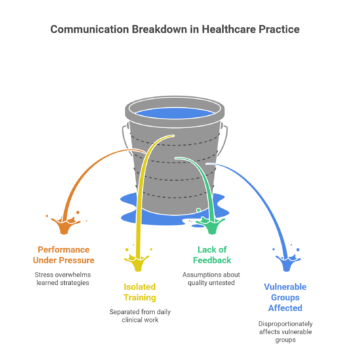
One of the central challenges in teaching effective communication in healthcare is that performance changes under pressure. Learners may understand empathy, clarity, and patient-centeredness, yet struggle to apply them when conversations become emotionally charged, time-constrained, or ambiguous.
Research helps explain this gap. Street et al. show that communication outcomes depend not only on knowledge, but also on cognitive load, emotional regulation, and situational awareness — all of which fluctuate in real clinical settings. Under stress, clinicians often revert to habitual communication patterns rather than consciously applying learned strategies. Communication does not fail because principles were forgotten, but because conditions overwhelm intention.
Curricula can unintentionally reinforce this problem. Communication training frequently occurs in isolated workshops or simulations, separated from daily clinical work. Learners perform well in structured settings, yet receive little systematic feedback once they return to practice. Without observation, assumptions about communication quality remain untested. Without reflection, insight stays superficial. Without documentation, improvement becomes difficult to track or justify.
This is particularly visible for patients who are older, have limited health literacy, or face language or cognitive barriers. Wynia and Osborn showed that patients with limited health literacy were “28–79% less likely than those with adequate health literacy to report their healthcare organization always provides patient-centered communication,” highlighting how communication failures disproportionately affect vulnerable groups.
For educators, the implication is clear. Teaching the principles of effective communication in healthcare is necessary, but insufficient. Transfer into practice depends on making communication performance visible, reviewable, and discussable over time. Without that infrastructure, even well-designed communication curricula struggle to hold up in real clinical environments.
Reflection and feedback as the missing link
If effective communication in healthcare is taught consistently yet fails to embed reliably, the missing link is rarely more instruction. Instead, it is the absence of structured reflection and feedback on real performance.
Communication skills develop through use, not exposure. Learners improve when they can revisit what actually happened in an interaction, compare intention with impact, and receive targeted feedback. This mechanism aligns with broader evidence on professional learning. A large Cochrane review by Ivers et al. showed that audit and feedback interventions lead to meaningful improvements in professional practice, particularly when feedback is specific, repeated, and linked to observable behavior rather than general advice.
Why observation changes the quality of feedback
In communication training, this distinction matters. Without observation, feedback tends to rely on self-report or recall, both of which are unreliable under stress. Kurtz and Silverman have long argued that communication skills do not transfer by default because learners rarely receive feedback on how they communicate in real clinical encounters, as opposed to simulated or classroom settings. As a result, learners may understand principles but lack insight into their own habitual patterns.
Reflection plays a critical role here. Research shows that learning after action often has more impact than instruction before action. Delayed, structured reflection reduces defensiveness and allows learners to process emotional and cognitive aspects of difficult conversations. Studies on video-supported reflection demonstrate that reviewing recorded interactions helps learners notice missed cues, nonverbal behavior, and unintended consequences that would otherwise remain invisible (Rammell et al., 2018).
Importantly, reflection alone is not enough. Feedback must be anchored in evidence and revisited over time. Govaerts et al. emphasize that workplace-based assessment becomes more valid and defensible when it relies on multiple observations and documented feedback rather than single impressions. In this sense, feedback infrastructure matters as much as pedagogy. Tools that allow educators to observe, comment, and track communication performance longitudinally enable effective communication in healthcare to be developed as a measurable, trainable skill rather than an aspirational ideal.
What changes when communication becomes visible and reviewable
Making communication visible changes how educators teach it and how learners improve it. When interactions can be reviewed rather than remembered, discussions about communication move from abstract ideals to specific, observable behavior.
For learners, visibility creates insight. Reviewing recorded consultations or handovers helps them see gaps between intention and impact. This matters most for nonverbal cues, pacing, and listening — which patients often notice more clearly than clinicians. Sharkiya et al. show that empathy, listening, and clarity strongly shape patient experience and emotional well-being in older adults, yet clinicians frequently underestimate these elements.
For educators, visibility enables precise feedback. Instead of commenting broadly on “communication skills,” faculty can reference concrete moments, behaviors, and choices. This reduces subjectivity and improves calibration across assessors. Zota et al. found broad agreement among European healthcare professionals that effective communication improves trust, adherence, and satisfaction, while also identifying limited training and feedback structures as persistent barriers. Making communication reviewable directly addresses this gap.
Visibility also strengthens fairness and defensibility. When institutions base assessment decisions on documented observations rather than memory or isolated encounters, they can justify progression and entrustment decisions with greater confidence. This matters particularly for interactions with vulnerable populations. Jenstad et al. show that patients with limited health literacy or communication challenges benefit most from adaptive communication, which requires awareness of what actually occurred.
Finally, visibility supports cultural change. Treating communication as observable work rather than a personal trait makes feedback easier to give and receive. Over time, communication shifts from a “soft skill” to a shared professional responsibility that learners practice, review, and refine with the same rigor applied to other clinical skills.
Designing curricula that embeds effective communication
Curriculum designers embed effective communication in healthcare most effectively when they design for longitudinal practice rather than isolated instruction. Communication skills rarely develop through one-off workshops or single assessment moments. Learners improve when curricula create repeated opportunities to perform in real settings, reflect on what happened, and receive targeted feedback over time.
Effective curricula treat communication as observable work. Research on workplace-based assessment shows that educators make more valid and defensible judgments when they base decisions on multiple observations collected across contexts, particularly for complex skills such as communication and professionalism. Govaerts et al. demonstrate that longitudinal evidence strengthens assessment quality and reduces reliance on subjective impressions. This has a clear design implication: programs should embed communication outcomes across courses, placements, and assessment points instead of confining them to a single module.
From observation to structured reflection and feedback
Reflection also requires deliberate design. Simply asking learners to “reflect” rarely leads to change unless reflection connects to concrete evidence. Ivers et al. show that feedback improves professional practice most reliably when it remains specific, repeated, and linked to observable behavior rather than general advice. Educators therefore need to anchor reflection activities to actual interactions — such as recorded consultations, annotated excerpts, or documented handovers — rather than relying on recall alone.
Feedback structure matters as much as feedback quality. Communication skills often fail to transfer because learners receive little systematic feedback once they leave simulated environments. Curricula that succeed define who provides feedback, when it happens, and how educators document it. Clear ownership and predictable workflows prevent communication training from becoming inconsistent or optional.
Design choices also affect equity and defensibility. Wynia and Osborn found that patients with limited health literacy experience patient-centered communication far less often than others. When programs rely on informal observation, these gaps remain invisible. Documented observation and feedback allow educators to identify patterns, intervene early, and justify progression decisions transparently.
Finally, infrastructure supports consistency at scale. Secure tools that enable recording, annotation, and longitudinal feedback help educators operationalize evidence-based communication training without increasing administrative burden. Videolab’s overview of implementing feedback models in healthcare training shows how structured, video-supported workflows make effective communication in healthcare observable, reviewable, and improvable across an entire curriculum.
Moving from teaching communication to sustaining it
Effective communication in healthcare does not fail because educators ignore it. It fails when curricula treat it as something learners should absorb, rather than something they must repeatedly practice, observe, and refine under real conditions. The evidence is clear: communication improves when performance becomes visible, feedback becomes structured, and reflection becomes routine.
For educators and faculty, this shifts the role of communication teaching. The task is no longer to add more workshops or introduce new models. Instead, healthcare education should create learning environments where clinicians can observe, discuss, and revisit communication over time. That means creating space for learners to review real interactions, receive specific feedback, and track their development across placements and courses.
For curriculum designers, the implications are structural. Effective communication in healthcare needs longitudinal learning outcomes, shared assessment language, and documented evidence that supports fair and defensible decisions. When communication remains invisible, assessment relies on impression and memory. When communication becomes observable, assessment gains consistency, equity, and credibility.
At the institutional level, this requires investment in feedback infrastructure — not just faculty goodwill. Secure, scalable systems that support recording, annotation, and longitudinal review allow programs to operationalize what research has called for over decades. Videolab plays this role by enabling reflective, video-supported feedback workflows that respect privacy while strengthening learning and governance.
Ultimately, effective communication in healthcare improves not when it is taught more, but when it is embedded better. Programs that make communication visible and reviewable give learners the conditions they need to improve, and educators the confidence to stand behind their assessment decisions. That is where communication moves from aspiration to practice.