


You notice that a classmate missed an important moment during an OSCE practice session. Saying nothing feels unhelpful, but saying “you did not show enough empathy” could sound personal. Better feedback focuses on what happened, why it mattered, and what the student could try next. This article presents seven steps for doing that, with examples from clinical training, simulation, and group work.
How to Give Feedback in 7 Steps
Useful feedback starts with a shared purpose, describes an observable behavior, and ends with something the recipient can try. The process should feel like a conversation between students, not a verdict delivered by one student to another.
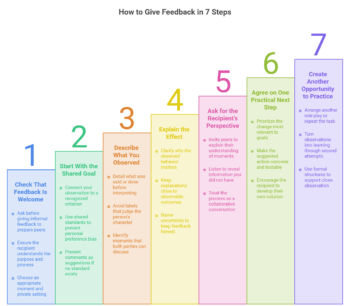
1. Check That Feedback Is Welcome
Ask before giving informal feedback. A simple question gives your peer a moment to prepare and shows that you respect their role in the conversation. You might say, “Would you be open to one observation from that consultation?” or “Can I share something I noticed during the handover?”
You do not always need to ask explicitly. Feedback may already be part of an agreed activity, such as an OSCE practice session, structured peer assessment, or simulation debriefing. However, even in these settings, the recipient should understand the purpose and process. Guidance on peer assessment from Lerchenfeldt and Taylor emphasizes training, transparency, and an environment that does not feel threatening.
Choose an appropriate moment as well. Give sensitive feedback privately, and avoid starting when either person is too distracted to discuss it properly. If the observation concerns an immediate patient safety risk, do not wait for an informal peer conversation. Raise it with the responsible educator or supervisor.
2. Start With the Shared Goal
Connect your observation to a criterion that both people recognize. This might be an OSCE checklist, a learning outcome, a clinical protocol, or an agreement about how a group will work. A shared standard gives the feedback a clear purpose and prevents personal preference from becoming the measure of someone else’s performance.
For example, say, “One of the station criteria was checking the patient’s understanding,” rather than, “I would have explained that differently.” During group work, you could say, “We agreed that each person would have two minutes to present,” rather than, “You spoke for too long.”
This distinction follows the research based definition proposed by Van de Ridder and colleagues. Feedback compares an observed performance with a standard and is given with the intention of improving that performance. If there is no relevant standard, present the comment as a personal response or suggestion, not as an authoritative correction.
3. Describe What You Observed
Describe what the person said or did before interpreting it. Observable details give the recipient something concrete to examine. Labels such as “careless,” “unprepared,” “not empathetic,” or “a poor communicator” turn a changeable behavior into a judgment about the person.
Instead of saying, “You seemed uninterested in the patient,” try, “While the patient described her concern, you looked at the notes and moved to the next question.” The second version does not claim to know what your peer intended. It identifies a moment that both of you can discuss.
Observation is especially important in clinical education. Van de Ridder and colleagues argue that feedback cannot address a performance that has not been observed. Their examples include history taking, clinical examination, patient handover, and teamwork. These are also situations in which a peer may notice interpersonal behavior that a supervisor does not see.
4. Explain the Effect
Explain why the observed behavior matters. The effect might concern patient understanding, clinical clarity, teamwork, time management, or an assessment criterion. Keep the explanation close to what you could reasonably observe.
For example, “The order of the information made the handover difficult to follow” is more useful than “Your handover was bad.” In a simulated consultation, you might say, “The patient’s concern was not acknowledged before the conversation moved to the next clinical question.”
Avoid exaggerating the effect or speaking for other people without evidence. If you are uncertain, name that uncertainty: “I found the transition difficult to follow,” or “I wondered whether the patient understood the plan.” This keeps the feedback honest without presenting your interpretation as fact.
5. Ask for the Recipient’s Perspective
Invite your peer to explain how they understood the moment. Useful questions include, “How did that part feel from your perspective?”, “Was there something you were trying to achieve there?”, and “What might you do differently on another attempt?”
The answer may reveal information you did not have. A student may have been following an instruction, responding to a time warning, or concentrating on a different assessment criterion. Listening does not require you to withdraw an accurate observation. It helps both people interpret it correctly.
Feedback is influenced by more than its factual content. A meta-review by Van de Ridder and colleagues identified the provider, recipient, relationship, message, standard, timing, and delivery context among the variables that can affect the process. Treating feedback as dialogue makes room for that context.
6. Agree on One Practical Next Step
Turn the discussion into one action the recipient can test. A long list of corrections can leave a student unsure where to begin, so prioritize the change most relevant to the learning goal.
For example, “On the next attempt, pause after explaining the procedure and ask the patient to describe their understanding.” This is more actionable than, “Check understanding more.” During a presentation, the next step might be to state the main conclusion before discussing supporting details.
Do not prescribe a solution when the recipient can develop one. Ask, “What could you try next time?” and add a suggestion if needed. Research on medical student peer review found that feedback training, a shared rubric, and repeated opportunities to act on comments improved the quality of feedback students produced. The study by Camarata and Slieman also distinguished specific guidance from generic praise or criticism.
7. Create Another Opportunity to Practice
Feedback becomes useful when the recipient can apply it. Arrange another role-play, repeat the OSCE station, rehearse the handover again, or return to the point during the next group session. The second attempt turns an observation into learning.
A plan to observe performance again is one feature of stronger feedback in the definition developed by Van de Ridder and colleagues. Lerchenfeldt and Taylor likewise argue that students need opportunities to practice giving and receiving peer feedback. A formal structure can help, but it should support the conversation rather than replace close observation. Videolab’s guide to implementing feedback models explains how different frameworks fit different learning situations.
What Does Constructive Feedback Sound Like?
Constructive feedback names an observable behavior, explains why it matters, and identifies a realistic next action. These examples show how to replace vague or personal comments with information a student can use.
Feedback After an OSCE Practice Station
Avoid: “You did not show enough empathy.”
Try: “When the patient said she was worried, you moved directly to the next clinical question. On your next attempt, you could pause and acknowledge the concern before continuing.”
Feedback on a Clinical Handover
Avoid: “Your handover was confusing.”
Try: “I heard the investigation results before the main clinical concern, so I found the priority difficult to identify. You could state the immediate concern first on the next attempt.”
Feedback During Group Work
Avoid: “You always dominate the discussion.”
Try: “During the last two questions, you answered before anyone else had spoken. Pausing after each question could give the rest of the group more room to contribute.”
Positive Feedback
Avoid: “Good job.”
Try: “You paused after explaining the medication and asked the patient to repeat the plan. That gave you a clear check of their understanding. Keep that step in your next consultation.”
Peers can contribute useful observations about communication, teamwork, work habits, and professionalism because they often see one another in situations that faculty do not observe continuously. However, students still need guidance and shared criteria. The research and implementation considerations are explored further in Videolab’s article on peer feedback in medical education.
How Can You Give Feedback Without Sounding Rude?
Be direct about the behavior, restrained about its meaning, and collaborative about the next step. Respectful feedback does not need to be vague.
- Discuss sensitive observations privately.
- Describe one relevant behavior instead of judging the person.
- Avoid exaggerations such as “always” and “never.”
- Explain your interpretation without presenting it as objective fact.
- Ask for the recipient’s perspective before offering several solutions.
- Keep the discussion focused on the agreed learning goal.
Tone matters, but careful phrasing cannot guarantee that feedback will feel comfortable. The 2015 meta-review found that feedback has less effect when recipients perceive a threat to their self-esteem. This does not mean avoiding a difficult point. It means separating the behavior from the person and giving the recipient a meaningful role in deciding what happens next.
How Do You Give Useful Positive Feedback?
Useful positive feedback identifies the successful behavior, explains why it worked, and makes it repeatable. “Good job” expresses approval, but it does not tell the recipient what to retain.
Compare that praise with: “You summarized the patient’s concern before presenting the plan. That showed you had understood the problem and gave the patient a chance to correct anything you had missed.” The recipient now knows which behavior produced the positive result.
Positive feedback should be as specific as corrective feedback. Van de Ridder and colleagues note that performance may sit above or below the expected standard. In both cases, feedback should explain the relevant gap. Camarata and Slieman’s work similarly treated unexplained compliments as insufficient guidance.
Should Students Use the Feedback Sandwich?
Do not use generic praise to hide a correction. You can discuss both strengths and improvement points, but each should be specific and easy to interpret.
A clearer sequence is to identify one behavior that worked, describe one behavior that could improve, and agree on the next attempt. For example: “Your opening question gave the patient room to explain the problem. Later, you introduced three management options without pausing to check understanding. On the next attempt, try presenting one option at a time and asking what questions the patient has.”
The evidence does not justify claiming that the feedback sandwich always fails. The 2015 meta-review identified the ordering of positive and negative comments as an area that still required further research. Clarity is therefore the better reason to choose a different structure.
Educators who want a learner-first sequence can compare this approach with Pendleton’s feedback model.
What If Someone Becomes Defensive?
Stop trying to win the argument, clarify the observation, listen for missing context, and return to the shared goal. Defensiveness does not automatically mean that the feedback was wrong or delivered badly.
- Pause and let the person respond without interruption.
- Acknowledge the reaction without diagnosing it: “I can see that this is difficult to hear.”
- Restate the observation in neutral language.
- Ask whether you are missing relevant context.
- Reconnect the discussion to the shared criterion or goal.
- Offer time before deciding on the next step.
- End the conversation if it is no longer productive.
Trust, the relationship, message content, and threats to self-esteem can all influence how feedback is received, according to the Van de Ridder meta-review. You can improve the conditions for a useful conversation, but you cannot control another person’s reaction.
Peer feedback also has limits. A conversation between students is not the appropriate process for resolving patient safety concerns, discrimination, harassment, misconduct, or formal assessment disputes. Raise these issues through the responsible educator, supervisor, or institutional procedure.
How Can Recorded Practice Improve Feedback?
Recorded practice lets students discuss the same observable moment instead of relying entirely on memory. Review one relevant passage, let the performer reflect first, and then connect comments to a specific behavior and learning goal.
Watching yourself can feel uncomfortable. In a qualitative study of medical students, Nilsen and Baerheim found that some students experienced apprehension before video feedback. However, students evaluated the sessions positively afterward and described benefits from seeing aspects of their consultations that they had not previously recognized.
Video does not make feedback useful automatically. Students still need a shared standard, a focused observation, and a realistic next action. Reflection should also lead somewhere. Videolab’s comparison of self-awareness and self-reflection explains the difference between noticing a behavior and examining how to change it.
Videolab allows students and educators to attach time-specific comments to recorded clinical practice. This can keep the conversation anchored to the same moment, support reflection before discussion, and make a later attempt easier to compare with the original performance.
Frequently Asked Questions
What Is the Best Way to Give Constructive Feedback?
Describe one observable behavior, connect it to a shared goal, explain its effect, and agree on a practical next step. Give the recipient room to explain their perspective before deciding what should change.
How Do You Give Negative Feedback in a Positive Way?
You do not need to make a negative observation sound positive. State it respectfully and specifically, avoid labels, and focus on what the person can try next. Clear feedback is more useful than praise added only to soften the message.
How Do You Give Feedback to Someone Who Becomes Defensive?
Pause, listen, restate the observation neutrally, and ask whether you are missing context. Return to the shared goal rather than arguing about character or intention. If the conversation is no longer productive, agree to revisit it later or involve an educator when appropriate.
Related guides: Feedback Models · Pendleton’s Rules · Formative vs Summative Feedback · Summative Feedback · Peer Feedback in Medical Education · How to Receive Feedback