


Micro Expressions in Healthcare Training: Context First
Micro expressions are very brief facial movements that may appear when someone experiences or suppresses an emotion. In healthcare training, they can help students notice moments where a patient may feel uncertainty, discomfort, fear, anger, or sadness.
Micro expressions still shouldn’t be treated as proof of what a patient feels. They are subtle, fast, and easy to misread. Research on micro expression spotting and recognition describes them as short, difficult to detect, and challenging even for trained observers.
That’s why educators should teach micro expressions as prompts for curiosity, not conclusions. A learner should not think, “The patient is hiding something.” A safer thought is, “Something changed in the patient’s expression. I should check what that moment meant.”
This makes micro expressions relevant to nonverbal communication in healthcare, emotional cue recognition, and video based reflection.
Micro expressions in healthcare examples
| Moment | Possible cue | Risky interpretation | Safer training response | What students practice |
|---|---|---|---|---|
| A patient briefly tightens their face after hearing a diagnosis | Possible distress or shock | “The patient is angry.” | “I noticed that landed heavily. What is going through your mind?” | Checking emotional meaning |
| A patient smiles quickly after saying they are fine | Possible discomfort or masking | “The patient is hiding the truth.” | “You said fine, but I wonder if part of this still feels difficult.” | Responding without accusation |
| A parent briefly looks tense when treatment risks are mentioned | Possible anxiety | “The parent disagrees.” | “Can we pause on the risks for a moment? What concerns come up?” | Managing family emotion |
| A student misses a patient’s facial change during consent | Possible uncertainty | “The student lacks empathy.” | Review the clip and ask what changed before the next question | Video based observation |
| A patient looks away after a prognosis discussion | Possible sadness, shame, or processing | “The patient is avoiding.” | “I noticed you looked away there. Would it help to pause?” | Using observation gently |
What micro expressions are
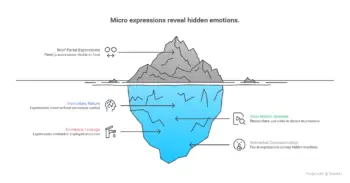
Micro expressions are brief facial movements that can happen quickly and with low intensity. Some research describes them as lasting between 1/25 and 1/5 of a second, although definitions vary across studies.
This speed creates the central training problem. In real time, students may miss the expression entirely. Even when they notice something, they may not know what it means.
Research on micro expression recognition highlights several challenges, including subtle movement, head movement, lighting variation, imbalanced datasets, and difficulty recognizing these expressions with the naked eye.
Clinical educators should avoid teaching micro expressions as a reliable emotion label for exactly this reason. Instead, they should teach them as one part of a wider communication pattern that includes speech, tone, posture, timing, clinical context, and patient response.
Why context matters more than detection
A facial change does not explain itself. The same brief expression could mean fear, confusion, pain, embarrassment, disagreement, fatigue, or nothing clinically important.
The best clinical response isn’t detection, then. It’s verification. Students should learn to notice the cue, stay tentative, and invite the patient to explain.
For example, after explaining a treatment risk, a learner may see the patient’s face tighten. A weak response would be to assume fear and move into reassurance. A stronger response would be: “I noticed your expression changed when we talked about that risk. What came up for you?”
This connects micro expressions with emotional cues in healthcare. Both require curiosity before interpretation.
What students can safely infer
Students can safely infer that something may deserve attention. They cannot safely infer the exact emotion, the cause, or the patient’s intention from the facial movement alone.
This distinction matters. If a learner says, “The patient was hiding anger,” feedback should redirect them. A better observation would be: “The patient briefly tightened their mouth after the treatment option was explained.”
Then the learner can ask a clinical question: “Did I check whether the patient had concerns at that point?”
That reframes micro expression training as communication training. The goal is not to catch the patient. The goal is to improve the learner’s ability to notice possible emotional shifts and respond respectfully.
Research on spontaneous facial expression coding also shows why this field requires careful observation and coding rather than casual interpretation.
Example 1: Micro expressions after bad news
A student gives a patient unexpected results. The patient smiles briefly, nods, and says, “Okay.” Then the student continues with treatment information.
During video review, the educator pauses the moment after the result. The patient’s quick smile may not mean acceptance. It may be politeness, shock, discomfort, or an attempt to stay composed.
The better training point is not “the smile was fake.” The better question is: did the learner check emotional readiness before continuing?
A useful response would be: “I know I just gave you a lot of information. What is going through your mind right now?”
This fits naturally into bad news communication training, where learners often rush from diagnosis to explanation.
Example 2: Micro expressions during consent
A patient agrees to a procedure while briefly looking tense when complications are mentioned. The student hears agreement and moves on.
Consent isn’t only about saying yes, though. The patient also needs enough space to process risk, ask questions, and express values.
A better response would be: “Before we continue, can I check how you feel about the risks we just discussed?”
This does not pressure the patient. Instead, it creates space for uncertainty.
Educators can connect this moment to shared decision making in healthcare, because brief facial changes may reveal where the patient needs more support to deliberate.
Example 3: Micro expressions in family conversations
In pediatric or family consultations, micro expressions may appear in the patient, parent, or caregiver. For example, a parent may briefly look tense when the clinician mentions home treatment.
The learner should avoid assuming disagreement. The parent may worry about cost, confidence, time, transport, or fear of doing something wrong.
A useful response would be: “I noticed a reaction when we talked about managing this at home. What concerns would you like us to address?”
This helps the learner include family emotion without losing structure. It also prevents a common error: treating silence as acceptance.
In video based feedback, this kind of moment works well because the group can review who noticed the cue, who responded, and whether the family member became more open afterward.
How video helps teach micro expressions
Video helps because micro expressions often disappear before the learner can process them. Slow review gives students time to notice what happened and connect it to the next communication move.
Educators should stick to short clips, though. A 10 second segment can be enough. The goal is not to analyze every facial movement in the consultation. The goal is to study one meaningful moment and ask what the learner did next.
A useful review structure is:
- What changed in the patient’s face, voice, or posture?
- What was happening clinically at that moment?
- What did the learner do next?
- Did the patient open up, close down, or stay unclear?
- What could the learner try next time?
Research on video based feedback using real consultations links video review with self perception, peer feedback, patient centered reflection, and reflective practice.
For clinical programs, video recording software for medicine can support this kind of structured observation when recordings need privacy, review tools, and secure feedback workflows.
How to assess micro expressions in clinical education
Educators should not assess whether students correctly “read” a hidden emotion. That would make the assessment fragile and unfair.
Instead, assess whether students respond to possible cues in a clinically safe way. A practical rubric can focus on observable behavior:
- The learner notices a possible emotional cue.
- The learner describes the cue without exaggeration.
- The learner avoids accusing or labelling the patient.
- The learner checks the meaning with an open question.
- The learner integrates the answer into the next step.
That links micro expressions to measuring communication skills in healthcare directly. It also keeps assessment focused on what students can control.
In OSCEs, standardized patients can display subtle facial reactions after a risk, diagnosis, or difficult question. The scoring should reward checking and responding, not guessing the exact emotion.
Common mistakes when teaching micro expressions
The first mistake is treating micro expressions as a lie detector. Some research discusses deception contexts, but clinical education should avoid turning patient care into suspicion.
The second mistake is overconfidence. Students may think a brief facial movement reveals the patient’s true feeling. In reality, facial behavior needs context.
The third mistake is ignoring culture, pain, fatigue, neurodiversity, and individual expression style. Not every patient shows emotion in the same way.
The fourth mistake is focusing only on the patient. The learner’s own reaction also matters. A patient’s anger, sadness, or silence can make a student rush, over explain, or shut down.
Micro expression training should connect with metacognition in medical education for the same reason. Learners need to notice both the patient’s cues and their own communication habits.
Practical checklist for students
Use this checklist during simulation, OSCE preparation, or video review.
- What exactly changed in the patient’s expression?
- What was happening in the consultation at that moment?
- Did I assume the emotion, or did I check it?
- Did my response invite the patient to say more?
- Did I avoid accusation, labelling, or premature reassurance?
- Did the patient’s answer change the next clinical step?
- What did I do when I felt uncomfortable?
- What phrase could I try next time?
This checklist keeps micro expressions grounded in communication practice. It helps students move from noticing a cue to responding with care.
Final thoughts
Micro expressions can be useful in healthcare training, but only when educators teach them carefully. They should not become a shortcut for judging patients or claiming hidden emotions.
The safer approach is context first. Students can learn to notice brief facial changes, connect them to the clinical moment, and check meaning through respectful questions.
Video review makes this easier because learners can slow down the consultation and observe what happened before, during, and after the cue.
When taught this way, micro expressions become part of a broader skill: noticing emotional moments and responding without assumption. That is more useful for clinical education than trying to read the patient’s mind.
References
Haggard EA, Isaacs KS. Micromomentary Facial Expressions as Indicators of Ego Mechanisms in Psychotherapy. In Methods of Research in Psychotherapy. 1966.
Short extract: “quicker than the eye.”
Hall JA, Harrigan JA, Rosenthal R. Nonverbal Behavior in Clinician Patient Interaction. Applied and Preventive Psychology. 1995.
Short extract: “facial expression, gaze, body movement and gesture.”
Goh KM, Ng CH, Lim LL, Sheikh UU. Micro Expression Recognition: An Updated Review of Current Trends, Challenges and Solutions. The Visual Computer. 2018.
Short extract: “split second transition with minute intensity levels.”
Pan H, Xie L, Wang Z, Liu B, Yang M, Tao J. Review of Micro Expression Spotting and Recognition in Video Sequences. Virtual Reality and Intelligent Hardware. 2021.
Short extract: “short and imperceptible expressions.”
Dong Z, Wang G, Lu S, Li J, Yan W, Wang SJ. Spontaneous Facial Expressions and Micro Expressions Coding: From Brain to Face. Frontiers in Psychology. 2022.
Short extract: “manual annotation of ME videos requires.”
Dohms MC, Collares CF, Tibério IC. Video Based Feedback Using Real Consultations for a Formative Assessment in Communication Skills. BMC Medical Education. 2020.
Short extract: “self perception, peer feedback, patient centered approach.”