

What Is Longitudinal Research?
A single OSCE score in June tells you where a trainee stands that afternoon. It says nothing about how they got there or where they are heading next.
Longitudinal research answers that second question. It follows the same subjects across multiple time points. It tracks change within individuals, not differences between separate groups measured once. A cohort of medical students tested at entry and again after each clinical year is a longitudinal design. A single survey compared against another single survey is not, no matter how similar the two groups look on paper.
The distinction matters for training programs specifically. Cross-sectional snapshots describe a population at rest. Longitudinal data describes a trajectory, and trajectories are what competency-based education actually needs to demonstrate.
Longitudinal vs. Cross-Sectional: Which Design Answers Your Question
Choose cross-sectional research to describe where a group of learners stands right now. Choose longitudinal research to show whether a curriculum or assessment program is changing outcomes over time.
Cross-sectional studies are faster and cheaper to run. Recruit a sample, measure it once, and report the result. That speed comes at a cost. Cross-sectional data cannot answer the questions program directors actually ask. Is a new simulation curriculum improving communication skills across the cohort? Or did this year’s students simply arrive stronger? A single measurement cannot separate a genuine training effect from a coincidence of who enrolled.
Longitudinal designs solve that by measuring the same people repeatedly. Van der Vleuten and Schuwirth made this case directly in their influential 2005 argument for programmatic assessment: “Instead of designing course-related assessments only, one could think of longitudinal, course-independent measures targeted at individual students’ growth or personal development” (van der Vleuten & Schuwirth, 2005). Their point was not that single assessments are worthless. It was that a single data point, however well designed, cannot show growth. Growth is a comparison across time, and a comparison needs repeated measurement of the same subject.
A simulation director evaluating a new curriculum needs this distinction. So does a competency committee tracking a resident’s progress toward entrustment. Ask what you need to know before choosing a data collection method, not after.
Why Competency-Based Medical Education Is Inherently Longitudinal
Competency-based medical education cannot rest on a single test. Entrustment is a judgment about a trajectory, not a verdict on one afternoon’s performance.
Van der Vleuten and colleagues made this the founding principle of programmatic assessment. Their 2012 model states it plainly: “Good assessment requires a programmatic approach in a deliberate and arranged set of longitudinal assessment activities” (van der Vleuten et al., 2012). A single low-stakes data point tells a supervisor almost nothing on its own. Dozens of them, collected across rotations and aggregated over time, build the evidence base instead. A high-stakes decision, like advancing a resident to unsupervised practice, actually requires that accumulated evidence.
Entrustable Professional Activities work the same way. Ten Cate and colleagues describe curriculum design around EPAs as an individualized trajectory (ten Cate et al., 2015). A trainee’s entrustment level for a given activity shifts across postgraduate years as evidence accumulates. It moves from unobserved, to supervision on request, to fully unsupervised. A program that measures entrustment once, at a single checkpoint, loses exactly what the model is built to capture. It captures the shape of the change, not just its endpoint.
That is where a lot of programs stall. Building infrastructure for continuous entrustment tracking across years is harder than running a single OSCE circuit. That operational challenge belongs alongside the broader challenges of implementing EPAs in medical education. Simulation-based programs already sit closer to this model than most. Repeated, structured scenarios across a curriculum are a natural source of the longitudinal data programmatic assessment needs. Our guide to medical simulation scenarios lays out that case in practical detail.
Examples of Longitudinal Research in Medical Education
Three studies show what longitudinal data reveals that a single measurement cannot.
Hojat and colleagues tracked 456 medical students at five time points, from orientation through the end of each academic year. A cross-sectional comparison of first-years against final-years would have shown a gap and left the timing a mystery. The longitudinal data pinpointed exactly when it opened. Empathy scores held steady through the first two years, then dropped sharply during the third. That drop lined up precisely with the curriculum’s shift toward direct patient care (Hojat et al., 2009). Knowing when a decline happens is what makes it addressable.
Brouwer and colleagues followed international medical program graduates across four survey waves between 2017 and 2020. A single post-graduation survey would have captured wherever each person happened to be at that moment. Followed over time, the same cohort told a different story: “two years after graduation, the majority (more than 70%) of our participants were practicing in a country other than their country of training” (Brouwer et al., 2022). That pattern only becomes visible when the same graduates are tracked across years, not surveyed once. The licensing and support gaps behind it stay invisible in a single snapshot.
Homer and Ababei worked from the largest dataset of the three: 8,238 two-examiner OSCE station administrations across 382 stations. The data came from the UK’s licensing exam for international medical graduates, drawn between November 2016 and October 2024. Tracking the same stations over eight years let them show something a single audit cycle never could. Newer, more recently revised stations showed measurably better examiner agreement than older ones (Homer & Ababei, 2026). The correlation was small but statistically significant (r = -0.089, p < 0.001). That is not a snapshot of exam quality. It is evidence that quality assurance, applied consistently, actually works.
Programs running remote OSCEs or tracking graduates through continuing professional development already sit on this kind of repeatable data. The question is whether anyone is capturing it consistently enough to look back on.
Designing a Longitudinal Study or Assessment Program
Start with the decision the data needs to support, not the instrument. That single choice shapes everything else about the design.
Van der Vleuten and colleagues describe the core structure as a cycle (van der Vleuten et al., 2012). Training activities, assessment activities, and supporting activities repeat across defined periods. Each one feeds an intermediate evaluation before the cycle runs again. No single station or exam carries the full weight of a decision. The stakes rise only as data points accumulate, and enough low-stakes moments aggregate into a defensible high-stakes judgment.
That structure only works if every data point is actually captured and actually comparable. A rotation that documents entrustment differently from the one before it breaks the trajectory the whole model depends on. So does a supervisor’s narrative comment that never makes it past a paper form. It never reaches the record a committee later reviews.
The practical design question, then, is not how to build one better assessment. It is how to make dozens of ordinary ones connect into a single readable trajectory. That trajectory has to build without asking already stretched faculty to do more manual tracking.
The Common Failure Point: Fragmented Rotations and Lost Data
Longitudinal designs fail for a structural reason, not a statistical one. The training structure itself breaks continuity before the data collection ever starts.
Hirsh, Holmboe, and ten Cate made this argument for clerkship design specifically (Hirsh et al., 2014). Short block rotations, often just weeks long, do not give trainees enough time with the same patients or supervisors. That gap leaves too little time to build the trust a valid entrustment decision requires. Longitudinal Integrated Clerkships pair with EPAs for exactly this reason. They preserve continuity across a full year instead of resetting it every few weeks. As the authors put it, this is “time to trust.” Supervisors need time to trust trainees, and trainees need time to earn that trust.
Cost compounds the problem. Van der Vleuten and Schuwirth’s original case for programmatic assessment already flagged the sampling burden. Collecting enough data points, across enough contexts, to support a defensible judgment is expensive. Every point needs a new observation, a new form, and a faculty member’s time (van der Vleuten & Schuwirth, 2005). Add rotations that scatter trainees across sites and supervisors who never see the same resident twice. The data fragments before anyone can even analyze it.
The fix is not fewer rotations. It is a way of capturing what happens during them. That record should not depend on one supervisor’s memory or one paper form surviving a handoff.
How Captured Video Evidence Simplifies Longitudinal Data Collection
A supervisor watching a single encounter forms an impression in the moment, then moves on to the next patient. Three months later, when a competency committee asks what changed since the last rotation, that impression is gone.
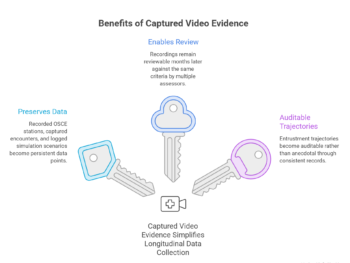
Video changes what survives. A recorded OSCE station, a captured encounter, or a logged simulation scenario becomes a data point. That data point still exists when the committee meets, not a memory that has already faded. Captured consistently across rotations, those recordings become exactly the kind of low-stakes, repeated evidence programmatic assessment depends on. They stay reviewable months later, against the same criteria, by more than one assessor, without repeating the moment.
That is also what makes entrustment trajectories auditable rather than anecdotal. It is the same infrastructure question our piece on video in competency-based medical education works through in more detail. A training program does not need a bigger exam. It needs a record of the ordinary ones that holds up when someone finally looks back across all of them.
Frequently Asked Questions
What’s the difference between longitudinal and cross-sectional research?
Cross-sectional research measures a group once and describes where it stands at that moment. Longitudinal research follows the same subjects across multiple time points, tracking change within individuals rather than comparing separate groups. Use cross-sectional data to describe a population, and longitudinal data to show whether an intervention is actually changing outcomes over time.
Why is competency-based medical education considered longitudinal by design?
Entrustment decisions in CBME rest on a trajectory, not a single test. Entrustable Professional Activities track a trainee’s entrustment level as it shifts across postgraduate years, moving from close supervision toward independent practice. A program that measures entrustment only once loses the shape of that change.
How much data does a defensible entrustment decision need?
Programmatic assessment relies on dozens of low-stakes data points, collected across rotations and aggregated over time, rather than one high-stakes exam. Training, assessment, and evaluation activities repeat across defined periods, with the stakes rising only as evidence accumulates.