

Communication Skills in Healthcare: From Soft Skill to Measurable Clinical Competency
Clinical communication skills shape diagnosis, decision-making, and patient safety. Yet many healthcare programmes still treat communication as a soft skill rather than a measurable clinical competency. When educators fail to define clinical communication skills in behavioural terms, learners struggle to improve them.
If communication influences outcomes, then we must teach, assess, and refine it with the same precision we apply to procedural skills.
How to Define Communication Skills in Healthcare?
Clinical communication skills refer to the observable behaviours clinicians use during patient encounters to gather information, build trust, and align on management plans.
In practice, these behaviours include:
- Setting a clear agenda at the beginning of a consultation
- Asking open questions before narrowing the focus
- Structuring explanations logically
- Checking patient understanding explicitly
- Responding to emotional cues in real time
Effective clinical communication skills require more than warmth. They require structure, clarity, and responsiveness.
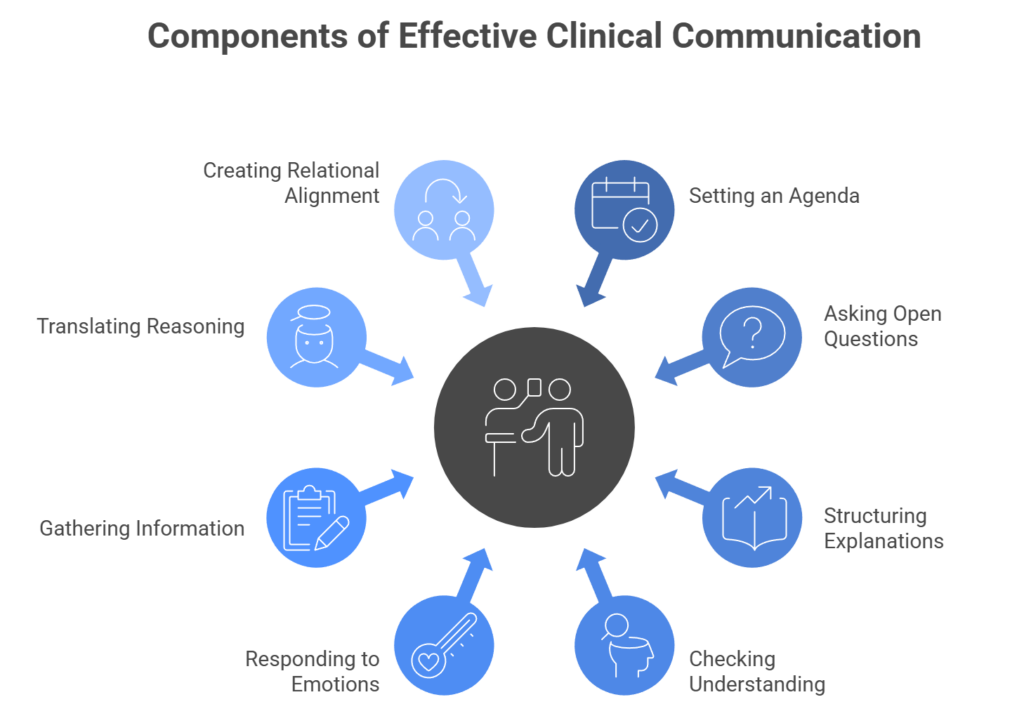
First, clinicians must gather information without premature interruption. Research consistently shows that physicians interrupt early in consultations. When clinicians allow patients to complete their opening statements, they gather more accurate information and reduce misunderstandings.
Second, clinicians must translate clinical reasoning into accessible language. Technical precision without clarity creates confusion. Checking understanding prevents silent disagreement.
Third, clinicians must create relational alignment. Patient centred communication increases trust and agreement, which support adherence and engagement.
Because these behaviours are visible, educators can record, analyse, and score them. That measurability distinguishes clinical communication skills from personality traits.
Crucially, communication also shapes clinical reasoning itself. When a clinician fails to explore a patient’s narrative fully, diagnostic accuracy suffers. When assumptions go unchecked, relevant data remains hidden. Strong communication skills therefore strengthen both relational and cognitive performance.
Why Clinical Communication Skills Affect Health Outcomes
Clinical communication skills influence health outcomes through mechanisms rather than direct physiological change.
Conversation does not lower blood pressure by itself. Instead, communication affects understanding, trust, shared decision-making, and motivation. These intermediate factors influence adherence and self management.
Research supports this pathway model. Communication affects health indirectly by improving understanding, trust, and alignment between clinician and patient, which then influences adherence and disease management.
When educators recognise this mechanism, training becomes more focused. If adherence improves through clarity and agreement, then clarity and agreement must become explicit assessment criteria.
Teaching empathy without behavioural anchors does not produce reliable change. Teaching observable clinical communication skills does.
Communication skills in healthcare influence outcomes through behavioural pathways that unfold after the consultation. When clinicians clarify expectations, confirm understanding, and align on next steps, patients leave with cognitive clarity and emotional security. That clarity reduces uncertainty, strengthens motivation, and increases follow-through. In contrast, ambiguous explanations or unaddressed concerns create silent disagreement, which often appears later as non-adherence. Communication therefore shapes behaviour before it shapes biology.
This distinction matters in education. If programmes want to improve outcomes, they must measure the mechanisms that drive them. Measuring tone alone is insufficient. Measuring whether a clinician explicitly checks understanding provides stronger predictive value.
Clinical Communication Skills as an Assessed Competency
Modern medical education frameworks recognise clinical communication skills as core competencies. OSCEs, workplace-based assessments, and licensing examinations include structured communication criteria.
However, many programmes still rely on subjective impressions. Assessors often write comments such as “good rapport” or “needs better structure.” These comments lack behavioural precision.
Two evaluators can observe the same interaction and assign different scores if they rely on memory rather than defined criteria.
Reliable assessment of clinical communication skills requires:
- Behaviourally anchored rating scales
- Defined observable actions
- Clear performance descriptors
- Consistent evaluator training
Communication also varies by clinical context. A breaking bad news conversation requires pacing and emotional containment. A medication reconciliation requires clarity and verification.
Assessment must reflect context while maintaining behavioural consistency.
Without structured evaluation, communication remains inconsistently measured and inconsistently improved.
When programmes assess communication skills in healthcare without behavioural criteria, subjectivity increases. One assessor may value warmth, another prioritises structure. Competency requires standardisation. Behaviourally anchored rubrics reduce variability by defining what effective communication looks like in observable terms. For example, “summarises patient concerns before planning” provides more reliability than “good interaction.” Clear criteria improve fairness, feedback quality, and learner confidence.
Strong assessment systems also allow longitudinal tracking. When learners receive structured scores across multiple encounters, they can identify persistent patterns rather than isolated weaknesses. Longitudinal data transforms communication assessment from episodic judgement into developmental progression.
Designing Assessment Systems for Communication Skills in Healthcare
Most institutions teach clinical communication skills through:
- Simulation
- Role play
- Standardised patients
- Supervised real consultations
These methods create exposure. Exposure alone does not create mastery.
Experience becomes learning when reflection and feedback follow performance.
Research on simulation based education emphasises that feedback is central to skill development.
Precise feedback must connect to observable behaviour. Instead of saying “be more empathetic,” educators should identify specific moments where the learner missed or responded to emotion.
Deliberate practice requires repetition, correction, and refinement.
Structured feedback sessions should focus on three questions:
- What behaviour occurred?
- What was its impact?
- What alternative behaviour could improve the outcome?
When learners repeatedly cycle through action, analysis, and refinement, improvement stabilises.
Why Video Strengthens Communication Assessment
Video review transforms how institutions assess clinical communication skills.
After a consultation, clinicians often believe they structured explanations clearly or avoided interruption. Recordings frequently show early interruption, rushed transitions, or unverified understanding.
Video shifts assessment from recall to evidence.
When learners observe their own performance, they:
- Identify interruption patterns
- Notice non verbal signals
- Detect pacing issues
- Compare intention with impact
Feedback grounded in recorded behaviour reduces defensiveness and increases learning transfer.
Video review exposes discrepancies between intention and impact. A clinician may believe they allowed space, yet the recording reveals repeated interruption. They may feel empathetic, yet their tone appears rushed. Seeing performance objectively accelerates behavioural adjustment.
Video also enables multi-assessor review. Supervisors, peers, and learners can analyse the same interaction using shared criteria. This shared evidence reduces disagreement and increases reliability.
Over time, repeated cycles of performance, review, and adjustment stabilise clinical communication skills as durable capabilities rather than isolated successes.
Barriers That Undermine Clinical Communication Skills
Even strong communicators face constraints.
Time pressure increases interruption frequency. Cognitive overload reduces listening accuracy. Emotional discomfort prompts topic shifting.
Cultural differences introduce additional complexity. Assumptions about decision-making roles or health beliefs can create silent disagreement.
Hierarchy within healthcare teams affects interaction dynamics. Junior clinicians may hesitate to clarify. Patients may avoid questions.
Training programmes must incorporate these real-world pressures into communication assessment scenarios. Simulation should replicate time pressure. Assessment should include emotionally complex cases. Evaluation must reflect real clinical constraints rather than idealised settings.
Measuring Clinical Communication Skills Systematically
Institutions can strengthen communication training by:
- Defining behavioural indicators for clinical communication skills
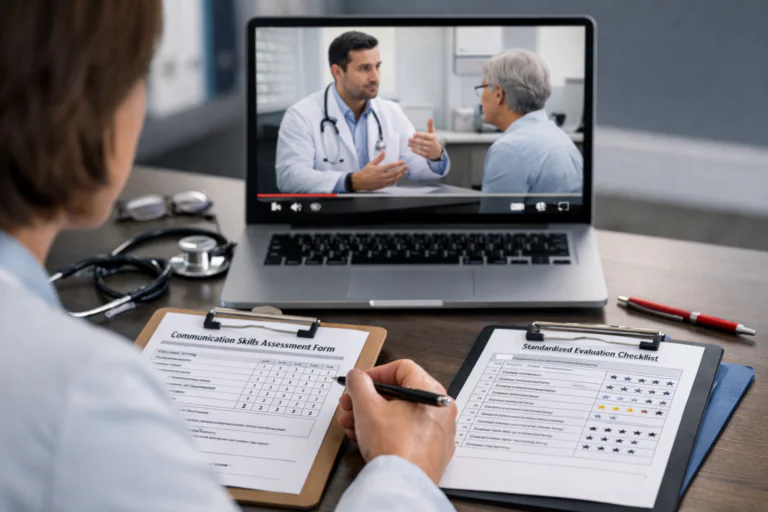
- Using structured evaluation forms
- Incorporating multi-source feedback
- Comparing performance longitudinally
- Integrating video review into assessment workflows
When institutions measure communication consistently, they reduce subjectivity and increase fairness.
Clinical communication skills then move from soft evaluation criteria to defensible, evidence-based competencies.