
Interprofessional Collaboration Examples in Healthcare
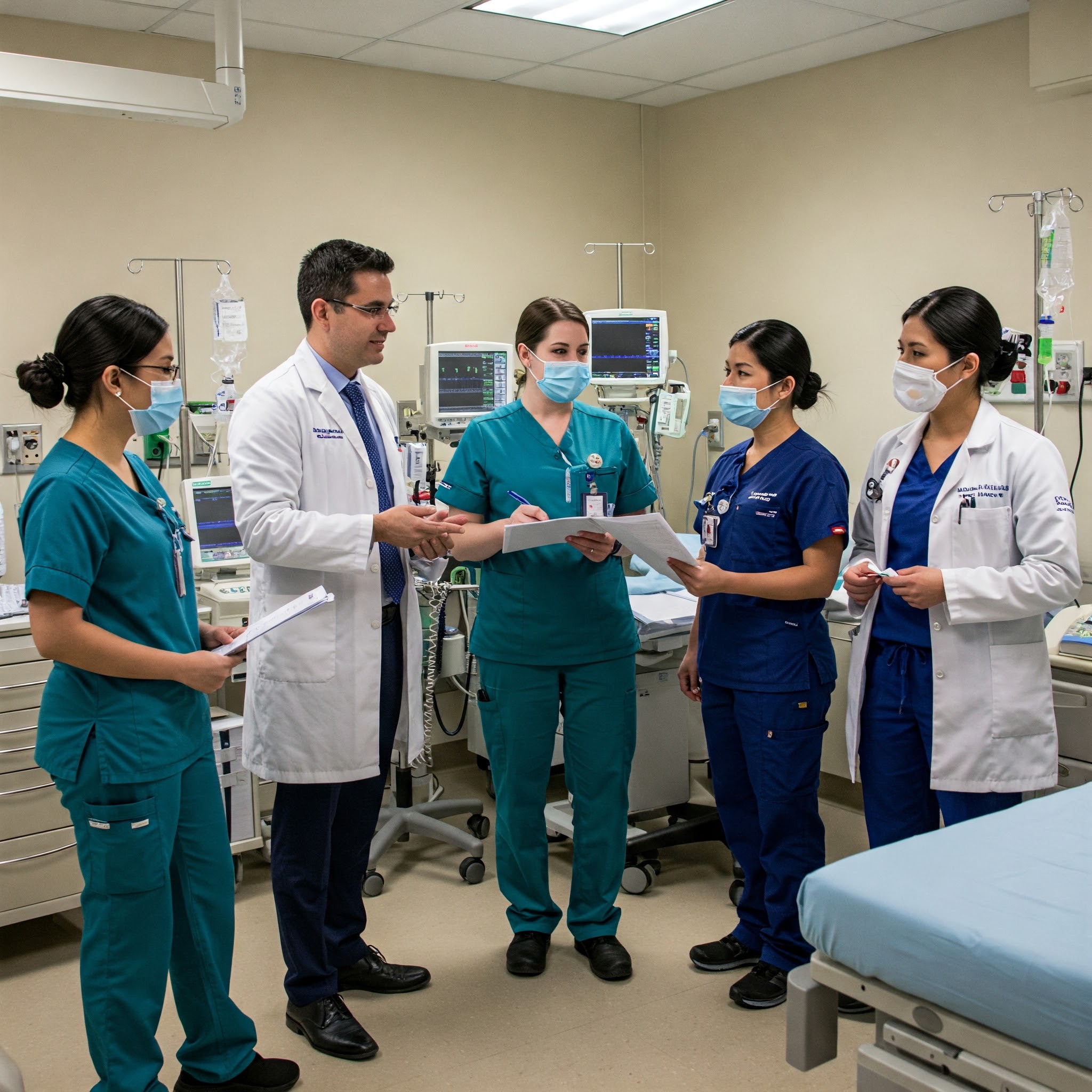
Interprofessional collaboration in healthcare happens when professionals from different disciplines work together to understand a patient, make decisions, and deliver care. In practice, this may involve doctors, nurses, pharmacists, psychologists, physiotherapists, occupational therapists, speech and language therapists, and other clinical staff.
Good collaboration doesn’t happen just because several professions appear in the same room, though. Teams also need shared goals, clear communication, role awareness, and space to challenge decisions safely. Research on interprofessional communication in healthcare shows that communication styles, hierarchy, confidence, structure, and standardization can all affect how teams work together.
For students and trainees, collaboration becomes easier to learn when educators turn it into observable behavior. That’s the focus of the examples below: what learners can see, discuss, and improve during simulation, OSCEs, team debriefing, or video based competency training.
Interprofessional collaboration in healthcare examples
| Example | Setting | Collaboration problem | What students can observe | Reflection prompt |
|---|---|---|---|---|
| Escalating concern about deterioration | Acute care or simulation | A nurse notices risk before the doctor responds | How concern gets stated, acknowledged, and turned into action | Where did concern become a shared plan? |
| Discharge planning | Ward or community care | The medical plan misses functional or home barriers | Whether nursing, therapy, or pharmacy input changes the plan | Whose knowledge changed the decision? |
| Shared decision making | Consultation or OSCE | The patient agrees without expressing preferences | Whether the team explores choice, options, and patient values | Was the decision shared or only explained? |
| Medication review | Hospital or primary care | A medication risk appears late in the process | Whether the pharmacist’s recommendation enters the clinical plan | Did the team treat medication review as clinical judgment? |
| Mental health MDT discussion | Acute psychiatric care | Each profession sees a different part of the case | Whether the team builds one plan from several perspectives | What did the team know together that no one knew alone? |
| Interprofessional OSCE | Assessment station | The learner must include another professional and the patient | Whether the learner keeps structure while inviting input | Did the learner make collaboration visible? |
| Team debriefing after simulation | Simulation center | Team members remember the event differently | Who spoke, confirmed actions, missed cues, or held back | Where did the team lose shared understanding? |
Why interprofessional collaboration breaks down
Healthcare teams often communicate from different professional habits. For example, nurses may describe the wider patient story, while physicians may expect a short summary and clear recommendation. Neither style is wrong, but the mismatch can create frustration, especially under time pressure.
Hierarchy also shapes team communication. A junior nurse, medical student, or trainee may notice risk but hesitate to speak. As a result, the team may lose valuable information before it reaches the person making the decision. Leonard, Graham, and Bonacum describe communication failures as a major cause of patient harm and argue for shared mental models, standardized tools, and safer speaking up in effective teamwork and communication.
Educators should train collaboration as a clinical skill because of this, not as a personality trait. Learners need to practise how to speak up, ask for another discipline’s view, check shared understanding, and respond when someone challenges the plan.
Example 1: Escalating concern about a deteriorating patient
A nurse notices that a patient has become more breathless and less responsive. The doctor focuses on recent test results and does not immediately see the same level of urgency. In this moment, interprofessional collaboration depends on whether concern becomes clear action.
Students can observe how the nurse frames the situation, whether the doctor asks for more context, and whether both professionals agree on the next step. They can also notice whether the nurse gives a recommendation or only hints at concern.
A stronger exchange might sound like this: “I am worried because his breathing has changed in the last 20 minutes. I think he needs urgent review now.”
This example connects directly with SBAR, a tool that structures situation, background, assessment, and recommendation. It also gives educators a practical way to teach speaking up during simulation based debriefing.
Example 2: Discharge planning with nursing and therapy input
A patient seems medically ready for discharge, but the nurse reports that the patient struggles to walk safely to the bathroom, and the occupational therapist raises concerns about the home environment.
In this example, collaboration means more than updating the discharge form. The team must integrate clinical status, functional ability, home support, medication needs, and patient preference.
Students should watch for who gets invited into the decision. They should also notice whether the final plan changes because of nursing or therapy input.
A useful feedback question is: whose knowledge changed the plan?
If the answer is “no one’s,” then the team may have listened without truly collaborating.
Example 3: Shared decision making in a treatment discussion
A patient has two reasonable treatment options. The doctor explains both, yet the nurse notices that the patient looks uncertain. The patient says, “I suppose I should do what you recommend.”
This is a strong example of collaboration because shared decision making in healthcare often needs more than one professional perspective. The doctor may explain evidence, while the nurse may notice hesitation, confusion, or practical concerns.
Learners should watch for three things here: how the options were introduced, how patient preferences were explored, and whether another professional helped open the decision space.
Elwyn and colleagues describe shared decision making through choice talk, option talk, and decision talk. This model gives educators a practical way to observe whether the team made room for patient values.
Example 4: Medication review with a pharmacist
A patient takes several medicines after a hospital admission. The doctor plans to continue the current list, but the pharmacist identifies a possible interaction and suggests changing the timing of one medicine.
Here, collaboration depends on whether the pharmacist’s expertise enters the decision early enough. If the pharmacist only checks the list at the end, the team may miss an opportunity to prevent harm.
Students can observe whether the doctor invites the pharmacist’s view, how the pharmacist explains risk, and whether the team checks the plan with the patient.
A useful reflection prompt is: did the team treat medication review as an administrative step or as a clinical decision?
This example helps learners see that collaboration often happens in small moments. A brief recommendation can change the care plan if the team creates space for it.
Example 5: Mental health care in a multidisciplinary team
In an acute psychiatric unit, a patient presents with agitation, poor sleep, medication concerns, and family conflict. The psychiatrist, nurse, psychologist, pharmacist, occupational therapist, and support worker each see a different part of the case.
In this example, collaboration means building one care plan from several partial views. The psychiatrist may focus on diagnosis and medication. The psychologist may focus on coping patterns. Meanwhile, nursing staff may notice triggers during the day, and occupational therapy may identify routines that reduce distress.
A recent interprofessional case based teaching programme in an acute psychiatric unit reported themes such as shared perspectives, better role understanding, patient focused reflection, and team building. Use this source as an illustrative conference abstract, not as full peer reviewed evidence.
A good debriefing question is: what did the team understand after the discussion that no single professional knew alone?
Example 6: Interprofessional collaboration in an OSCE
An OSCE station can include a doctor, nurse, patient, and family member. For example, a trainee may need to explain a care plan while a nurse adds practical concerns and a family member asks emotionally charged questions.
This design tests more than communication with the patient. It also tests whether the learner can include another professional without losing structure.
Educators can assess whether the trainee acknowledges the nurse’s input, clarifies roles, responds to the family, and keeps the patient involved in the decision.
OSCEs can become artificial, though, if the scenario has only one correct answer, which is why educators should design cases with real tradeoffs instead. For example, the safest medical plan may conflict with patient preference, home support, or staff capacity.
For assessment design, this connects naturally with video based OSCEs, where educators can review observable team behaviors rather than rely only on checklist scoring.
Example 7: Team debriefing after a simulation
After a simulation, the team often remembers the same event differently. One learner remembers giving a clear instruction. Another remembers confusion. A third remembers that no one confirmed the task.
This makes debriefing one of the best places to train interprofessional collaboration, as long as the facilitator keeps the discussion focused on behavior, not blame.
Video can help because the team can review a short clip and ask specific questions:
- Who spoke first?
- Who confirmed the action?
- Who had information that others did not use?
- Where did the team lose shared understanding?
Video based feedback with real consultations has been linked with self perception, peer feedback, patient centered reflection, and reflective practice in communication skills training, which is exactly why recorded team scenarios help learners move from memory based comments to observable discussion.
How video helps teach interprofessional collaboration
Video gives students and educators a shared object for reflection. Instead of saying “the team communicated poorly,” the group can pause the exact moment where communication shifted.
For example, learners can review whether a nurse’s concern was invited, whether a pharmacist’s recommendation changed the plan, or whether a trainee checked patient preference before closing a decision.
Recording alone doesn’t create learning on its own, though. Educators need focused prompts and psychological safety. Otherwise, learners may defend themselves or comment on personality rather than behavior.
A useful video review structure is simple. First, identify one collaboration moment. Next, describe only what happened. Then, discuss how each profession contributed. Finally, choose one behavior to try in the next consultation or simulation.
This is also where platforms designed for video recording in medical education can support teaching, especially when educators need secure recording, structured feedback, and easier review of observable moments.
Reflection prompts for students and trainees
Use these prompts after an OSCE, simulation, ward based discussion, or recorded consultation.
- What information did each profession bring to the case?
- Who changed the direction of the plan?
- Did anyone notice a risk that others missed?
- Was disagreement expressed clearly and respectfully?
- Did the team create a shared plan, or did each person keep a separate version?
- Did the patient’s preferences influence the decision?
- Did hierarchy affect who spoke and who stayed quiet?
- What could the team do differently next time?
These questions help learners move from “we worked well together” to a more useful analysis. They also support feedback in healthcare training because they focus on specific behavior rather than vague impressions.
Common mistakes when teaching interprofessional collaboration
The first mistake is treating collaboration as attitude only. Respect matters, but learners also need concrete skills: asking for input, summarizing the plan, making recommendations, and challenging safely.
The second mistake is using scenarios where collaboration does not change anything. If one profession already has the complete answer, learners quickly sense that the team element is decorative.
The third mistake is separating professions during feedback. Interprofessional learning works better when different learners discuss the same case together, because they can compare how each role understood the situation.
Finally, educators should avoid feedback that praises politeness but ignores decision quality. A team can sound respectful and still fail to share risk, uncertainty, or responsibility.
Final thoughts
Interprofessional collaboration in healthcare becomes easier to teach when educators make it concrete. Students do not just need to hear that teamwork matters. They need to see where a plan changed because a nurse spoke up, a pharmacist questioned a medicine, a therapist explained a practical barrier, or a patient preference altered the decision.
The strongest training examples reflect that: they include real tension, showing hierarchy, uncertainty, time pressure, disagreement, and incomplete information.
When educators combine clear scenarios with structured reflection, learners can practise collaboration as a clinical skill. Moreover, with video based review, they can return to the exact moments where teamwork either supported care or broke down.
References
Foronda C, MacWilliams B, McArthur E. Interprofessional communication in healthcare: An integrative review. Nurse Education in Practice. 2016.
Short extract: “trained differently and they exhibit differences in communication styles.”
Leonard M, Graham S, Bonacum D. The human factor: the critical importance of effective teamwork and communication in providing safe care. Quality and Safety in Health Care. 2004.
Short extract: “Communication failures are an extremely common cause.”
Elwyn G, Frosch D, Thomson R, et al. Shared Decision Making: A Model for Clinical Practice. Journal of General Internal Medicine. 2012.
Short extract: “choice, option and decision talk.”
Dohms MC, Collares CF, Tibério IC. Video based feedback using real consultations for a formative assessment in communication skills. BMC Medical Education. 2020.
Short extract: “self perception, peer feedback, patient centered approach.”
Bezzina O, Ramaswamy V. An Interprofessional Case Based Teaching Programme for the Multidisciplinary Team of an Acute Adult Inpatient Psychiatric Unit. BJPsych Open abstract. 2025.
Short extract: “shared perspectives, better understanding of professional roles.”
Note: Use as an illustrative conference abstract only. The abstract states that it was reviewed by the RCPsych Academic Faculty rather than by the standard BJPsych Open peer review process.