


Identifying emotions is a key skill in human communication. Emotions influence how people interpret information, respond to others, and make decisions during conversations. However, emotions are not always expressed directly. Instead, they often appear through subtle behavioural signals such as facial expressions, tone of voice, and body language.
Learning how to identify emotions helps individuals better understand social interactions and respond more effectively in complex conversations. Research in psychology and neuroscience shows that emotional signals emerge through both internal physiological responses and observable behavioural cues during interactions (Garfinkel & Critchley, 2013; Porter & ten Brinke, 2008).
This article explains how emotions appear in the body and in behaviour, how subtle signals such as microexpressions reveal concealed emotions, and how observation and training can improve emotional awareness in communication.
How to Identify Emotions
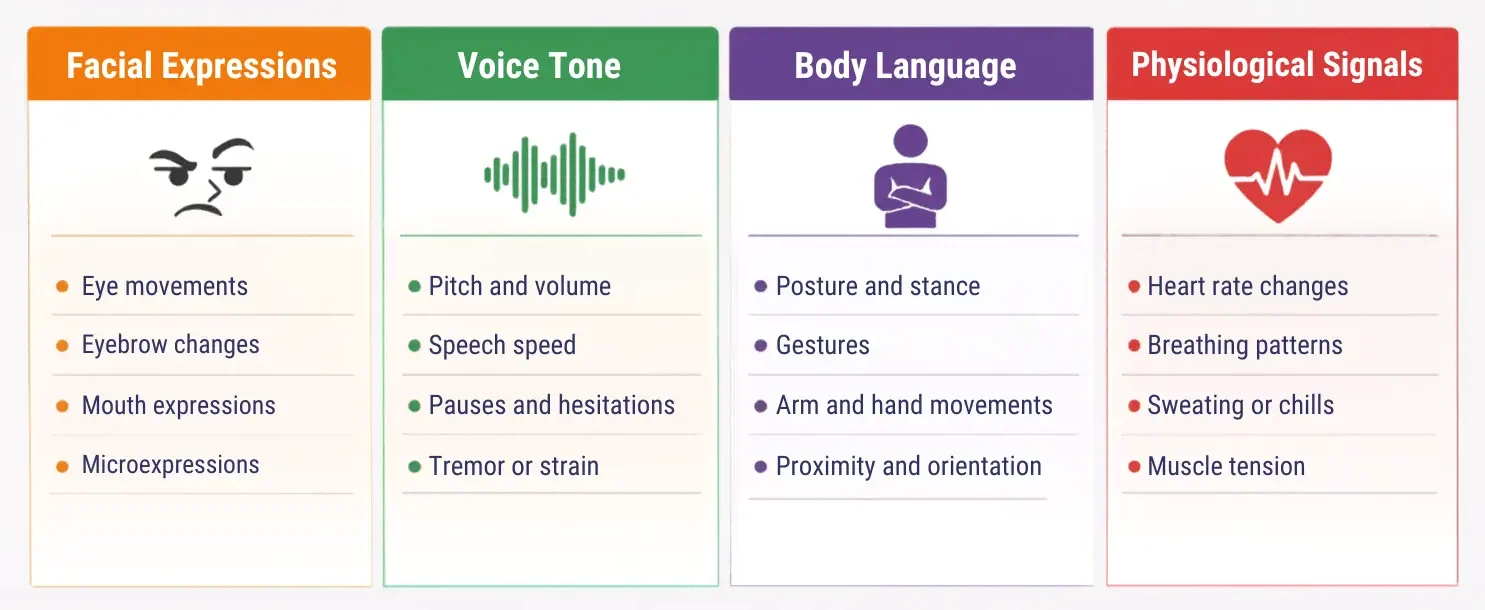
To identify emotions, observe three types of signals during communication:
- Facial expressions – movements of the eyes, eyebrows, and mouth that reveal emotional reactions.
- Voice tone – changes in pitch, speed, or pauses that indicate stress, uncertainty, or enthusiasm.
- Body language – posture, gestures, and orientation that reflect emotional states.
Emotions often appear through combinations of these behavioural cues, even when people do not express their feelings directly.
Why Identifying Emotions Matters in Communication
Emotions shape how people interpret information and respond to others during conversations. Because of this, identifying emotions is essential for understanding communication. In many interactions people do not state their emotions directly. Instead, they appear through tone of voice, facial movement, or changes in posture. Observing these signals helps listeners understand the emotional meaning behind the words.
This skill is particularly important in healthcare communication. Patients often experience anxiety, uncertainty, or frustration during consultations. However, these emotions may not be explicitly stated. When clinicians recognize emotional cues, they can respond more effectively and support better communication.
Research on concealed emotions shows that people frequently attempt to hide or regulate their emotional expressions during social interactions. Nevertheless, brief behavioural signals can still reveal underlying feelings. Porter and ten Brinke found that genuine emotions may appear through involuntary facial expressions even when individuals try to mask them. The authors note that concealed emotions can be detected because “brief facial expressions may leak when individuals attempt to suppress emotional responses”.
Where Emotions Appear in the Body and Brain
Emotions do not exist only as thoughts. They are closely connected to signals within the body. Changes in heart rate, breathing, muscle tension, and other physiological responses often accompany emotional experiences. These internal signals contribute to how the brain interprets emotional states.
Scientists describe this process as interoception, which refers to the brain’s ability to detect internal bodily signals. According to Garfinkel and Critchley, interoception plays a central role in emotional awareness because the brain continuously integrates information from internal physiology with social and environmental cues. Their research explains that “signals from the body provide a key foundation for emotional experience and social behaviour”.
This connection explains why emotional awareness often begins with bodily sensations before a person can name the feeling. For example, increased heart rate and tension may signal anxiety, while warmth or relaxation may accompany positive emotions. As a result, recognizing these physical signals can help individuals identify emotions earlier during social interactions.
How Emotions Appear in Behaviour
Although emotions originate in internal processes, they quickly become visible through behaviour. Facial expressions, voice tone, and body posture often reveal emotional states during conversations. Because these signals occur rapidly and sometimes unconsciously, they provide important clues about how someone feels.
Facial expressions are among the most studied emotional signals. Subtle movements around the eyes, eyebrows, and mouth can indicate emotions such as happiness, anger, surprise, or sadness. Voice tone also carries emotional information. Changes in pitch, speed, and intensity often signal emotional reactions even when the spoken words remain neutral.
Body posture and gestures add further information. For example, a person who feels defensive may lean away or fold their arms, while openness often appears through relaxed posture and direct orientation toward the other person. Observing several cues together improves the accuracy of emotional interpretation.
Research suggests that emotional signals are often expressed automatically through behaviour. Even when people attempt to regulate their emotions, nonverbal cues may still reveal underlying emotional responses (Gyurak, Gross & Etkin, 2011).
Microexpressions and Concealed Emotions
People sometimes attempt to hide their emotions during social interactions. In these situations the face may briefly reveal the true emotion before conscious control alters the expression. These extremely rapid facial movements are known as microexpressions.
Microexpressions typically last only a fraction of a second. Because they occur so quickly, they are often missed during normal conversation. However, careful observation or video review can reveal these brief signals. Research on emotional deception shows that suppressed emotions may “leak” through short involuntary facial movements before the individual consciously regulates the expression (Porter & ten Brinke, 2008).
Microexpressions are particularly relevant in emotionally complex interactions such as clinical consultations, negotiations, or conflict discussions. In these settings people may attempt to appear calm or agreeable while experiencing stress or disagreement. Recognizing subtle emotional cues therefore helps observers understand the emotional dynamics of the interaction more accurately.
Learning to Identify Emotions Through Observation
Recognizing emotions improves with deliberate observation. Although people naturally detect emotional cues, training and repeated exposure significantly increase accuracy. Emotional signals often appear quickly during conversations, so structured observation helps learners notice patterns they might otherwise miss.
One effective approach involves reviewing recorded interactions. Video allows learners to pause, replay, and analyze subtle cues that occur in real time. Facial movements, tone shifts, and posture changes become easier to detect when observers can examine specific moments carefully. This process helps trainees develop what researchers call empathic accuracy, the ability to infer another person’s emotional state from observable behavior.
Observation training also improves emotional understanding because it encourages learners to focus on multiple signals simultaneously. Instead of relying on a single cue, they learn to interpret facial expressions, voice tone, and body language together. Emotion regulation research suggests that people continuously monitor social signals while adjusting their own emotional responses during interactions (Braunstein, Gross & Ochsner, 2017). Practicing observation strengthens this skill and improves emotional awareness in communication.
Practical Ways to Improve Emotion Recognition
Emotion recognition is a skill that develops through practice. Several strategies help individuals become more attentive to emotional signals during conversations.
One effective method is focused observation. Learners can review conversations and identify moments where emotional cues appear. For example, they might notice changes in facial tension, pauses in speech, or shifts in posture. Writing down these observations encourages deeper reflection and improves pattern recognition over time.
Another useful approach involves comparing verbal content with nonverbal behavior. When words and emotional signals differ, the nonverbal cues often reveal the underlying emotion. Studies on emotion regulation show that people frequently attempt to manage how emotions appear in social situations, which means behavioral signals may briefly contradict the spoken message (Gyurak, Gross & Etkin, 2011).
Feedback also plays a critical role in developing emotional awareness. When learners discuss observed emotional cues with peers or instructors, they gain alternative perspectives on the interaction. This collaborative review helps refine interpretation skills and reduces common errors in emotional judgment.
Common Mistakes When Interpreting Emotions
Identifying emotions is complex, and misinterpretations occur easily. One common mistake is relying on a single signal to infer emotional meaning. For example, a brief frown might suggest frustration, but it could also reflect concentration or confusion. Accurate interpretation requires observing several cues together.
Another frequent error involves assuming that emotions have universal meanings in every context. Cultural norms influence how people express emotions, including facial expressions, gestures, and tone of voice. As a result, the same behaviour may carry different emotional meanings depending on cultural background and social setting.
Overconfidence also reduces accuracy in emotional interpretation. People often believe they can easily read emotions, yet research suggests that emotional signals can be subtle or ambiguous. Studies on emotional expression demonstrate that individuals sometimes display mixed signals or regulate their emotions deliberately, making interpretation more difficult (Porter & ten Brinke, 2008).
Developing emotional awareness therefore requires careful observation, openness to alternative interpretations, and attention to context.
Why Emotion Recognition Is a Core Clinical Skill
In healthcare communication, recognizing emotions is essential for building trust and understanding patient concerns. Patients often experience strong emotions during consultations, particularly when discussing diagnoses, treatment options, or uncertainty about outcomes. These emotional signals influence how information is received and how decisions are made.
Effective communication therefore requires clinicians to notice and respond to emotional cues. When clinicians recognize signs of anxiety, confusion, or hesitation, they can adjust their explanations and provide reassurance. This responsiveness improves patient engagement and supports more collaborative decision making.
Shared decision making research highlights the importance of understanding patient perspectives during medical conversations. In this model, clinicians and patients exchange information while discussing treatment options and personal preferences. Emotional understanding helps clinicians recognize patient concerns and support informed decisions. Shared decision making has been shown to increase patient satisfaction and improve adherence to treatment plans.
Conclusion
Identifying emotions is a fundamental communication skill. Emotions influence how people interpret information, respond to others, and make decisions during interactions. Although emotional experiences originate within the body and brain, they often appear through observable behavioural signals such as facial expressions, tone of voice, and posture.
Because these signals can be subtle or brief, developing emotional awareness requires practice. Structured observation and feedback help learners recognize patterns in behaviour and interpret emotional cues more accurately. Research also shows that emotional signals can appear even when individuals attempt to conceal their feelings, which makes careful observation particularly important.
In professional settings such as healthcare, recognizing emotions supports empathy, trust, and effective communication. By improving emotional awareness, professionals can better understand the perspectives of others and respond more appropriately during complex conversations.