


Deescalating Situations in Healthcare: Why It Matters in Clinical Practice
Deescalating situations is not a soft skill. It is a core clinical competence. In healthcare, emotional tension can quickly disrupt judgment, teamwork, and patient safety. Therefore, learning to manage escalation is part of learning to practice safely.
Effective communication sits at the center of clinical care. As Silverman, Kurtz, and Draper explain, communication competence is a critical component of clinical competence, not an optional extra. When tension rises during a consultation, the ability to listen actively, structure the interaction, and respond empathically determines whether the encounter stabilizes or deteriorates.
Moreover, Leonard, Graham, and Bonacum show that communication failures are the leading cause of inadvertent patient harm. In high-stress moments, teams must share a common understanding and feel safe to speak up. Otherwise, escalation affects not only relationships but also outcomes. At the same time, Bandura’s social learning theory reminds us that behaviors are learned through observation and modeling. Students who see calm, structured deescalation in action are more likely to reproduce it themselves.
In short, deescalating situations protects patient safety, strengthens therapeutic relationships, and supports effective teamwork.
What Escalation Looks Like in Clinical Encounters
Escalation rarely starts with shouting. Instead, it often begins with subtle shifts in tone, posture, or pacing. Recognizing these early signals is the first step in deescalating situations.
Rosenberg in ‘Nonviolent Communication’ argues that judgments and moralistic evaluations block compassion and increase conflict. When clinicians label a patient as “difficult” rather than identifying unmet needs or emotions, tension intensifies. In contrast, shifting attention to feelings and needs opens space for empathy. Similarly, Goleman’s work on emotional intelligence emphasizes self-awareness and emotional regulation as foundations for effective interpersonal behavior. If you cannot regulate your own frustration, you cannot calm someone else. And in team settings, escalation may appear as silence rather than noise.
In ‘The Fearless Organization’, Edmondson describes how psychological safety enables people to speak up about concerns without fear. When team members withdraw, avoid eye contact, or stop contributing, the situation may already be escalating. Therefore, learning to observe verbal and nonverbal cues, regulate your own reactions, and invite dialogue allows you to intervene before conflict peaks.
Core Principles for Deescalating Situations in Healthcare
Deescalating situations begins with self regulation. Before addressing the other person, manage your internal response. Emotional reactions spread quickly, so pause, slow your breathing, and lower your tone deliberately.
Next, separate observation from evaluation. Describe what you see without labeling or blaming. Saying “I notice you seem frustrated” keeps the focus on behavior rather than character and reduces defensiveness.
Then shift from positions to needs. Anger often signals something important is unmet. Instead of debating who is right, explore what matters to the patient or colleague.
Finally, make it safe to speak. Invite input directly and acknowledge concerns. Clear structure and shared language maintain alignment when pressure rises.
Practical Techniques for Deescalating Situations with Patients and Teams
- Start by slowing the interaction down. Lowering your voice and reducing the speed of your speech often reduces emotional intensity. At the same time, maintain open body posture and steady eye contact, as nonverbal behavior strongly influences how messages are received.
- Next, use active listening. Allow the patient to speak without interruption, then summarize what you heard. This technique improves understanding and signals respect. When patients feel heard, their emotional arousal often decreases.
- In emotionally charged moments, name the emotion. For instance, you might say, “It sounds like you are worried about what this diagnosis means.” Naming emotions demonstrates empathy and reduces ambiguity. Moreover, it creates space for clarification.
How do you calm an angry patient?
Acknowledge the emotion, allow uninterrupted expression, summarize concerns, and maintain respectful boundaries. Avoid judgment and focus on underlying needs.
- In team situations, use structured communication. Brief, clear statements about the situation, background, assessment, and recommendation reduce misunderstanding. Shared structure ensures that everyone understands the plan and prevents further escalation.
- When needed, set boundaries calmly. You can acknowledge emotion while clarifying expectations. For example, “I want to understand your concerns, and we need to speak respectfully to do that.” This maintains dignity without escalating further.
Deescalating Situations in Interprofessional Teams
Some encounters escalate quickly, especially when fear, anger, or distrust are involved. In these moments, stabilize emotion before moving to solutions.
- Regulate yourself first. Notice your physiological response and slow it down. Defensive reactions amplify tension.
- Acknowledge the emotion explicitly. Brief reflective statements signal that you are listening and reduce ambiguity.
- Respond to the underlying need rather than the surface reaction. Anger often masks fear or uncertainty.
- Maintain professional structure. Validate emotion while reinforcing respectful interaction and shared goals.
Using Video Reflection to Improve Deescalation Skills
Learning to deescalate requires more than theory. It requires seeing your own behavior. However, in the heat of the moment, you rarely notice subtle shifts in tone, posture, or timing. Video reflection makes these patterns visible.
When you review a recorded consultation, you can observe where escalation began. For example, you may notice that you interrupted early or missed an emotional cue. This aligns with the principle of observing without evaluating, which encourages objective description before judgment.
Moreover, reviewing team interactions helps uncover unspoken dynamics. You can identify moments when someone attempted to speak but withdrew, or when structure broke down. Because communication skills can be taught and practiced, deliberate review accelerates improvement.
Video also supports modeling. When students watch examples of effective deescalation, they internalize specific behaviors. Over time, repeated observation and rehearsal strengthen these skills.
Therefore, integrating structured video analysis into communication training transforms deescalating situations from an abstract concept into an observable, improvable competence.
Common Mistakes That Escalate Clinical Situations
Understanding how to deescalate situations also requires recognizing what makes them worse. Escalation often results from predictable communication errors rather than extreme behavior.
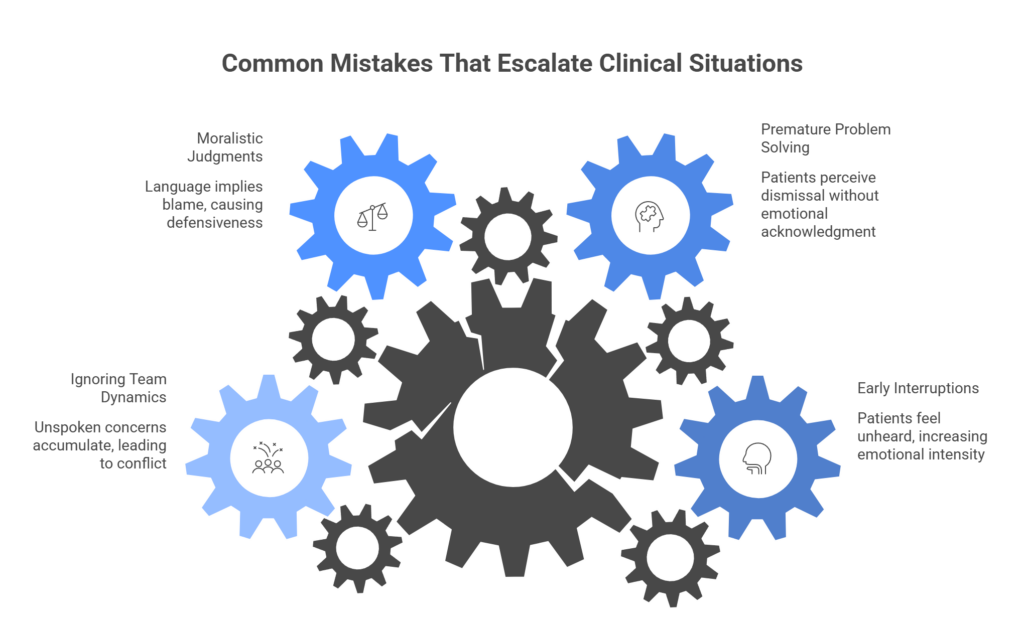
First, interrupting too early can intensify frustration. Research on medical interviews shows that patients are frequently interrupted within seconds of beginning their explanation. When patients feel unheard, emotional intensity increases. Therefore, allowing uninterrupted opening statements reduces defensive reactions and improves clarity.
Second, shifting into problem solving too quickly can backfire. When clinicians move straight to advice without acknowledging emotion, patients may perceive dismissal. Empathic acknowledgment strengthens the relationship and prepares the ground for information exchange.
Third, moralistic judgments escalate tension. When language implies blame or character flaws, the other person becomes defensive. Describing observable behavior instead of labeling it keeps the conversation focused on facts rather than identity.
Finally, ignoring team dynamics can silently escalate risk. When concerns remain unspoken because of hierarchy or fear, frustration accumulates. Inviting clarification and explicitly checking for dissent prevents silent disagreement from becoming open conflict.
How to Practice Deescalating Situations During Training
Deescalation is a skill, not a personality trait. Therefore, it can be practiced deliberately.
- Start with simulation. Structured role play allows students to rehearse responses to anger, anxiety, or disagreement in a safe setting. Because rehearsal strengthens neural pathways, repeated practice increases confidence and fluency.
- Next, use reflection. After a simulated or real consultation, identify specific moments where tension rose. Ask what you observed, what you felt, and what you chose to say. This approach reinforces awareness and emotional regulation.
- Peer feedback also strengthens learning. When colleagues point out subtle shifts in tone or posture, blind spots become visible. Over time, this builds shared standards for respectful communication.
- Finally, integrate debriefing into team training. Brief discussions after challenging encounters normalize learning and reduce shame. When teams analyze communication openly, they improve both competence and cohesion.
By combining rehearsal, reflection, feedback, and debriefing, students transform deescalating situations into a deliberate and measurable communication skill.
Deescalating Situations When Emotions Run High
Some clinical encounters escalate rapidly. For example, you may face anger after a delayed diagnosis, fear following unexpected results, or distrust in culturally sensitive conversations. In these moments, your primary task is emotional containment before clinical problem solving.
- Regulate yourself. Emotional intelligence research emphasizes that self awareness and self management precede effective social regulation. If you respond defensively, escalation accelerates. Therefore, notice your physiological response and intentionally slow it down.
- Acknowledge the emotion explicitly. Naming what you observe reduces ambiguity and signals presence. For example, you might say, “I can see this is very upsetting.” This aligns with the principle that empathy is a skill that can be demonstrated through reflective statements rather than assumed as a feeling.
- Distinguish stimulus from cause. Anger is often directed at you, yet the underlying cause may be fear, grief, or unmet expectations. When you respond to the deeper need instead of the surface reaction, intensity decreases.
- Maintain structure. Even in emotionally charged exchanges, clear boundaries and organized communication protect safety. You can validate emotion while setting limits on disrespectful behavior.
- Return to shared goals. In healthcare, both clinician and patient usually want understanding, relief, and safety. Reconnecting to common purpose shifts the interaction from opposition to collaboration.
Deescalating Situations in OSCEs and Assessments
High stakes assessments amplify emotion. In OSCEs, students often encounter simulated anger, anxiety, or resistance. Because performance pressure increases cognitive load, escalation can occur faster than in routine consultations.
- Remember that structure protects you. Using a clear consultation framework reduces mental overload and prevents reactive responses. When you signpost the interaction and summarize periodically, you regain control of the pace.
- Focus on process, not performance. If a simulated patient becomes confrontational, your goal is not to win the interaction but to demonstrate safe communication. Acknowledge emotion, explore concerns, and maintain professional boundaries. These behaviors align with core communication skills validated in consultation models.
- Review your recordings. Video analysis allows you to identify exactly where escalation began. You may notice subtle interruptions, defensive tone shifts, or missed emotional cues. Because communication skills are teachable and observable, assessment becomes an opportunity for measurable improvement rather than judgment.
Cultural and Power Dynamics in Escalation
Escalation does not occur in a vacuum. Cultural expectations, language differences, and power hierarchies shape how conflict unfolds. Therefore, deescalating situations requires awareness of these dynamics. Patients may interpret tone, eye contact, or authority differently depending on cultural background. What feels direct to one person may feel disrespectful to another. Actively checking understanding reduces misinterpretation and prevents unintended offense.
Power distance also influences communication. Patients may hesitate to question doctors, while junior clinicians may avoid challenging seniors. When concerns remain unspoken, tension accumulates. Explicitly inviting questions and acknowledging uncertainty reduces this imbalance.
In addition, reflective practice strengthens cultural sensitivity. After challenging encounters, ask yourself which assumptions influenced your response. Over time, this builds adaptive communication rather than rigid scripts.
Ultimately, deescalating situations in diverse environments depends on empathy, humility, and structured dialogue.