

Communication in nursing becomes teachable when educators define what learners should say, notice, and do in a specific situation. A student may understand active listening in theory yet miss a patient’s hesitation, rush through discharge instructions, or give an unstructured handover under pressure. The educational task is therefore not simply to explain communication. It is to make effective behavior visible, give learners repeated opportunities to practice it, and assess it against the demands of the encounter.
This guide sets out seven communication skills that nursing educators can teach and observe. It also shows how to turn barriers into scenario variables, choose an appropriate practice method, and assess performance without reducing a complex interaction to a superficial checklist.
What does communication in nursing include?
Communication in nursing is the verbal, nonverbal, written, and structured exchange nurses use with patients, families, and healthcare colleagues. It supports four connected tasks: building a therapeutic relationship, gathering information, explaining care, and coordinating action across a team.
These tasks require more than speaking clearly. The Nursing and Midwifery Council’s Code expects nurses to use understandable terms, respond to language and communication needs, consider cultural sensitivities, check understanding, and communicate effectively with colleagues. The AACN Essentials likewise place communication within person-centered care, professional practice, and interprofessional partnership.
Consequently, communication should not be taught as one generic competence. A conversation with an anxious patient requires different behaviors from an SBAR handover. Explaining a new medication differs from escalating a deteriorating patient’s condition. Educators need to define what successful communication looks like in each situation.
For a cross-professional overview of observation tools and evidence sources, see Measuring Communication Skills in Healthcare. This guide keeps the focus on nursing-specific tasks and scenarios.
Seven communication skills nursing educators can make observable
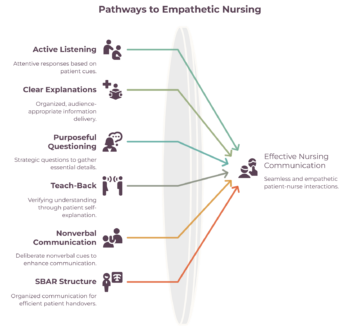
The following seven skills translate broad communication principles into actions that an educator can see or hear. They are not a universal scoring instrument. Instead, educators should select and adapt them to the objective, learner level, and clinical context.
1. Active listening and responding to cues
Active listening means using the patient’s words, behavior, and emotional cues to guide the next response. It is visible when a learner allows the patient to finish, notices a meaningful cue, acknowledges it, and follows up rather than returning immediately to a prepared list of questions.
Suppose a patient says, “I know I need the operation, but I have not been sleeping.” A task-focused response might move directly to the preoperative checklist. An attentive response first explores the cue: “What has been keeping you awake?” The learner can then discover whether the concern involves pain, uncertainty, family responsibilities, or fear of the procedure.
Educators can look for five behaviors: appropriate pauses, relevant follow-up questions, acknowledgment of emotion, accurate summaries, and evidence that the patient’s response changes what the learner does next. A recent systematic review of high-fidelity simulation in nursing education found that standardized patients and immersive virtual reality were the most promising modalities for practicing communication, empathy, and active listening. However, the authors also reported substantial variation in scenarios, educational frameworks, and measurement quality. Therefore, the evidence supports carefully designed practice, not the claim that one technology is universally best. Read the systematic review.
2. Clear, audience-appropriate explanations
A clear explanation is organized around what this person needs to understand or do next. The learner uses familiar language, introduces information in manageable portions, explains unavoidable clinical terms, and adjusts the pace to the person’s responses.
For example, “You are NPO after midnight” may be routine language within the team, but it is not necessarily clear to a patient. “Please do not eat or drink after midnight, including water” is more direct. The learner should then explain why the instruction matters and what to do if it is not followed.
Assessment should consider organization and adaptation, not only vocabulary. Did the learner prioritize essential information? Did they notice confusion? Did they change the explanation when the first version did not work? A polished monologue can still be ineffective if it ignores the listener.
3. Purposeful questioning, clarification, and summarizing
Good nursing communication uses different questions for different purposes. Open questions invite the patient’s account. Focused questions establish necessary detail. Clarifying questions test an uncertain interpretation. Summaries bring several pieces of information together and allow correction.
A learner might begin with, “What has changed since yesterday?” They can then focus on onset, severity, and associated symptoms. Before moving on, they might say, “Let me check that I have understood. The breathlessness began this morning, is worse when you walk, and is different from what you usually experience. Is that right?”
Counting open and closed questions does not show whether the interview was effective. Instead, educators should ask whether each question advanced understanding, whether the learner followed important answers, and whether the summary represented the patient’s account accurately.
4. Checking understanding with teach-back
Teach-back checks how clearly the nurse explained information. It does not test the patient’s memory or intelligence. After explaining a manageable portion, the nurse asks the patient to describe the plan in their own words, identifies misunderstandings, explains again differently, and rechecks.
Rather than asking, “Do you understand?” a learner might say, “I want to make sure I explained the medication change clearly. When you get home, how will you take these tablets?” If the response reveals confusion, the learner takes responsibility for clarifying it.
The AHRQ teach-back guidance recommends this explain, check, clarify, and recheck cycle. It also provides an observation tool, making teach-back particularly suitable for behavior-focused learning. Educators can assess whether the learner framed the request without shame, listened to the answer, corrected the explanation, and verified understanding again.
5. Using nonverbal communication deliberately
Nonverbal communication includes position, physical orientation, facial expression, vocal tone, pace, eye contact, gesture, and silence. These behaviors affect whether attention, urgency, openness, or discomfort is conveyed. They also help the nurse detect information that the patient has not stated directly.
Context matters. Fixed rules such as “always maintain eye contact” are poor teaching tools because culture, distress, neurodiversity, physical positioning, and the clinical task can change what is appropriate. A stronger assessment question is whether the learner’s nonverbal behavior supported the purpose of the interaction and adapted to the other person’s responses.
For a deeper discussion, see Nonverbal Communication in Healthcare.
6. Structuring handovers with SBAR
SBAR organizes a clinical message into Situation, Background, Assessment, and Recommendation. It is useful when learners need to select relevant information and communicate a clear request under time pressure.
Consider a student calling about a patient whose condition has changed. Naming the patient and immediate concern establishes the situation. Relevant history and recent observations provide the background. The student’s interpretation forms the assessment. The recommendation states the response they need, such as an urgent review.
A systematic review of SBAR-based simulation programs for nursing students found the clearest evidence for improved communication clarity. Findings for broader outcomes, including confidence and critical thinking, were more variable. The review also found substantial differences in intervention components and measurement methods. Therefore, educators should assess whether SBAR improves the structure and actionability of the message rather than assume that completing four headings proves effective communication. Read the SBAR review.
The AHRQ TeamSTEPPS tools complement SBAR with check-back, closed-loop communication, handoff, advocacy, and assertion techniques.
7. Assertive escalation and respectful interprofessional communication
Assertive communication makes a safety concern and requested action explicit while remaining professional. A learner should state the concern, provide relevant evidence, make a clear recommendation, confirm that the message was received, and escalate again if the risk remains unresolved.
This skill is especially important when hierarchy or professional differences make it difficult to speak up. An integrative review of interprofessional communication described how distinct professional communication styles, interruptions, stress, hierarchy, and fear of humiliation can obstruct shared understanding. It concluded that simulation and standardized tools can support interprofessional communication training, although the review’s deliberately focused search limits the strength and breadth of that conclusion. Read the integrative review.
Educators should not assess assertiveness by vocal confidence alone. The relevant evidence is whether the learner identifies the risk, states what is needed, responds appropriately to resistance, and closes the communication loop.
Turn communication barriers into scenario variables
Communication barriers become educationally useful when they change what the learner must notice or do. A list of barriers builds awareness. A scenario tests adaptation.
| Barrier | Scenario variable | Observable response |
|---|---|---|
| Anxiety or distress | The patient struggles to process instructions | The learner acknowledges emotion, slows down, prioritizes information, and checks understanding |
| Language difference | The patient has limited proficiency in the teaching language | The learner seeks appropriate language support and avoids relying on assumptions |
| Hearing, speech, or cognitive needs | Standard questioning produces incomplete responses | The learner adapts the pace, medium, environment, or questioning approach |
| Noise and interruption | A handover takes place in a distracting setting | The learner protects critical information and reconfirms the message |
| Hierarchy | A senior colleague initially dismisses a concern | The learner restates the risk and escalates through the appropriate route |
| Time pressure | The learner has limited time for patient education | The learner prioritizes essential information and uses teach-back |
An integrative review found that simulated patients have been used in nursing communication education across end-of-life care, oncology, mental health, hearing impairment, admission, and discharge. However, simulated-patient recruitment, training, and evaluation methods varied considerably. Educators should therefore define the role carefully and train the simulated patient to portray key cues consistently. Read the integrative review.
How to teach communication skills in nursing
Communication training works best as a cycle of targeted practice, observation, feedback, and another attempt. The educator first identifies a small number of behaviors, then chooses a method that creates the right interaction.
Match the practice method to the objective
Peer role-play provides accessible, repeatable rehearsal. It can work well when learners need several short attempts and the objective does not depend on a highly consistent patient portrayal.
Standardized patients can create consistent relational encounters and provide feedback from the patient’s perspective. They are particularly useful when emotional cues, adaptation, and relationship-building are central.
Manikin-based simulation can place communication within acute clinical action. However, it may foreground technical and verbal information exchange more than relational communication unless the scenario includes a relative, colleague, or additional patient voice.
Virtual simulation can offer repeatable, scalable encounters. A meta-analysis of ten studies reported a positive overall effect of virtual reality simulation on nursing students’ communication skills. Nevertheless, the included studies varied, and factors such as follow-up measurement and debriefing affected the results. The evidence supports VR as one practice option, not a replacement for every human interaction. Read the meta-analysis.
Interprofessional simulation is appropriate for handover, shared decisions, escalation, and conflict. It should give each profession a meaningful role rather than simply place different learners in the same room.
A review of simulated patients and role-play found that both are widely used, but the evidence did not establish which method is best for every circumstance or learner. It also noted that role-play may provide a less costly alternative in some settings. Read the review.
Use a repeatable learning cycle
- Set one or two observable objectives.
- Brief the learner, patient role, and observers.
- Run a focused interaction.
- Review evidence from the performance.
- Choose one deliberate change.
- Repeat the interaction.
- Increase complexity as performance becomes more consistent.
A systematic review found some evidence that communication improvements taught through simulation can transfer beyond the simulation center. However, only 18 studies in the review demonstrated outcomes at the selected higher levels, and study design limited the strength of the conclusions. Read the systematic review. Educators should therefore assess performance across time and contexts rather than rely on immediate post-session confidence.
The scenario itself also needs deliberate design. The guide to Medical Simulation Scenarios provides examples and a planning checklist.
How to assess communication without reducing it to a checklist
Communication assessment should combine task-specific behavioral evidence with an overall judgment of whether the interaction worked. One universal score cannot represent every nursing encounter.
Start with the purpose of the scenario
A medication explanation, emotional conversation, handover, and escalation require different evidence. Before choosing a rubric, educators should define:
- What the learner needs to accomplish
- Which information must be gathered or communicated
- Which behaviors matter in this context
- How the learner should adapt to the other person
- What would make the interaction unsafe or ineffective
Use several assessment dimensions
A practical rubric can combine five dimensions:
- Task completion: Was the necessary information gathered or conveyed?
- Interaction quality: Did the learner listen and respond to the other person?
- Adaptation: Did the learner change their communication when the situation required it?
- Verification: Did the learner check understanding or confirm message receipt?
- Professional judgment: Was the communication appropriate for this situation?
A systematic review identified 14 instruments for assessing patient-centered communication and providing direct feedback. The instruments differed in the dimensions they covered and in the evidence supporting their measurement properties. The authors recommended choosing an instrument according to the specific learning context, its conceptual coverage, feasibility, and measurement quality. Read the assessment review.
Accordingly, a rubric should support observation rather than manufacture precision. A total score can hide an important pattern, such as accurate information delivered without checking understanding. Narrative evidence and behavior-level feedback preserve that distinction.
Once the observer has identified that evidence, the next step is to turn it into a useful learning conversation. The guide on how to give feedback provides a practical seven-step process with examples.
Use more than one perspective
Direct observation can be combined with standardized-patient feedback, peer feedback, self-review, and repeated assessment across scenarios. Video review can help learners compare their intention with visible behavior and return to moments that would otherwise depend on memory. However, educators should establish psychological safety, consent, access controls, and a clear purpose for recording.
After a simulation, a structured conversation helps learners interpret the evidence and plan another attempt. See Debriefing Models for Simulation for approaches to post-scenario learning.
Turn an abstract competency into visible behavior
Nursing educators can teach communication more effectively when they replace broad labels with situation-specific behaviors. Active listening, clear explanations, purposeful questions, teach-back, nonverbal adaptation, structured handovers, and assertive escalation can all be practiced and observed. The appropriate combination depends on the patient, task, learner, and clinical context.
Videolab supports this process by letting learners and educators return to the same recorded interaction, identify precise evidence, and compare performance across repeated attempts. In a nursing communication scenario, that means feedback can point to the moment a cue was missed, understanding went unchecked, an SBAR recommendation became unclear, or an escalation lost its urgency.