

It is not controversial to say that providing feedback is a very difficult task to master. Therefore, many different frameworks such as the Ask-Tell-Ask model, have been developed to help medical practitioners effectively train the next generation. This blog will analyse and summarise what the research says about the Ask-Tell-Ask model (ATA) and how to use it. The ATA is a structured feedback model in which the learner self-assesses before the educator speaks. The educator then shares specific observations and closes the conversation by asking the learner to commit to one concrete change. Developed in surgical education and now used across clinical training settings, ATA can typically be completed in under ten minutes and fits any observed encounter.
Ask-Tell-Ask structures how feedback is given. What the learner does with it afterward is a separate skill, covered in our guide on how to receive feedback well.
Where Ask-Tell-Ask Comes From
Ask-Tell-Ask began as a patient communication technique, not a feedback model. It was drawn from motivational interviewing, where clinicians are trained to ask patients what they already know before sharing new information, then ask again to check understanding. The structure is built for dialogue between parties with different knowledge, not for one-way delivery.
Educators at the Cleveland Clinic adapted that structure for trainee feedback around 2005. In 2015, French et al. formalised the model in the Journal of Surgical Education, positioning it as a practical tool for the ACGME Milestones framework, a competency-based system that tracks developmental progress over time rather than performance at a single point. A model that elicits self-assessment fits that purpose better than one that simply delivers a verdict.
The origin matters because it explains the model’s register. ATA is a conversation structure built for two-way engagement, not a checklist.
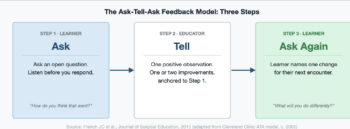
The Three Steps: With the Words to Use
Ask: Invite the Self-Assessment
The first step asks the learner to speak before the educator does. An open question works best: one that does not hint at the conclusion the educator has already formed.
Example phrases:
- “Before I share what I observed, how do you think that went?”
- “What felt like it worked, and what would you change?”
- “Which part of that encounter would you want to revisit?”
The question should be followed by silence. Filling the pause too quickly narrows the learner’s response to what they think you want to hear. The self-assessment that emerges, even if incomplete, tells the educator which concerns the learner already carries and which still need naming.
Tell: Specific, Targeted Feedback
The tell is not a full performance review. It covers one positive observation and one or two specific areas for improvement, anchored to what the learner said in Step 1.
If the learner identified a problem correctly, the educator confirms it and adds precision. If they missed something important, the educator names it directly.
The difference between vague and specific:
Vague: “Your communication was good, but your examination technique needs work.”
Specific: “Your eye contact during the history was consistent, which helped the patient stay engaged. The abdominal examination started before you explained what you were about to do. That is worth practising explicitly.”
The specific tell is shorter in word count but harder to dismiss.
Ask Again: The Forward Commitment
The second ask is what separates ATA from most other feedback models. The educator does not close the conversation by summarising what went wrong. The learner does.
Example phrases:
- “What is the one thing you want to do differently in your next encounter?”
- “How will you practise that before the next session?”
- “What support do you need from me to work on that?”
A commitment stated in the learner’s own words tends to carry more weight than a list of recommendations delivered by someone else. That is the forward-looking anchor the Tell alone cannot provide.
How ATA Differs from Pendleton’s Model
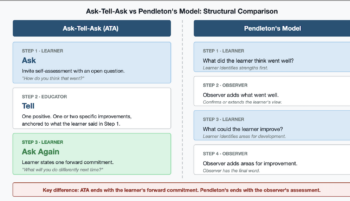
Both Ask-Tell-Ask and Pendleton’s Model ask the learner to speak before the educator; thus, it is a good framework to compare it to. That similarity leads them to be treated as interchangeable. They are not.
Pendleton’s follows a fixed four-part sequence: the learner identifies what went well, the observer adds what went well, the learner identifies what could be improved, the observer adds what could be improved. The structure is transparent and predictable. Experienced trainees sometimes describe it as feeling scripted: they wait through the positives for the part they know is coming.
ATA is more conversational. The first Ask is open-ended rather than organised around good and improve categories. The Tell responds to what the learner actually said rather than following a preset order. And the second Ask introduces something Pendleton’s does not: a forward commitment stated by the learner. The conversation closes with the learner naming what they will do next, not the educator.
In practice, ATA tends to work better in time-constrained ward settings where a rigid four-step structure is difficult to complete. Pendleton’s offers more scaffolding for trainees early in their development who benefit from an explicit framework. Neither model is superior across all contexts. The right choice depends on the learner, the setting, and the time available.
What the Evidence Says
The evidence base for ATA is modest, and it is worth being honest about that.
The foundational paper by French et al. (Journal of Surgical Education, 2015) makes a strong theoretical case for the model but does not report outcome data. The argument is educational: a feedback structure that elicits self-assessment fits competency-based training better than one that delivers a verdict. That reasoning is sound, but it is not drawn from a controlled study.
Survey data from Saeed et al. (Pakistan Journal of Medical Sciences, 2020) offers some observational support. Of 209 medical students at King Saud University, 59% reported that their PBL tutors asked them to self-assess first, and 72% described the feedback environment as non-threatening. Implementation was inconsistent across tutors, which is itself a relevant finding.
The most rigorous comparison available is a 2023 randomised controlled trial by Lin et al. (BMC Oral Health) comparing ATA against the feedback sandwich with 69 dental students. Overall perception scores showed no significant difference between the two models (p = 0.197). Three individual items favoured the sandwich. After controlling for gender and ethnicity, the overall difference between groups was non-significant (p = 0.325).
ATA is a well-constructed model grounded in sound educational principles. The evidence that it outperforms alternatives in clinical settings, however, remains limited.
When Ask-Tell-Ask Fits
ATA works best when the learner has just performed something observable and has immediate recall of the encounter. Post-OSCE debriefs, simulation scenarios, and ward-based observed clinical encounters are its natural home. The learner can self-assess meaningfully because the experience is fresh, and the educator has specific observations to anchor the Tell.
The model also requires a few practical conditions. A minimum of five to ten minutes is needed to complete all three steps without compressing the self-assessment. Some degree of established trust helps: a learner who feels evaluated rather than supported will give a defensive first-Ask response, which limits what the model can do.
ATA is less well-suited to certain contexts. Asynchronous written feedback does not lend itself to a three-step dialogue. Paper-based assessment review is harder to anchor: without direct observation, the Tell has no specific moment to refer to. Very early learners who have not yet built enough clinical experience to self-assess accurately may also struggle with the first Ask.
In those situations, a more directive approach or a review of other feedback models may serve better.
One context where ATA gains an extra layer is video-based feedback. When a learner watches a recording of their own clinical encounter before sitting down with an educator, they have already done part of the first Ask. They have seen what happened, formed a view, and often identified specific moments they want to discuss. The opening question lands differently: the learner is not searching memory but responding to something they have just watched. The educator’s Tell can be more precise because the first Ask has more material to work with. The recording does not replace the conversation. It sharpens the step that starts it.