


The expensive question is not whether standardized patients work. It is where their realism, consistency and feedback justify the resources they require.
Clinical education programs rarely need one patient method for every stage of learning. Students may need inexpensive repetition when they first practice history taking, more realistic encounters before an OSCE and controlled portrayals during a formal assessment. Using trained standardized patients for all three stages can consume resources without improving every objective.
The practical approach is to reserve standardized patients for the points where their specific functions matter, then use lower resource methods for preparation, repetition and review.
What does a standardized patient provide?
A suitable alternative must replace the function needed for the activity, not simply put another person in the patient role.
- Live interaction: The learner must respond to questions, emotion, hesitation and unexpected behavior.
- Consistency: Different learners should face a comparable case with controlled difficulty.
- Patient perspective: Feedback should describe how the interaction felt to the person receiving care.
- Availability: The case must be delivered at the required time and repeated across groups.
Trained standardized patients can provide all four functions. However, doing so requires recruitment, case preparation, training, scheduling and performance monitoring. The AMEE guide to simulated patient methodology identifies dedicated staff time and financial resources as core requirements for maintaining a patient bank.
An alternative becomes reasonable when the learning objective needs only some of these functions. For example, a peer can provide live interaction during early communication practice, while a recorded encounter can support observation and feedback without creating another live case.
What are the five main standardized patient alternatives?
The strongest alternatives are peer role play, trained student patients, teacher portrayed patients, real patients and video enhanced practice. They are not equivalent patient types. They are different ways to deliver selected parts of the learning experience.
1. Peer role play for frequent, lower stakes practice
Peer role play allows students to rotate through the clinician, patient and observer roles. It provides live interaction and repetition without requiring an external participant.
- Best used for: Early communication practice, history taking, consultation structure and preparation for more realistic encounters.
- Avoid when: Learners need an unfamiliar patient, controlled assessment conditions or credible feedback from a patient perspective.
- Minimum setup: A structured case brief, clear role boundaries, an observation guide and time for feedback and repetition.
The evidence supports peer role play as a credible teaching method, but not as a universal substitute. A 2025 meta analysis combined ten studies with 721 participants and found similar overall effects for role play and standardized patients. Standardized patients produced a greater improvement in learner self confidence. Cultural and sample differences also limited the generalizability of the findings. The synthesis by Xiao and Fu supports matching the method to the objective.
Peer role play can also reduce delivery resources. In one undergraduate communication course, Bosse and colleagues calculated 112 staff and participant hours for peer role play and 172 for standardized patient training, with high post training performance in both groups. However, the study measured immediate results in one course. The cost effectiveness analysis does not establish the same advantage for every scenario.
Feedback quality is the main operational risk. Observers need to identify specific behavior and its effect rather than comment on confidence, personality or acting ability. See peer feedback in medical education for a structured approach.
2. Trained student patients for repeatable cases
Trained student patients sit between informal peer role play and an established standardized patient program. Students learn a defined case and repeat it across encounters rather than changing roles within a small practice group.
- Best used for: Formative OSCEs, repeated practice and cases that match the available student population.
- Avoid when: The case requires demographics or lived experience that the student group cannot represent, or when the assessment has high consequences.
- Minimum setup: Case specific training, rehearsal, portrayal checks, rest periods and a clear policy on whether students provide ratings or feedback.
Wu and colleagues trained university students for a nursing OSCE. Eighty two examinees completed the evaluation and rated the student patients highly for professionalism, familiarity with the case and realistic portrayal. The student patients completed six hours of training and also described fatigue from portraying cases across a full day. The mixed methods study found the approach feasible.
However, the study did not compare student patients with professional standardized patients. Its student patients were also young and female. Programs should therefore validate trained students against the requirements of each case rather than assuming that feasibility proves equivalence.
3. Teachers or clinicians for guided introductory practice
Teacher portrayed patients allow an educator to present clinical cues, pause the encounter and give immediate explanations. The method combines a patient role with direct instruction.
- Best used for: Small introductory sessions, guided history taking and cases where the teacher needs to reveal the reasoning behind a response.
- Avoid when: Learners need psychological distance from faculty, independent performance or a realistic unfamiliar patient.
- Minimum setup: A script, agreed responses, rehearsal and separation between feedback given in role and instruction given as faculty.
A 2025 study compared teacher standardized patients with scripted and unscripted peer role play among 630 third year medical students. Scripted peer role play produced the highest scores for several history taking and communication measures, while medical record writing did not differ between groups. The study by Wei and colleagues favored role play for this junior history taking course.
The study assessed much of the work at group level and did not follow long term outcomes. Its practical message is narrower: faculty portrayal can support guided teaching, but faculty expertise alone does not make it the strongest option for repeated practice.
4. Real patients for authentic findings and lived experience
Real patients contribute genuine histories, physical findings and perspectives that a scripted portrayal may not reproduce. Some participate as an educational resource, while trained patient instructors take a more active teaching and feedback role.
- Best used for: Stable physical findings, chronic conditions, lived experience and patient perspective.
- Avoid when: The activity requires identical presentations, repeated emotionally difficult encounters or predictable availability.
- Minimum setup: Informed consent, clear boundaries, preparation for the teaching role, clinical support and the patient’s unrestricted right to stop.
Bokken and colleagues reviewed real and simulated patient roles in undergraduate education. Real patients supported patient centered learning and authentic contact, but availability and variability limited equivalent learning experiences. Selected patient instructors could teach specific physical examination skills and give feedback from the patient’s perspective. The review emphasized that active patient instructors need stable findings and the ability to tolerate repeated examination.
Real patients should not be treated as a convenient source of realism. Their educational value must outweigh the time, discomfort and privacy demands placed on them.
5. Video enhanced practice for review and remediation
Video enhanced practice does not replace the person in a live encounter. Instead, it reduces the number of additional encounters needed for observation, feedback and remediation by making one performance reviewable.
- Best used for: Self review, peer discussion, assessor calibration, targeted feedback and remediation.
- Avoid when: The objective is to respond to a new patient or manage an unfamiliar conversation in real time.
- Minimum setup: A clear recording purpose, appropriate consent and access controls, an observation framework and protected review time.
Wang and colleagues combined video feedback with peer role play in an undergraduate problem based course. The study reported improvements in several learning measures, but it used a small sample, a nonstandardized questionnaire and one communication assessment instrument. The 2024 study supports the combined method as promising rather than conclusive.
Park and colleagues compared two forms of review after recorded standardized patient encounters. Both preceptor feedback and peer discussion improved OSCE scores and self efficacy. Students with weaker baseline performance gained more in patient physician interaction from preceptor review. The video remediation study suggests that peer review can extend capacity, while underperforming learners may still need faculty attention.
Which method fits each clinical education scenario?
The learning stage and consequences of the decision should determine the method.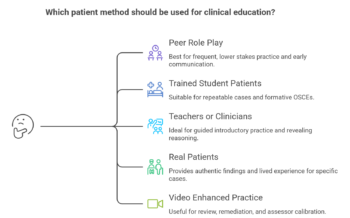
Early communication and history taking practice
Use scripted peer role play. Learners need frequent attempts, clear observation criteria and permission to restart. Add video when seeing the interaction again would improve feedback.
Preparation for an OSCE
Begin with peer role play, then introduce trained student patients or trained standardized patients as the examination approaches. This progression adds unfamiliarity and consistency after learners have developed basic fluency.
Summative or high stakes OSCEs
Retain trained standardized patients unless the alternative has undergone equivalent quality assurance. Candidate comparability, portrayal consistency and defensible scoring matter more than reducing the cost of each encounter.
Sensitive conversations
Use a trained standardized patient when the case involves breaking bad news, conflict or intense emotion. Peer role play can prepare learners, but asking classmates to portray distress may reduce realism or create unnecessary personal exposure.
Context matters even within cost analysis. Bosse and colleagues found a cost advantage for peer role play in undergraduate communication training. By contrast, an exploratory breaking bad news study found better performance with standardized patients and judged them more cost effective despite slightly higher delivery costs. The study by Paramasivan and Khoo shows why programs should not transfer one cost conclusion to every scenario.
Physical examination with genuine findings
Use a real patient or trained patient instructor when the finding cannot be portrayed reliably and participation is safe. Use a standardized patient when repeated examination, controlled difficulty or availability matters more than authentic pathology.
Remediation after weak performance
Use recorded review with faculty guidance. Peers can support reflection, but learners with persistent difficulty need an educator who can identify the most important behavior and connect it to a specific next attempt.
How can programs combine the alternatives?
A staged model gives learners repetition first and reserves the most controlled encounters for later decisions.
- Practice: Learners rehearse a structured case through peer role play.
- Review: They watch the recording, receive evidence based feedback and repeat the difficult part.
- Increase realism: A trained student patient or standardized patient introduces an unfamiliar person and a more consistent portrayal.
- Assess: A trained standardized patient delivers the controlled case used for progression or certification decisions.
This sequence avoids spending the highest resource method on every early attempt. It also prevents an abrupt jump from classroom discussion to a formal simulated encounter. Programs can shorten or extend the sequence according to learner experience and case difficulty.
When should standardized patients remain nonnegotiable?
Standardized patients should remain the default when variation could undermine fairness, patient feedback forms part of the assessment or the program must defend a progression decision.
Standardization still requires monitoring. In a communication OSCE involving 79 residents, Iramaneerat and colleagues found that standardized patients and cases formed the largest identified source of error variance after residual error. Their quality control study shows that a script alone does not guarantee equivalence. Programs must review cases, train portrayals, monitor ratings and investigate inconsistent stations.
Therefore, an alternative should not enter a high stakes assessment merely because it worked in a teaching session. The program should demonstrate that the portrayal, case difficulty and rating process remain sufficiently consistent for the decision being made.
A decision checklist for clinical educators
Before selecting a patient method, answer these questions:
- Is the activity for first practice, advanced rehearsal, feedback or formal assessment?
- Does the learner need a responsive person or only an observable example?
- Must every learner face an equivalent presentation?
- Does the case require genuine clinical findings or lived experience?
- Who should provide feedback, and what preparation do they need?
- Could the role create discomfort, fatigue or personal exposure for the participant?
- What evidence will show that the method worked as intended?
If consistency and defensibility dominate the answers, retain trained standardized patients. If repetition and formative feedback dominate, begin with peer role play or trained students. If authenticity dominates, consider real patients. If observation and targeted improvement dominate, add structured video review.
Frequently asked questions
Is peer role play as useful as standardized patients?
Peer role play can support selected communication and history taking objectives. Standardized patients provide greater unfamiliarity, portrayal control and patient perspective. The methods can complement each other at different stages.
Can students act as standardized patients?
Students can portray defined cases after suitable training and rehearsal. Programs must confirm that their age, background and performance fit the case, particularly when the encounter contributes to an assessment decision.
Can real patients replace standardized patients?
Real patients are preferable when authentic findings or lived experience form the learning objective. They are less suitable when availability, repetition and equivalent presentations are required.
Can video replace a live patient interaction?
Video can replace some additional observation and feedback sessions, but it cannot respond to the learner. It works best as part of peer practice, encounter review or remediation.
Videolab helps clinical education teams apply this staged approach without separating each method into a different review process. Teams can record peer role play, student portrayals and formal simulated encounters, then use the same criteria and time marked evidence across practice, feedback and assessment. This makes it easier to reserve faculty review and trained standardized patients for the learners and decisions that require them most.