


Human communication involves much more than spoken words. Facial expressions, tone of voice, and body language all shape how people interpret what someone is feeling. Among these signals, one of the most subtle and debated forms of nonverbal communication is the micro expression.
Micro expressions are extremely brief facial expressions that appear when a person experiences an emotion but attempts to suppress or conceal it. These expressions typically last only fractions of a second, which makes them difficult to detect during normal conversation. Because of this short duration, researchers often rely on video recordings and frame by frame analysis to study them.
The concept became widely discussed in psychology after studies on emotional suppression and deception suggested that fleeting facial signals may reveal emotional reactions that people do not intentionally express. However, researchers also emphasize that these expressions do not automatically indicate deception. Instead, they signal that an emotion briefly surfaced before being regulated or replaced with a different expression.
In healthcare education and communication training, understanding micro expressions can help students and clinicians become more aware of subtle emotional reactions during conversations. When consultations are recorded and reviewed, learners can analyze these brief facial signals and reflect on how emotional responses shape patient interactions.
What Are Micro Expressions (ME)?
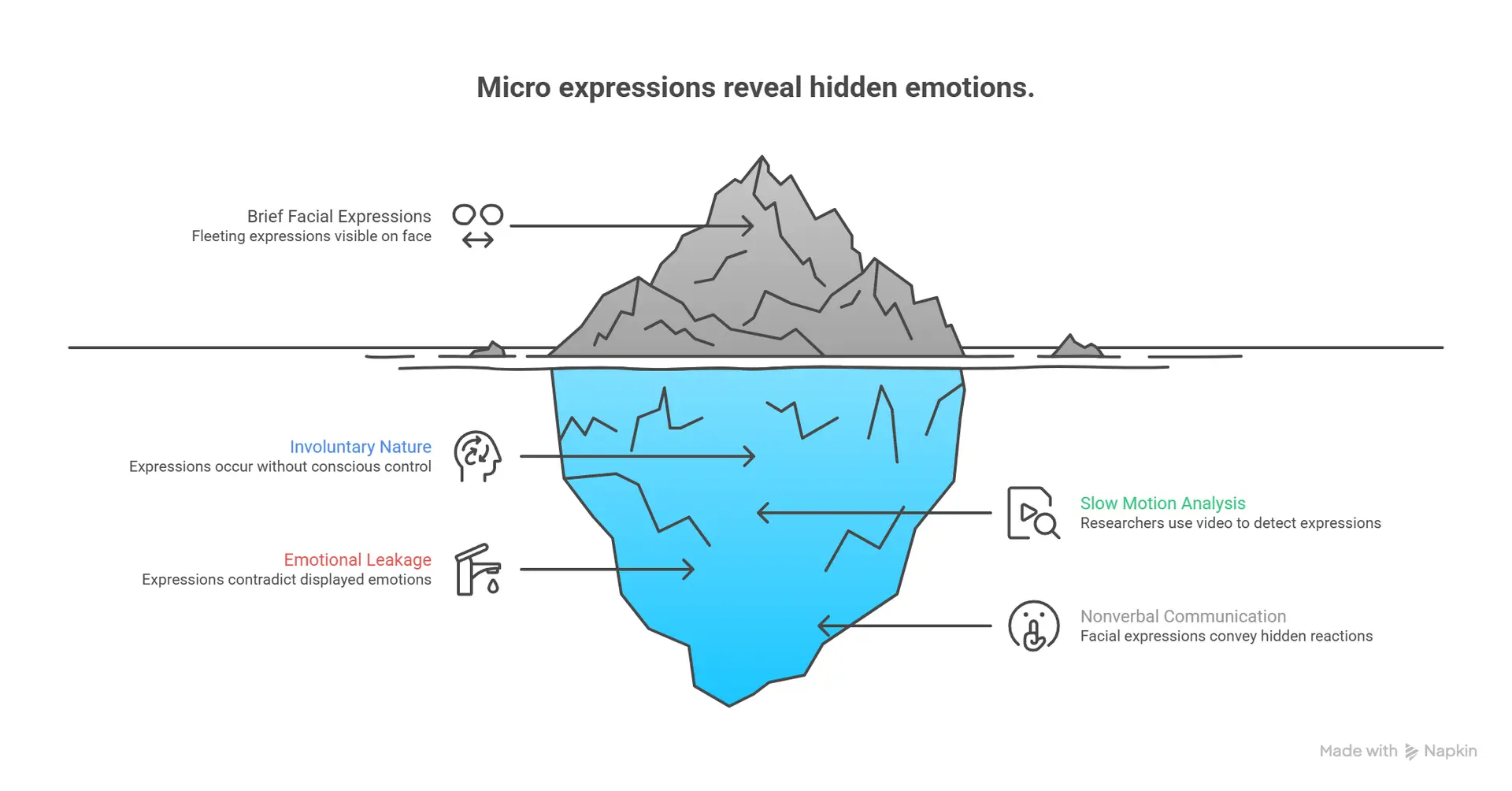
Micro expressions are very brief facial expressions that appear when a person experiences an emotion but tries to hide it. They typically last between about 0.04 and 0.2 seconds and often occur involuntarily, making them difficult to detect during real time conversation.
Researchers study micro expressions using video recordings and frame by frame analysis because these expressions happen too quickly for most people to notice without slow motion review.
The concept became widely known through research on facial expressions and emotion. Scientists studying deception and emotional suppression observed that people sometimes display a fleeting expression that contradicts the emotion they are attempting to show. These momentary signals are sometimes described as emotional leakage.
For students and educators studying communication, micro expressions highlight how much emotional information is conveyed through the face. Although spoken words carry meaning, facial expressions often reveal reactions that are not intentionally communicated.
Why Micro Expressions Reveal Hidden Emotions
Micro expressions are often linked to situations where a person tries to conceal or regulate an emotional reaction. When an emotion emerges quickly, the brain may trigger facial muscle movements before conscious control can suppress them. As a result, a brief expression may appear before the person replaces it with a different facial display.
Psychological studies describe several ways people manipulate emotional expressions. A person may simulate an emotion that is not genuinely felt, mask a true emotion with a different expression, or neutralize the face to hide what they feel. During these attempts, a short and involuntary expression may appear that does not match the displayed emotion.
However, researchers emphasize an important limitation. A micro expression does not automatically indicate deception. Instead, it signals that a person is experiencing an emotion that may not align with what they are showing outwardly. The underlying cause of that emotion still requires interpretation within context.
Understanding this distinction is especially important in professional communication settings such as healthcare, where emotional reactions may reflect anxiety, confusion, or discomfort rather than dishonesty.
How Micro Expressions Are Studied in Research
Studying micro expressions requires careful analysis because these expressions occur so quickly. Researchers typically record participants on video while they experience emotional stimuli or attempt to hide an emotional response. The recorded footage is then analyzed frame by frame to detect very brief facial movements.
In experimental studies, facial expressions are often coded using structured systems that classify individual muscle movements in the face. These coding systems allow researchers to identify specific patterns associated with different emotions and measure how long they appear.
Frame level video analysis is essential in this process. Researchers frequently analyze recordings at high frame rates to capture subtle facial changes that occur within fractions of a second. In one experimental study of genuine and deceptive expressions, researchers examined more than one hundred thousand video frames to identify short emotional signals and other facial cues.
Because these changes are difficult to observe in real time, video recording has become one of the most important tools for studying facial expressions and emotional communication.
Why Video Is Essential for Detecting ME
Micro expressions are difficult to detect during live interactions because they occur so quickly and often with very low intensity. Even trained observers may miss them when they appear for only a fraction of a second.
Video recording changes this limitation. When an interaction is captured on video, the recording can be replayed, slowed down, and examined frame by frame. This allows educators and researchers to observe facial movements that are invisible during real time communication.
Video analysis also supports structured observation. Instead of relying on memory, reviewers can pause the recording and examine the exact moment when a facial expression appears. This makes it easier to compare emotional reactions with the surrounding conversation and contextual cues.
For communication training, this approach has practical value. Students reviewing recorded consultations can observe subtle emotional reactions from patients or clinicians that they did not notice during the interaction. Over time, this type of review helps learners become more aware of nonverbal communication signals that influence trust, empathy, and understanding in professional conversations.
Micro Expressions in Healthcare Communication
Communication in healthcare often involves emotionally sensitive conversations. Patients may experience anxiety, uncertainty, or fear while discussing symptoms, diagnoses, or treatment decisions. Although patients may try to remain calm during these discussions, brief facial reactions can still reveal emotional responses to what they are hearing.
Micro expressions can therefore provide insight into moments when a patient experiences discomfort, confusion, or concern. Because these expressions appear quickly and often without conscious control, they can indicate emotional reactions that are not verbally expressed. In many cases, a patient may say they understand a treatment plan while briefly showing surprise, worry, or hesitation.
For medical students and trainees, learning to observe these signals can strengthen communication skills. Recognizing subtle emotional reactions can prompt follow up questions, clarification, or reassurance. As a result, clinicians may better understand how patients interpret information and respond to clinical conversations.
Video recorded consultations are particularly useful in this context. When students review interactions after the consultation, they can identify moments where emotional reactions appeared and reflect on how the conversation unfolded. This process helps learners develop greater awareness of nonverbal communication during patient interactions.
How Educators Can Train Students to Notice ME
Recognizing subtle facial signals requires practice and structured observation. In many training environments, students focus primarily on clinical content during patient interactions. As a result, they may overlook nonverbal communication cues that occur during the conversation.
Educational programs often introduce observation exercises to help students develop this skill. For example, learners may watch recorded consultations and pause the video at key moments to analyze facial reactions from both the clinician and the patient. This approach allows students to examine emotional responses that occurred during specific parts of the conversation.
Video based reflection also supports peer discussion. When students review the same consultation recording, they can compare observations and discuss how emotional cues may have influenced the interaction. These discussions help learners understand that communication involves both spoken information and subtle behavioral signals.
Over time, repeated exposure to recorded consultations improves students’ ability to notice brief emotional reactions during live conversations. As learners become more attentive to facial signals, they can respond more effectively to patient concerns and emotional needs.
Limitations and Misconceptions
Although micro expressions are widely discussed in psychology and popular media, several misconceptions persist. One common belief is that a micro expression automatically reveals that someone is lying. Research does not support this interpretation.
A brief facial expression may indicate that a person is experiencing an emotion that differs from the expression they are presenting. However, that emotional reaction can arise for many reasons. A patient might display surprise while hearing a diagnosis, or discomfort while discussing sensitive information. These reactions do not necessarily imply deception.
Another limitation involves reliability. Micro expressions occur very quickly and may involve only small facial muscle movements. Because of this, observers often disagree when interpreting them, especially without training or video analysis tools.
Researchers studying facial expressions also emphasize the importance of context. Emotional signals must be interpreted alongside the surrounding conversation, body language, and situational factors. Without this context, interpreting micro expressions can easily lead to incorrect conclusions.
Understanding these limitations is essential for educators and students who use facial expression analysis in communication training.
The Future of ME Analysis
Advances in video technology and artificial intelligence are expanding the ways researchers study facial expressions. Computer vision systems can analyze recorded video sequences to detect subtle facial movements that may be difficult for humans to observe in real time.
Recent research in micro expression recognition focuses on identifying these brief signals within video recordings using automated algorithms. These systems analyze facial muscle movements across thousands of video frames and attempt to detect patterns associated with emotional expressions.
Although automated analysis remains an emerging field, these technologies are already being explored in areas such as behavioral research, human computer interaction, and training environments. Video based datasets of facial expressions are increasingly used to develop and evaluate these systems.
For healthcare education, the growing availability of video recordings creates new opportunities for communication training. Recorded consultations allow educators and students to analyze subtle aspects of interaction that are difficult to observe during live encounters. As video analysis tools continue to improve, they may provide additional ways to support reflective learning and communication research in clinical education.
Key Takeaways
Micro expressions are brief facial expressions that reveal emotional reactions a person may be trying to conceal. Because these expressions appear and disappear in fractions of a second, they are often invisible during real time interactions.
Researchers study micro expressions by analyzing recorded video sequences frame by frame. This approach allows investigators to observe subtle facial muscle movements and emotional signals that occur too quickly for the human eye to detect.
In communication training, video review provides an opportunity to analyze these signals after an interaction has occurred. Students and educators can pause recordings, examine facial reactions, and reflect on how emotional responses influenced the conversation.
For healthcare education, this process supports the development of stronger communication skills. By learning to notice subtle emotional cues, clinicians can better understand patient reactions, respond to concerns, and improve the quality of clinical conversation