

The doctor-patient consultation sits at the center of healthcare delivery. It’s where information gets shared, diagnoses get made, and treatment plans get built. Every consultation looks a little different depending on the patient and the doctor, but most still follow a common structure underneath. Understanding that structure helps patients participate more in their own care, and it helps healthcare professionals treat more effectively. This article walks through the common steps of a doctor-patient consultation and how clinicians actually learn this skill.
Key Takeaways
- Structured consultations improve both patient experience and clinical outcomes
- Structure saves time and improves efficiency
- The Calgary-Cambridge Guide provides a framework for structured consultations
- Doctor- patient consultations can be trained

4 Factors why structure is important in a doctor-patient consultation
According to Eurostat, the frequency of medical consultations varied significantly across EU nations in 2021, with the average number of yearly doctor visits per inhabitant ranging between 3.5 and 7.8 in most member countries. Multiply that by the EU’s population, and the quality of each individual consultation clearly adds up to something that shapes the whole healthcare system. Four factors capture why structure matters this much, for patients and doctors alike.
Patient Experience
A structured evaluation helps a patient feel heard and understood. Clear expectations, a conversation steered toward what matters, and active listening all give a patient a sense of control. That sense of control alone tends to lower anxiety, and it improves both satisfaction and therapeutic results.
Clinical Outcomes
A standardized approach to a patient’s symptoms and medical history lowers the odds of missing something crucial, which improves diagnostic accuracy on its own. The same data collection lets a doctor build a treatment plan around a specific patient’s history, lifestyle, preferences, and risk factors, rather than a generic protocol. And a structured conversation tends to be a more honest one, which leaves patients understanding their own condition and treatment plan better, and that understanding is itself part of the outcome.
Efficiency and Time Management
Given how many people see a doctor every year, time is one of the scarcest resources in the system. A structured consultation spends it more efficiently by directing the conversation to key subjects and prioritizing what information actually gets collected. That focus lets a clinician assess the patient, weigh diagnoses, and discuss treatment options faster, without cutting corners. It tends to simplify the administrative side too, note-taking and record-keeping included, which takes some load off healthcare staff directly.
Legal and Ethical Considerations
Healthcare professionals do end up in legal disputes with patients, and a structured consultation is one of the more effective safeguards against that. Standardized forms and templates keep documentation clear and consistent, which cuts down on the misunderstandings that turn into legal challenges. The same structure helps guarantee compliance with informed consent, patient confidentiality, and professional conduct, protecting patients and clinicians alike. A well-documented, structured consultation also doubles as evidence of adequate care if a malpractice claim ever comes up, which protects individual clinicians seeing multiple patients a day and takes some pressure off the legal system as a whole. (Source)
Calgary-Cambridge guide to medical interviews
So how is a doctor-patient consultation structured? The Calgary-Cambridge guide to the medical interviews is a widely recognised model for assessing communication skills between healthcare professionals and their patients. Initially developed by Kurtz and Silverman at the University of Calgary and the University of Cambridge, this guide offers an organised way to conduct medical interviews, with the aim of improving the quality of patient care and the effectiveness of clinical interactions. (Source)
Goals of the Guide
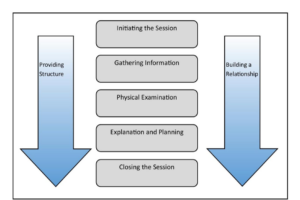
Its fundamental objectives are divided into two main areas. First of all, building an effective relationship and providing a clear structure for interviews between doctor-patient consultations.
- Building an effective relationship is one of a doctor’s central goals in a consultation because it opens up communication. A patient who feels valued and understood shares more, which supports a more accurate assessment. It also promotes empathy, and a warm, respectful environment lowers a patient’s stress and anxiety, letting them feel like they are somewhere trustworthy.
- The second goal is a clear structure for the interview itself. The guide lays out every stage, from opening to closing, which keeps a doctor’s approach coherent and makes sure nothing necessary gets skipped. That structure helps manage time better while still covering everything diagnosis and treatment depend on, and it adds up to a more organised, more effective experience for the patient.
The Calgary-Cambridge model divides a doctor-patient consultation into five phases. Each phase has specific objectives and skills that healthcare professionals develop and apply during doctor-patient consultation. These phases guide practitioners through a structured approach to patient interaction, ensuring comprehensive and effective communication throughout the medical interview. (Source)
Structure of the Model
Phase 1: Initiating the Session
This phase focuses on preparation and establishing a relationship with the patient. It begins with creating a comfortable environment, introducing oneself, and explaining the purpose of the consultation. It is essential for the healthcare professional to show empathy and respect for the patient’s concerns from the start. (Source)
Phase 2: Gathering Information
In this phase, the goal is to obtain a complete and accurate medical history. Using different types of questions, both open-ended and closed, the symptoms, past medical history, and family and social backgrounds are explored. It is crucial to listen actively and show genuine interest in the information provided by the patient. (Source)
Phase 3: Examination
During this phase, a physical examination is conducted based on the information previously provided. It is important to explain each procedure to the patient. Further, the healthcare professional needs to obtain consent, ensuring their comfort and safety during the examination. (Source)
Phase 4: Explanation and Planning
After collecting and analysing all the information, the healthcare professional must explain the findings to the patient in a clear and understandable manner. Possible diagnoses and treatment options are discussed, and a joint decision is made on the action plan. The patient’s active and conscious participation in this phase is essential for their adherence to the treatment. (Source)
Phase 5: Closing the Session
The interview concludes with a summary of what was discussed and a clear follow-up plan. The professional must ensure that the patient understands all the information and that all their doubts are resolved. The availability for future consultations is reinforced, and contact information is provided if necessary. (Source)
How self-reflection can be beneficial to doctor-patient consultations
Mastering a consultation takes more than structure. It also takes verbal and nonverbal communication skills, which come naturally to some people and have to be trained deliberately in others. Self-reflection is how that training happens: it connects a past experience to a current problem and turns it into a better decision going forward.
Reflection helps a trainee recognise their own strengths, blind spots, and emotional triggers, which is what self-awareness is actually built from.
It also helps them see a patient encounter from the patient’s side, building the empathy and compassion that trust with patients and families depends on.
How Can Videolab improve your doctor-patient consultation
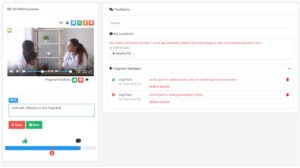
Videolab is a video recording tool built around exactly that kind of reflection. Trainees learn the doctor-patient structure by getting feedback through several channels at once, peer feedback, self-reflection, direct coaching, or a structured evaluation, rather than just one.
Those multiple feedback sources are what surface a trainee’s own strengths, blind spots, and emotional triggers, and that self-awareness is what turns into real personal and professional growth.
How Videolab works:
Trainers or trainees can safely record a patient consultation, either through a skills lab’s camera setup with CloudControl or with the Videolab Recorder application. The recording is encrypted on upload and is not stored anywhere else. From there, they can review it, add time-stamped feedback, and share it securely with peers, experts, or instructors across the organisation. Structured evaluations can be layered on top, and feedback connects to whatever learning management system the institution already uses.