
Cybersecurity in Healthcare: Risks and Best Practices
Healthcare runs on data.
Patient records, diagnostic results, surgical notes, clinical assessment videos, and consultation recordings now live in connected systems. That connectivity helps modern healthcare work. It also makes healthcare one of the most targeted sectors for cybercrime.
In 2015 alone, more than 110 million patients in the United States had their healthcare data compromised (Martin et al., 2017). Cyberattacks on healthcare institutions grew by 125 percent between 2010 and 2017 (Kruse et al., 2017). Approximately 90 percent of healthcare providers reported at least one data breach in a recent two year window (Kruse et al., 2017).
These are not abstract numbers. Behind each breach are hospitals running on paper records, delayed procedures, exposed patient data, and teams trying to restore care under pressure.
Cybersecurity in healthcare is a patient safety issue. This guide explains why healthcare is targeted, which cybersecurity risks matter most, why medical education environments face specific vulnerabilities, and how institutions can build better protection around sensitive clinical data.
Why healthcare is such a target for cybercrime
No other sector combines the same level of sensitive data, connected technology, and operational pressure. Healthcare organizations hold personal, financial, clinical, and identity data in one place. Attackers value that combination because medical records can support identity theft, fraud, blackmail, and resale.
Unlike financial data, health data is difficult to replace. You can cancel a credit card. You cannot change a blood type, erase a diagnosis, or replace genetic information once it has leaked.
Argaw et al. (2020) found that individual health records can sell for 10 to 20 times more than stolen credit card numbers. Martin et al. (2017) estimated a value of around $50 per record. That value helps explain why attackers continue to target hospitals, clinics, universities, and other healthcare institutions.
The cost of a healthcare data breach
Ransom payments attract attention, but they rarely show the full cost of a breach. A healthcare data breach can create several layers of damage:
- Operational downtime
- Delayed care
- Loss of access to patient records
- Legal and compliance costs
- Patient notification costs
- Reputational damage
- Loss of trust among patients, students, staff, and partners
Coventry and Branley (2018) calculated the average cost per stolen healthcare record at $380. For large institutions, that can become tens or hundreds of millions.
Healthcare also faces a structural funding gap. Martin et al. (2017) reported that healthcare organizations often spend only 1 to 2 percent of their annual budget on IT, compared with 4 to 10 percent in other sectors.
That underinvestment matters. Cybersecurity does not fail only because attackers become more sophisticated. It also fails when institutions rely on outdated systems, weak access controls, fragmented vendor oversight, and tools that were not designed for sensitive healthcare data.
The most common cybersecurity risks in healthcare
Healthcare cybersecurity risks rarely appear in isolation. A phishing email can expose credentials. Exposed credentials can open access to a vendor platform. A vendor platform can contain patient records, student data, clinical videos, or assessment results.
The most important risks fall into four overlapping areas.
Ransomware attacks and hospital downtime
Ransomware encrypts systems and demands payment to restore access. In healthcare, that disruption can quickly affect care delivery.
If staff lose access to medication systems, patient records, diagnostic tools, or internal communication platforms, the organization slows down at the exact moment when continuity matters most.
The WannaCry attack in May 2017 infected more than 200,000 systems across 150 countries. Around 50 UK hospitals experienced system wide lockouts. NHS hospitals delayed treatment plans and rerouted ambulances because they lost access to information systems (Argaw et al., 2020; Martin et al., 2017; Coventry and Branley, 2018).
In the United States, Hollywood Presbyterian Medical Center lost access to its systems for 10 days and paid $17,000 to recover them (Kruse et al., 2017).
That payment does not include lost revenue, delayed work, reputational damage, or the pressure placed on clinical teams.
Phishing and human error
Many successful cyberattacks begin with a person opening something they should not have.
Even in security conscious organizations, a well crafted phishing email can achieve a click rate of up to 30 percent (Martin et al., 2017). Password sharing compounds the problem. Healthcare staff often share login credentials because clinical environments move quickly and patient care takes priority over protocol (Martin et al., 2017).
That behavior is understandable, but it creates systemic risk. A single compromised account can expose a much wider environment.
Coventry and Branley (2018) found that more than half of healthcare data breaches originate inside the organization, through negligence or deliberate misuse. Human behavior is not a secondary issue. It is one of the main attack surfaces in healthcare cybersecurity.
Medical device and IoMT vulnerabilities
Modern healthcare depends on connected equipment, and Coventry and Branley (2018) found an average of 10 to 15 connected devices per hospital bed in US institutions. Infusion pumps, ventilators, MRI machines, blood storage units, and patient monitors often communicate with hospital networks and electronic health record systems.
That connectivity creates clinical value. It also creates cybersecurity risk.
One documented attack method, known as Medjack, injects malware into vulnerable medical devices and uses them to move laterally across the hospital network (Coventry and Branley, 2018).
Researchers have also demonstrated the ability to remotely alter settings on pacemakers, defibrillators, and insulin pumps, including potentially lethal changes to device behavior (Martin et al., 2017).
Many medical devices were not built with modern cybersecurity controls in mind. As a result, healthcare institutions often need to manage risks that the original device design did not fully address.
Third party and vendor risk
Hospitals and medical schools rarely operate as standalone systems. They depend on external scheduling platforms, billing tools, imaging software, telehealth services, video platforms, LMS integrations, and assessment tools. Many of these systems store or access sensitive data.
Luna et al. (2016) identified external threats as one of the two primary structural threat categories in healthcare. When vendor security is weak, the institution still carries the consequences.
This matters especially for clinical video, OSCE recordings, real consultation footage, and student assessment data. A general video tool may feel convenient, but convenience does not equal clinical data security.
Why medical education environments face unique risks
General healthcare cybersecurity guidance often focuses on hospitals and clinical operations. Medical schools, simulation centers, and clinical training programs face additional risks that receive less attention.
These environments combine healthcare data, educational data, student access, temporary users, AV systems, clinical platforms, and external examiners. That creates a specific risk profile.
Clinical video, OSCEs, and identifiable patient data
Clinical training increasingly depends on video, and OSCE recordings, consultation simulations, real patient interactions, and communication skills sessions all generate identifiable footage. That footage may include faces, voices, clinical details, emotional responses, and protected health information.
None of it is anonymized by default, and when these recordings move through platforms without adequate security, they carry the same exposure risk as electronic health records. A breach involving clinical assessment footage is not only embarrassing. It can trigger serious compliance obligations under GDPR and HIPAA.
It can also violate the trust patients extend when they participate in training environments.
Student access, simulation labs, and shared networks
Training environments involve many transient users: students rotate, remote examiners join temporarily, Visiting facilitators need access for specific sessions. Temporary staff may support OSCEs or simulation days. Each person becomes a potential access point.
Kruse et al. (2017) found that healthcare technology systems are often deployed faster than security controls can keep pace. The same pattern appears in medical education, where new platforms and integrations can enter the curriculum before security review catches up.
Shared simulation lab infrastructure adds another risk. AV recording equipment, clinical workstations, student devices, and assessment systems may sit on the same network. That creates the kind of lateral movement risk that Medjack style attacks exploit (Coventry and Branley, 2018).
For more on how digital tools shape clinical training environments, see our guide to clinical training with video feedback.
What a breach in a training environment can expose
A compromised training platform can expose more than one type of data. It may contain:
- Student records
- Patient consent forms
- OSCE recordings
- Real consultation footage
- Faculty assessment data
- Peer feedback
- Remediation notes
- Research material
This data is highly specific, highly identifiable, and difficult to recover once leaked.
That is the risk of treating clinical training platforms as lower priority than clinical operational systems. The data may sit in an educational context, but the privacy and compliance consequences remain serious.
Five practices that reduce cybersecurity risk in healthcare
Healthcare institutions cannot remove every cybersecurity risk. However, they can reduce exposure and improve resilience with the right controls.
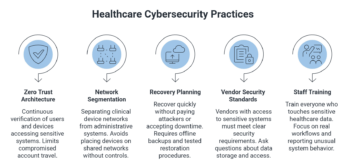
Move to zero trust architecture
Traditional network models assume that users inside the perimeter can be trusted. Zero trust assumes they cannot.
Zero trust requires continuous verification of every user and device that tries to access sensitive systems. In environments where students, remote examiners, staff, and vendors log in regularly, this model limits how far one compromised account can travel (Argaw et al., 2020).
For clinical training platforms, zero trust principles should translate into practical controls:
- Role based access
- Multi factor authentication
- Temporary access for guests and examiners
- Clear user removal procedures
- Audit logs
- Session controls
Segment networks and control connected devices
Not every device needs access to every system, and network segmentation limits how far attackers can move during an incident. Hospitals should separate clinical device networks from administrative systems where possible. Simulation centers should also avoid placing AV equipment, clinical workstations, personal devices, and assessment platforms on shared networks without proper controls.
Institutions should also audit connected device inventories, apply patches consistently, and enforce vendor security standards. Legacy devices running outdated software remain one of the most reliable attack vectors in healthcare (Argaw et al., 2020; Coventry and Branley, 2018).
Plan for recovery, not just prevention
No institution can guarantee that it will never face an attack, so the goal is to recover quickly without paying attackers or accepting prolonged downtime. That requires offline backups, tested restoration procedures, and documented disaster recovery protocols.
For medical education environments, recovery planning should include:
- OSCE recordings
- Assessment records
- Consent documentation
- Feedback data
- Student portfolios
- Supervisor notes
- Platform access logs
A recovery plan that covers only core hospital systems may leave clinical training programs exposed.
Require security standards from every vendor
Any vendor with access to sensitive systems should meet clear security requirements before gaining that access. This applies to clinical video platforms, LMS integrations, scheduling tools, billing systems, transcription services, and assessment platforms.
Before a vendor handles patient data, clinical footage, student records, or assessment information, institutions should ask:
- Where is the data stored?
- Who can access it?
- Is the data encrypted?
- Can users be removed quickly?
- Are access logs available?
- How long are recordings retained?
- What happens when the contract ends?
- Does the platform support GDPR or HIPAA requirements where relevant?
Third party risk management is not optional when vendor access extends to protected health information or identifiable clinical training data (Luna et al., 2016).
Train staff and students as part of the security perimeter
Human behavior drives many successful breaches, so training is one of the highest return investments an institution can make (Kruse et al., 2017; Martin et al., 2017).
Training should include everyone who touches sensitive healthcare data:
- Clinicians
- Students
- Teachers
- Supervisors
- Remote examiners
- Simulated patients
- IT staff
- Administrative teams
Security awareness should focus on real workflows. People need to understand why shared passwords create risk, why clinical videos should not move into personal drives, and how to report unusual system behavior.
Cybersecurity belongs to every person who logs in, not only the IT department.
What secure by design means for clinical platforms
The most resilient cybersecurity approach does not start with a policy document. It starts with architecture, and Coventry and Branley (2018) argue that security belongs in platform design from the beginning, not as a layer added later. Martin et al. (2017) also emphasize that systems need to account for how healthcare professionals actually behave, rather than assuming ideal protocol compliance at all times.
For clinical training environments, secure by design means choosing platforms where privacy and security are structural commitments.
A secure clinical video platform should support:
- Encryption at the point of capture
- Secure storage
- Role based access
- Controlled sharing
- Consent aware workflows
- Audit trails
- Isolated data environments
- Clear retention rules
- GDPR compliant data handling
- Institutional governance
This matters because clinical video is unusually sensitive. A consultation recording may show who the patient is, what they said, how they reacted, how the trainee responded, what feedback was given, and how the institution assessed the interaction.
When clinical video ends up in an unsecured third party tool because it was convenient at the time, the institution takes on liability it may not fully see.
For more on building patient centered, privacy aware clinical spaces, see our post on how to design your consultation room for patient-centered care.
Frequently asked questions
Why is healthcare targeted more than other industries?
Healthcare holds valuable and permanent data. Medical records contain personal, financial, and clinical information that cannot easily be changed once exposed. Hospitals also operate critical services under time pressure, which can make downtime especially damaging (Argaw et al., 2020; Martin et al., 2017).
What is the most common cybersecurity risk in hospitals?
Identity theft through data breach is one of the most prevalent forms of cybercrime in healthcare (Luna et al., 2016). Ransomware has also become a major operational threat because it can interrupt care delivery directly.
How do ransomware attacks affect patient care?
Ransomware can encrypt hospital systems and block access to records, medication systems, diagnostic tools, and communication platforms. Consequences include cancelled surgeries, delayed treatments, manual workarounds, and ambulance rerouting (Argaw et al., 2020; Coventry and Branley, 2018).
What is IoMT security and why does it matter?
IoMT security protects networked medical devices, including infusion pumps, patient monitors, ventilators, and imaging equipment. Many of these devices run outdated software or lack strong built in security, which can make them entry points into broader hospital networks (Coventry and Branley, 2018; Kruse et al., 2017).
How can medical schools protect clinical training data?
Medical schools should use purpose built platforms that encrypt data at the source and store clinical recordings within controlled, compliant environments. They should also enforce access controls, audit user activity, manage consent, and apply the same vendor security standards to training platforms that apply to clinical operational systems.
What is zero trust security in healthcare?
Zero trust is a security model that requires continuous identity verification from every user and device, regardless of network location. It limits the reach of any single compromised account, which is especially useful in medical schools and simulation centers with many temporary or rotating users (Argaw et al., 2020).
Securing clinical training data starts with the platform
Cybersecurity in healthcare is not only about preventing attacks. It is about protecting patient trust, clinical continuity, student data, and the integrity of healthcare education.
For medical schools, simulation centers, and clinical training programs, secure clinical video infrastructure is now part of that responsibility.
At Videolab, security is not configured after the fact. It is built into the architecture. Patient interactions, OSCE recordings, and clinical assessments can be encrypted at the source and stored within an isolated, GDPR compliant environment.
Your institution does not need to choose between accessible clinical training tools and secure clinical data.