

Welcome to a glimpse into what truly drives us in medical education! AMEE 2025 is just around the corner and once again promises to be the most important gathering for everyone committed to shaping the future of health professions education worldwide. At a time when medicine is evolving faster than ever, the exchange of innovative ideas, proven methods, and groundbreaking research is more crucial than ever to prepare the next generation of healthcare professionals.
At Videolab, I spend much of my work exploring key themes in education, ranging from soft skills in medical education and Entrustable Professional Activities (EPAs) to the latest technologies that are transforming how we teach and learn. That’s why I’ve put together my selection of the Top 5 sessions you can’t miss at AMEE 2025, talks that will inspire you and equip you to prepare your students for both the challenges and opportunities of modern medical education, with a particular focus on practical skills to integrate into curricula.
AI symposium
My first recommendation is the AI symposium. This two-day event runs Saturday and Sunday, welcoming everyone from complete beginners to seasoned AI users. The reason for that is quite simple: AI has become a bit of a buzzword to make inventions seem more interesting than they actually are, but at the same time, the leading tech companies are spending billions of euros each year to improve it. Therefore, it is crucial to actually understand AI, its use cases and its current limitations. The sessions ignite curiosity and spark change by offering hands-on demonstrations, expert-led talks, and interactive discussions designed to elevate teaching using AI.
Saturday 23rd August 2025
Time: 08:45-16:45
Saturday focuses on the practical uses of artificial intelligence across health professions education. By the end of the day, you will be able to recall concrete examples where AI is already being applied to teaching, learning, and assessment.
A special focus will be placed on the concept of prompt engineering. You will learn how to shape effective prompts and see how this skill can transform the way educators interact with AI tools.The sessions will also reveal how Generative AI is changing assessment. From creating realistic case scenarios to supporting objective evaluation, you will see how GenAI is starting to reshape the way learning outcomes are measured. Finally, participants will explore how GenAI can be applied to media generation in education. From producing video, images and interactive material to enhancing existing resources, you will walk away with clear ideas on how to integrate these tools into your own teaching practice.
Sunday 24th August 2025
Time: 08:45-16:30
Sunday takes that foundation further. Participants will leave the day able to identify the latest technologies, including Custom GPTs, AI tutors and intelligent agents, and understand how these can be used in their own teaching and practice.
The sessions highlight opportunities for applying AI in research and for driving meaningful innovation across curricula. You will also discover how AI is enhancing simulation and immersive learning, creating more authentic and adaptive experiences for learners. Another key focus is the use of predictive analytics, coaching platforms and outcome-driven applications. Educators will see how these tools can guide learners more effectively, supporting both performance and long-term growth.

Integrating Emotional Intelligence in Medical Curriculum
Sunday 24th August 2025
Time: 9:30 – 12:30
Shereen El Tarhouny and Tayseer Mansour lead the first workshop I want to share. Both are inspiring faculty members from Egyptian medical schools. Together, they will guide you through a fascinating session on emotional intelligence, focusing on how it shapes the professional identity of medical students. This has become incredibly important in the past decade.
Emotional intelligence is the ability to understand, regulate, and use emotions effectively. It touches every part of healthcare, directly impacting the quality of patient care. It further shapes how teams work together and how relationships thrive. By weaving emotional intelligence into the curriculum, educators can do much more. They can also build empathy, self-awareness, and emotional regulation. These are all crucial skills for future physicians to succeed in modern healthcare.
The workshop is particularly designed in a practical manner. So that medical educators, curriculum designers, and educational psychologists are enabled to bring these principles into their own teaching. Participants will begin with an introduction to the core components of emotional intelligence and its connection to professional identity formation, before diving into case-based group discussions that present real-life emotional and interpersonal challenges. From there, the focus shifts to hands-on strategies for weaving emotional intelligence into curricula. This includes practical methods for assessing and improving these skills. Ultimately, the session concludes with reflection and action planning, allowing participants to leave with concrete steps for implementing emotional intelligence-focused activities in their own educational settings.
Synergies between Feedback, Debriefing and Coaching
Wednesday, 27 August 2025
Time: 09:00–10:30
Among the symposiums, I want to first highlight “Synergies between Feedback, Debriefing and Coaching”. This symposium features an international panel of leading experts, tackling the essential challenge in medical education on how to make conversations about learning and performance truly effective. Whether in simulation labs, clinical debriefings, or one-on-one coaching moments, these learning conversations often aim at the same goal. This supports growth, reflection, and improvement. Yet they are not always used to their full potential. The panel will highlight how feedback, debriefing, and coaching, while distinct practices, share common principles.
Through short expert presentations, video vignettes, and an interactive discussion, participants will explore practical strategies for integrating these approaches across both simulation and workplace settings. A key focus will be on moving beyond error correction toward strength-based coaching conversations that encourage future-oriented action. The session also promises to shed light on conceptual overlaps and clarify blurred boundaries between these different approaches. Attendees will leave with a deeper understanding of how to tailor learning conversations to specific contexts and how to weave together feedback, debriefing, and coaching into a more cohesive and impactful educational practice. For anyone interested in creating more meaningful, transformative conversations with learners, this symposium is not to be missed
Quality, Standards and Culture for Lifelong Learning in Health
Tuesday, 26 August 2025
Time: 16:00 – 17:30
Another must-attend session at AMEE 2025 is the symposium Global Approaches to Continuing Professional Development: Quality, Standards and Culture for Lifelong Learning in Health. Bringing together experts from the World Health Organization, the University of Lodz, the International University of Health and Welfare in Japan, and Maastricht University, this session tackles one of the most pressing issues in global healthcare education: how to ensure continuing professional development truly drives meaningful change. While CPD is often mandated, its regulation and implementation vary widely across regions, professions, and countries. In some contexts, it is still minimal or even absent. This symposium will shine a light on how to elevate CPD worldwide, making it more consistent, impactful, and accessible across both regulated and unregulated occupations.
>Participants will hear diverse perspectives on CPD systems, learn how internationally accepted standards can improve quality, and explore the role of leadership initiatives such as the WHO Pan European Leadership Academy in fostering innovation. Through interactive presentations, voting tasks, and lively Q and A sessions, attendees will engage with real-world examples of what works and what does not in CPD across different contexts. The session will also focus on how to build a sustainable culture of lifelong learning. Thus, empowering healthcare workers to adapt to evolving demands while maintaining the highest standards of patient care. For educators, regulators, and professionals alike, this symposium offers a rare opportunity to rethink and reshape how CPD is delivered globally.
Leveraging Errors to Enhance Learning
No date and time currently available
With the official date yet to be revealed, “Leveraging Errors to Enhance Learning in Health Professions Education” will be one of the most thought-provoking sessions at AMEE 2025. Led by an international team from Stanford University, the University Hospital Basel, Seattle Children’s Hospital, and the University of Toronto, this symposium challenges the long-standing assumption in medical training that errors are simply mistakes to be avoided. Instead, the speakers will highlight how errors, when used purposefully, can become some of the most powerful tools for learning. Research on error-based learning has shown that deliberately introducing opportunities for errors can deepen understanding, strengthen problem-solving, and improve the transfer of skills into real-world practice.
The session will guide participants through both theory and practice. Attendees will begin with reflective activities and storytelling, then move into interactive case-based examples that distinguish between productive and unproductive errors. Educators will explore how to design safe environments that create just the right level of difficulty to trigger meaningful errors without overwhelming learners. Small group discussions will allow participants to plan how they might apply these strategies in their own educational settings. By the end of the symposium, it will be clear that shifting our perspective from avoiding errors to leveraging them is essential for building adaptability and deeper expertise in future clinicians.
Videolab
Of course, we hope you will also visit our Videolab booth. There you can experience Videolab live and see for yourself how easy it is to record simulations, analyze them, and generate valuable feedback. Our solution makes it possible to systematically record real interactions, whether in simulation centers or everyday clinical practice, to analyze them in a focused way, and to use them for feedback as well as reflective practice. This not only strengthens communication and professional skills but also creates lasting quality improvements in training.
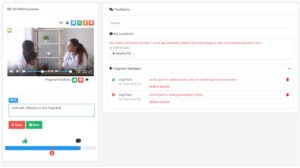
Videolab enables flexible recording of simulations or clinical interactions directly with personal devices such as smartphones or tablets, or integrated into already existing camera systems. Recordings are automatically deleted from the devices in order to avoid duplicates. then uploaded directly to an institution-specific cloud and stored in a secure vault, which ensures the highest standards of data protection and security. Thanks to its intuitive design, the platform integrates seamlessly into existing work and teaching processes without requiring complicated technical steps. A particularly practical feature is the option to give direct feedback using timestamps in the videos. This allows instructors to leave precise comments at the relevant moments, which supports student reflection and learning in a focused and asynchronous way.