

Medical students who score high on affective empathy (the kind that involves feeling what a patient feels) are at greater risk of burnout, not less. Students high in cognitive empathy show the opposite pattern. This is a design problem for anyone building a clinical communication curriculum.
Cognitive empathy is the ability to understand another person’s thoughts, concerns and perspective without sharing their emotional state. This can be trained according to a 2025 systematic review of 36 randomised controlled trials, but only with a moderate effect size. The five methods below have the strongest evidence behind them.
Cognitive Empathy vs Affective Empathy: Why Educators Need to Train Them Differently
Cognitive empathy and affective empathy are not two sides of the same skill. They are distinct psychological constructs that develop differently, respond to different training inputs, and carry different consequences for student wellbeing.
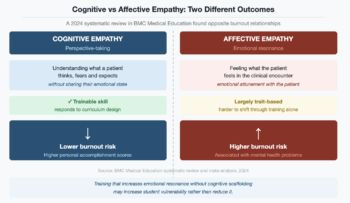
Cognitive empathy is perspective-taking: the capacity to understand what a patient thinks, fears and expects from a clinical encounter. Affective empathy is emotional resonance: feeling what the patient feels. Both matter in clinical practice. The problem is that most training interventions target empathy generically, without specifying which dimension they are trying to develop.
The distinction matters because the two types have opposite relationships with burnout. A 2024 systematic review and meta-analysis in BMC Medical Education, drawing on data from medical students across multiple institutions, found that higher affective empathy was associated with increased burnout and mental health problems. Higher cognitive empathy showed the reverse pattern, with lower burnout and higher scores on personal accomplishment. For programme directors, this is an important design implication: training that increases emotional resonance without building the cognitive scaffolding around it may be increasing student vulnerability rather than reducing it.
Cognitive empathy also has a cleaner relationship with observable clinical behaviour. Reading and responding to what a patient communicates, both verbally and non-verbally, is central to effective consultation. Understanding the non-verbal dimension of that skill is covered in detail in Nonverbal Communication in Healthcare.
The five methods below all target cognitive empathy specifically. None of them ask students to feel more. They ask students to understand more precisely.
1. Standardised Patient Encounters
Simulated encounters with standardised patients are the most consistently effective active method for developing cognitive empathy in medical students, outperforming role-play between peers and all passive instructional formats. A 2025 meta-analysis in Frontiers in Medicine found that standardised patient training produced stronger acquisition of communication skills than peer role-play, with the gap widening when scenarios were designed to surface emotional complexity rather than clinical procedure alone.
What makes standardised patient work effective for cognitive empathy specifically is the combination of realism and repeatability. Students encounter the same scenario multiple times across cohorts, which allows educators to design situations where perspective-taking is not incidental but structurally required. The student cannot complete the encounter satisfactorily without first understanding what the patient believes is happening.
The briefing given to standardised patients matters as much as the scenario itself. Patients trained only to present symptoms will produce encounters that test clinical knowledge. Patients trained to hold a specific set of beliefs, fears and expectations about their condition will produce encounters that test cognitive empathy.
What to include in the post-encounter debrief
The debrief is where cognitive empathy development actually happens. Three questions that consistently shift perspective-taking:
- What did the patient understand about their situation at the end of this encounter?
- At what point did the patient’s expectations and the student’s agenda diverge?
- What did the patient signal that the student did not respond to?
These are different from standard performance questions. They keep the patient’s frame of reference at the centre of the review rather than the student’s clinical decisions.
2. Narrative Medicine
Narrative medicine builds cognitive empathy through structured engagement with patient stories, used as deliberate practice in inhabiting another person’s frame of reference rather than as an exercise in emotional response. The distinction matters for implementation. Narrative work that asks students how a story made them feel targets affective empathy; asking students to reconstruct the patient’s understanding of their own situation targets cognitive empathy.
A 2023 study examining narrative medicine-based education in residents found improvements in empathy that persisted into high-stress clinical environments, an outcome that single-session communication workshops rarely produce. The most likely mechanism is repeated exposure to the gap between clinical reality as the practitioner sees it and the same reality as the patient experiences it.
In practice, narrative medicine sessions combine three elements: reading or listening to illness accounts, structured individual writing, and facilitated group discussion. The writing component is not free reflection. Students are given specific prompts that require them to adopt the patient’s perspective explicitly.
Prompts that develop cognitive empathy:
- Rewrite this account from the point of view of the patient one week after the encounter
- What did the patient think the doctor understood about their situation?
- What question did the patient most want answered that was not addressed?
Prompts that stay with the student’s emotional response do less work on cognitive empathy. The design of the prompt is the intervention.
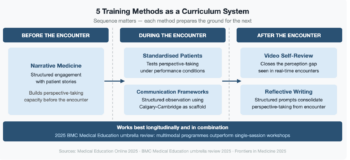
Narrative medicine works particularly well as a complement to standardised patient encounters: simulation tests perspective-taking under performance conditions; narrative work builds the underlying capacity before students enter the room.
3. Video-Based Self-Review
Watching a recording of their own consultation improves students’ cognitive empathy in ways that verbal feedback alone does not. The reason is specific: students reliably miss non-verbal signals during live encounters that become clearly visible on review. A patient’s hesitation before answering, a shift in posture when a diagnosis is mentioned, a question not asked. These are the data points cognitive empathy depends on, largely inaccessible in real time to students still managing the clinical demands of the encounter.
A 2020 study in BMC Medical Education using video feedback from real consultations found significant increases in self-perceived empathy among participants. The improvement was linked not to watching the video but to structured observation during the review: students guided to look for specific moments rather than left to assess their own performance generally.
What structured observation looks like in practice:
- Identify the moment the patient’s emotional state changed. What preceded it?
- At what point did the patient’s agenda and the student’s agenda stop aligning?
- What did the patient communicate non-verbally that the student did not acknowledge?
The quality of the debrief conversation after the video review determines how much cognitive development occurs. A student who watches a recording alone retains less than one who watches it with an educator annotating specific moments in the consultation.
This is where purpose-built platforms like Videolab add the most value: educators can mark and comment on specific timestamps in a recorded consultation, replacing broad post-encounter impressions with feedback anchored to exact moments. The gap between what the student thought happened and what the recording shows is where the learning sits.
4. Reflective Writing with Structured Prompts
Unguided reflection does not reliably develop cognitive empathy. Asking students to write about how a clinical encounter affected them produces self-focused accounts that can reinforce affective responses without building the perspective-taking capacity that defines cognitive empathy. The prompt is the intervention. Most reflective writing in medical education uses the wrong kind.
A 2025 umbrella review of empathy training in healthcare published in BMC Medical Education identified structured, patient-centred reflection as a component of the most effective multimodal programmes. What distinguished effective reflection from ineffective was direction: prompts that required students to reconstruct the patient’s perspective rather than explore the student’s own internal response.
Prompts that build cognitive empathy:
- What did this patient understand about their diagnosis at the end of the encounter?
- What was the patient trying to communicate that did not get addressed?
- How would this patient describe what happened in this consultation to a family member that evening?
Prompts that stay with the student’s experience:
- How did this encounter make you feel?
- What did you find challenging about this interaction?
- What would you do differently next time?
The second set is not without value, but it develops self-awareness rather than cognitive empathy. Both have a place in a communication skills curriculum. The distinction matters when the intended outcome is specifically perspective-taking.
Reflective writing works best when it follows a standardised patient encounter or video review rather than standing alone. The reflection needs specific material to work from. Used in that sequence, it consolidates the perspective-taking that the encounter began.
5. Communication Skills Frameworks as Observational Scaffolding
Named communication frameworks develop cognitive empathy most effectively when used as structured observation tools rather than performance checklists. The difference is in how students engage with them: a student performing to a framework is focused on their own behaviour; a student using a framework to observe a peer is focused on the patient’s responses at each stage of the encounter.
The Calgary-Cambridge Guide, developed by Silverman, Kurtz and Draper, provides a detailed map of the clinical consultation that makes explicit where patient perspective should be actively sought: at the opening, during information gathering, and across explanation and planning. When students observe a peer consultation using the framework as an annotation guide, they are trained to identify the specific moments where cognitive empathy was demonstrated or absent, and to articulate why. This is a different cognitive task from completing a global rating scale after the fact.
In practice, observer roles are often treated as secondary to the performer role. Research on framework-based training points in the other direction: the student observing with a structured framework may be doing more cognitive empathy work than the student conducting the encounter, because observation at one remove makes the patient’s frame of reference easier to track.
Frameworks also allow educators to give feedback that is referenced and specific rather than impressionistic.
“Your explanation of the diagnosis was clear”
is harder for a student to act on than
“At the Calgary-Cambridge planning stage, you proposed a treatment without checking what the patient already understood about their options.”
For high-stakes contexts such as breaking bad news or end-of-life conversations, frameworks like SPIKES operationalise empathic communication at a step-by-step level. A broader introduction to how consultation structure supports patient-centred communication is covered in How is a Doctor-Patient Consultation Structured.
Building a System, Not a Module
None of these five methods works well in isolation. The 2025 umbrella review of empathy training in healthcare found that longitudinal, multimodal programmes significantly outperformed single-session workshops across every measured outcome, and that combinations of experiential methods produced more durable results than any single approach repeated. For programme directors, the practical implication is straightforward: cognitive empathy training belongs distributed across the curriculum, not concentrated in a single communication skills module. A standardised patient encounter in year two means more when students have the reflective writing practice to process it and the video review infrastructure to revisit it. The five methods above are most accurately understood as components of a system rather than a menu of alternatives.