


Not all feedback works the same way. In healthcare education especially, the timing and purpose of feedback can drastically change how students learn and how educators teach. This blog explores the difference between formative and summative feedback, when to use each, and why combining both leads to stronger outcomes.
Drawing from real classroom examples, peer-reviewed research, and integrated models like the SOLO taxonomy, it also offers practical strategies that educators can apply immediately. Whether you’re teaching clinical skills or communication strategies, understanding this balance is key to building reflective, skilled practitioners.
What Is Formative Feedback?
Formative feedback is feedback provided during the learning process with the goal of improving student performance, not just evaluating it. Brookhart (2018) emphasizes that formative feedback is designed to promote learning rather than simply serve grading functions (Cambridge Handbook of Instructional Feedback). It’s typically ongoing, often informal, and offered as students work so they can adjust and grow. his type of feedback supports metacognitive awareness, encouraging learners to track their progress and plan their next steps, an idea supported in Hattie and Timperley’s framework as well.
Research collected in The Cambridge Handbook of Instructional Feedback shows how formative feedback becomes most effective when learners receive messages that guide improvement rather than just highlight errors. Authors like, Lipnevich and Smith, note that feedback which is specific, actionable, and timely boosts learning by supporting learners’ thinking about how they learn and what they need to do next.
Formative feedback also plays a role in developing self-regulation. As Hattie notes in his synthesis of over 800 meta-analyses, feedback significantly impacts students’ ability to monitor and direct their own learning (Visible Learning). When students learn to evaluate their progress and set personal goals, they become more engaged and autonomous in their learning.
What Is Summative Feedback?
Summative feedback refers to feedback provided after learning concludes and often ties directly to grading, benchmarking, or certification. It usually appears in end-of-unit tests, final projects, standardized exams, or portfolios. Students receive a score or grade that reflects their performance relative to a standard, and educators use it to measure outcomes and reward achievement rather than to guide ongoing learning.
Many students view summative feedback as high stakes, which can be motivating but often feels stressful. In higher education, traditional single assessments near the end of a course sometimes seem less accurate at reflecting progress than multiple smaller tasks. Segmented assessments and feedback opportunities throughout a course improve student engagement and perception of fairness (Morris et al., 2021)
Still, summative feedback becomes more impactful when linked to actionable follow-up. According to Carney et al. (2022), embedding opportunities for reflection within assessments allows learners to better understand their performance and plan how to improve. Additionally, Svensäter and Rohlin (2023) show that summative assessments integrated with formative elements, like structured feedback using the SOLO taxonomy, lead to deeper cognitive engagement and progression. This kind of blended model transforms assessment into a tool for both accountability and learning.
Key Differences Between Formative and Summative Feedback
Here’s a clear comparison of formative and summative feedback so you can see how they differ in timing, purpose, student outcomes, and teacher roles:
| Aspect | Formative Feedback | Summative Feedback |
| Timing | Occurs during learning and guides instruction in real time | Occurs at the end of learning to summarize achievement |
| Purpose | Help students know where they are and how to improve | Measures performance and awards grades or certification |
| Student Outcomes | Encourages reflection, self-regulation, and ongoing progress | Signals mastery levels, reinforces accountability |
| Teacher Roles | Interprets student understanding and adjusts teaching | Evaluates against standards and provides final judgment |
Formative feedback takes place while learning happens, enabling instructors to notice misconceptions and adapt lessons immediately, and learners to track how they learn. In contrast, summative feedback delivers a conclusive evaluation at a unit’s end, often tied to grades, benchmarks, or certification. It helps students understand how they performed overall and meets institutional accountability needs.
Reviews confirm that formative feedback consistently elevates learning when it is applied regularly and informs teaching decisions; summative feedback alone seldom enhances learning unless paired with formative elements (Morris 2021, Ismail 2022).
Do They Really Compete? Or Complement?
You might assume formative and summative feedback work in opposition. In reality, they function best when integrated. When feedback is aligned across both assessment types, it strengthens student learning, guides teaching, and improves outcomes at both course and program levels.
A useful model of this integration comes from Svensäter and Rohlin (2023), who applied the SOLO taxonomy to blend formative and summative assessment in health education. Students responded to realistic scenarios and received formative feedback tailored to their level of understanding – ranging from incorrect to descriptive to relational. Later, in a follow-up summative task, performance was reassessed. The majority of students progressed to more complex reasoning levels, showing that the formative phase supported their ability to meet higher-order summative criteria.
Carney et al. (2022) further argue that formative feedback must be embedded within broader instructional design. When feedback loops are intentionally aligned with learning outcomes, students become more self-aware, instructors gain clearer insight into learning progress, and institutions see greater program-level coherence. Rather than viewing summative testing as a standalone metric, Carney’s research encourages its alignment with formative goals for ongoing improvement across courses and departments.
This blend shifts assessment from a rigid checkpoint into a fluid process. Formative feedback clarifies learning needs in real time, while summative feedback affirms whether those needs have been met. Together, they enhance both mastery and motivation.
What the Evidence Says: Impact on Learning, Motivation, and Anxiety
Research consistently shows that formative feedback leads to deeper learning and greater motivation than summative feedback alone. In a 2022 review, Ismail and colleagues found that formative feedback significantly improved students’ self-regulation, confidence, and emotional resilience. Students receiving timely, low-pressure feedback were more likely to reflect on their learning, adjust strategies, and feel in control of their progress. Meanwhile, summative feedback, especially when tied to high-stakes outcomes, often increased anxiety and narrowed focus to just what would be tested.
Morris et al. (2021) conducted a systematic review of feedback strategies in higher education and found similar patterns. The most effective approaches included frequent low-stakes quizzes, peer evaluations, and structured reflection – all formative in nature. These practices helped students stay engaged while reinforcing memory and comprehension. However, when feedback was tied closely to grades, students often became more performance-focused and less willing to take risks or explore alternative strategies. The evidence here suggests a more complex interaction between assessment type and motivation, where formative methods typically support growth while summative formats may inhibit it unless carefully designed.
John Hattie’s Visible Learning synthesis backs these findings up with hard numbers. Across over 800 meta-analyses, feedback scored an effect size of 0.73, placing it among the most impactful strategies in education. However, the greatest impact came from formative feedback – feedback that was timely, specific, and focused on guiding improvement. Simply adding comments to a graded paper didn’t have the same effect. The timing, tone, and structure of the feedback made all the difference.
Together, these findings suggest that formative and summative feedback aren’t equally effective in every context. While summative feedback plays a critical role in certifying progress, it does little to enhance learning unless paired with actionable insights.
Practical Strategies for Educators
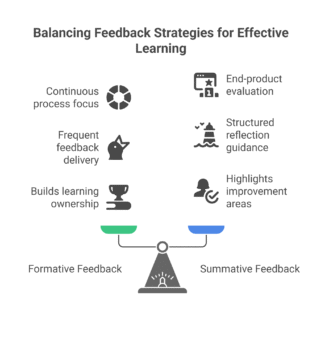
Knowing when and how to use feedback is just as important as choosing the right type. Formative feedback works best when it’s embedded throughout the learning process and aligned with clear goals. Brookhart outlines five key strategies that help teachers do this well: clarifying success criteria, engineering effective questions, providing frequent feedback, encouraging peer-to-peer feedback, and supporting self-assessment (Cambridge Handbook of Instructional Feedback). Dylan Wiliam adds that the most useful feedback isn’t simply delivered, it’s acted on. For example, asking students to revise their work after feedback reinforces understanding and builds ownership of the learning process.
Summative feedback can also be adapted to drive learning rather than just score it. Using rubrics that explain expectations in advance helps students focus on process as well as produc
t. Instructors add comment codes or checklist-based feedback to summative tasks to highlight areas for improvement. After assigning grades, they often guide students through structured reflections that help them internalize the feedback and apply it in future work.
To manage workload while maintaining feedback quality, automation can help. One example is Biggam’s Automated Assessment Feedback (AAF) tool, which integrates automated responses into summative assignments using pre-set feedback templates. In trials, this approach not only reduced marking time but also improved feedback clarity for students.
Pedagogical Foundations
When educators look deeper, formative feedback rests on solid cognitive learning theory. In particular, Brookhart explains that feedback works best when it connects what learners understand now to more sophisticated goals and guides them toward next steps in their thinking, not just final marks (Cambridge Handbook of Instructional Feedback). Moreover, research has shown that formative assessment can significantly boost student performance (sometimes accelerating learning by up to six months within a school year) when teachers use evidence from formative moments to adapt instruction (Wiliam, 2010 summarizing Black & Wiliam).
Furthermore, John Hattie’s Visible Learning synthesis confirms that feedback ranks among the most powerful drivers of learning, with an effect size around 0.73. That level of impact suggests students gain more when feedback supports their own thinking rather than just delivering a judgment (Visible Learning meta‑analyses, Hattie). Besides, formative feedback nudges motivation and metacognitive awareness, because students reflect on what they understand, plan how to improve, and track their growth over time.
Use Cases & Examples
In real classrooms, formative feedback fits naturally into everyday learning. For example, teachers often use peer review sessions so students exchange feedback on each other’s drafts and rethink their own work in light of a classmate’s perspective. Exit tickets allow students to write a quick response at the end of a lesson, maybe with a sentence that captures their understanding, so teachers can immediately spot confusion or gaps and adjust the next day’s lesson accordingly. Interactive quizzes, whether done via clickers or online tools, offer immediate feedback that keeps learners on track while allowing them to test ideas and correct course in real time. These tasks help students reflect on what they know and what they need to explore further and they promote metacognition, because learners monitor their own learning as they go.
By contrast, summative assessments are used at the end of units or courses to measure overall achievement. Final exams, standardized tests, or end-of-term portfolios sum up learning in a more formal way. These serve evaluation goals rather than guiding ongoing improvement.
However, formative feedback can be woven into summative tasks so they teach even as they assess. One study of a finance course showed that tutorial sessions within summative assessments offered formative feedback that correlated with better performance on exams and assignments. Likewise, a narrative review of feedback research highlights that blended approaches combining formative and summative feedback tend to support learning more effectively when feedback is frequent, timely, supportive, and constructive.
Conclusion
At its core, the difference between formative and summative feedback lies in timing and intent. Formative feedback supports learning while it’s still happening. It helps students reflect, revise, and move forward. Summative feedback, in contrast, steps in at the end to judge how far they’ve come. Both play important roles, but they’re most powerful when used together.
A balanced approach doesn’t mean using both equally in every task. It means aligning feedback with your goals. If the aim is growth, lean into formative strategies like peer review or quick check-ins. If it’s about certification or accountability, summative feedback provides a clear measure. The trick is designing courses where one builds toward the other.
For practical models of how teachers are using feedback to support both performance and wellbeing, check out the VideoLab blog, which highlights classroom-tested strategies for integrating feedback into everyday teaching.