
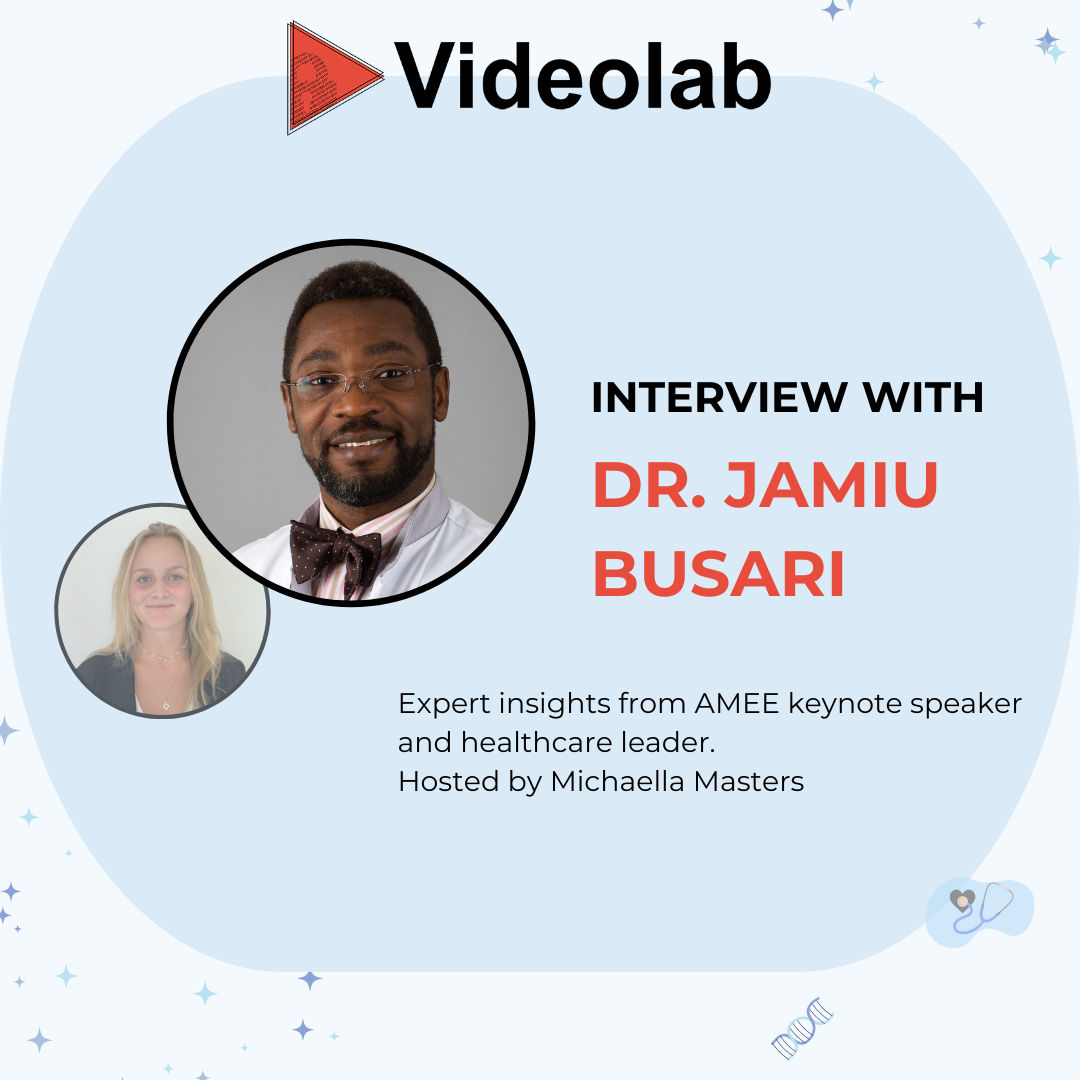
Last week I had the opportunity to interview Jamiu Busari, a leading figure of the healthcare education scene today, and a keynote speaker at AMEE.
In this interview, we discussed Jamiu’s career, achievements and some insights on the upcoming keynote talk at AMEE. Jamiu shared insights on the evolution of medical practice, the impact of AI, and the importance of maintaining humanity in communication. He also discussed the challenges faced by individuals entering the medical field and the significance of cultural context in healthcare.
Find the whole interview and transcript linked below.
[lyte id=’xVEp5JB3l1w’ /]
TRANSCRIPT
Michaella Masters
I’ve seen you participate in many different prestigious organisations. Some as an associate professor, I believe, of Maastricht University, a former executive member of NVMO, an honorary fellow of the Royal College of Physicians and Surgeons of Canada, and many more, I’m sure. So my first question would be, what would you say your overarching mission and goals are with your activities and daily practice?
JO Busari
I’ve been asked many questions over the years, but I would say this is probably one of the toughest to answer because it requires a very comprehensive response.
At the core of everything I do, my mission is actually quite simple: to make a difference and inspire reflection. Many of the academic and professional achievements people see today came from a deeply personal drive to prove that I was good enough. In many ways, that motivation shaped my journey.
When I describe myself professionally, I usually see my career through three main pillars.
The first is as a scholar, researcher, and scientist. The second is as a clinician, which is ultimately what I trained to become. The third is leadership within healthcare systems and organisations.
Those three areas together represent who I am professionally. Depending on which aspect of my work you are looking at, different achievements reflect different parts of that identity.
For example, within medical education and scholarship, serving as a member of the executive board of the Dutch Medical Education Board reflects that academic dimension of my work. Similarly, my role as an Associate Professor of Medical Education also sits within that pillar.
When you look at leadership, being a founding member of Sanokondu and becoming a Canadian Certified Physician Executive are reflections of that part of my professional journey.
Then, from the clinical perspective, being recognised as an Honorary Fellow of the Royal College of Physicians and Surgeons of Canada reflects my work as a physician. Likewise, my role as a clinician scientist at Ontario Tech University connects directly to that clinical and scientific identity.
So yes, it’s probably a longer answer than expected, but I think it helps explain the broad range of achievements and experiences I’ve accumulated over the years, and how they all connect back to those three central pillars of my career.
Michaella Masters
Looking at your research, obviously, was having quite a look at some of the papers, and I did notice that you cover a wide range of topics. What would you say your preferred areas of research are?
JO Busari
My preferred area of research at this present time and at this stage of my career is in the area of social justice and then social justice within the fields of those three areas. Social justice in clinical work as a doctor, as physician, social justice in medical education, which is why I’m going to AMEE, for example, and social justice in the area of leadership, for example, I am the commissioning editor at BMJ Leader. BMJ leader is one of the subsidiary journals of BMJ, and leader is all about leadership. And being a commissioning editor there gives me the opportunity to push for social justice when it comes to doing work in the area of leadership as it applies to healthcare, but also to leadership in general.
Michaella Masters
Brilliant. Yes, because I have seen, obviously, a little bit about what your talk is going to be about. AMEE, could you give any insights into that, obviously, without telling us your whole talk?
JO Busari
What I’m planning is more of a conversation or dialogue with the attendees rather than a formal presentation. During my preparation for this work, I came across the concept of syllogism. I’m not sure if you’re familiar with the term, but it really helped shape the way I’m thinking about these issues.
A syllogism is essentially a pattern of reasoning built around three connected statements: a major premise, a minor premise, and a conclusion that links them together.
For example, someone might say, “All Black people are lazy.” That becomes the major premise. Then they say, “Jamui is Black.” That becomes the minor premise. The conclusion they draw is: “Therefore, Jamui is lazy.”
You can reverse the example as well. Someone might say, “All white people are rich. Michaela is white. Therefore, Michaela is rich.” In both cases, assumptions are being transformed into conclusions and then treated as reality.
What interests me is how often we use these kinds of syllogisms in everyday conversations without fully realising it. In attempts to persuade people, win arguments, gain influence, or reinforce beliefs, we rely on assumptions that may or may not be true.
Some of these patterns of reasoning appear harmless, while others contribute directly to prejudice, inequality, discrimination, and microaggressions. Over time, they shape the way we see and treat one another. I think they also contribute to the growing lack of compassion and respect we are seeing in society today.
That is why I want this session to feel like a dialogue rather than a debate. A debate is usually about proving a point or winning an argument. That is not what I’m trying to do.
Instead, I want us to explore these processes together and become more aware of how we communicate with each other. I’m not using syllogism to prove anything. I’m using it as a tool to illustrate the kinds of assumptions that often sit beneath our interactions.
My hope is that, once we recognise these patterns, we may begin to reflect on whether the way we currently engage with one another is actually producing the outcomes we want. If it is not, then perhaps we need to rethink the way we communicate.
I hope that makes sense. That is really what I’m trying to achieve with the session, and I genuinely hope you’ll be there to take part in it.
Michaella Masters
What day is it actually that you are?
JO Busari
It’s the closing plenary. That’s the last day of the conference.
Michaella Masters
Yes, I’ll definitely be there. I think it sounds so interesting. And it’s very much about how people judge or group others together, sometimes subconsciously and without intending to. I think it’s a necessary conversation because it encourages reflection. As you said, the goal is to create dialogue rather than deliver a presentation or spark an argument.
Then what have been probably the most significant milestones, would you say, in your medical career? I’m not sure if it is linked to your talk or to the subjects around the talk. What’s been the most significant milestone?
JO Busari
That’s a tough one. I’ve been privileged to have been recognized for so many things in my career. I have this most significant milestone. I think the most significant milestone for me.
JO Busari
Okay, well, so there is one and a half. Okay, I’ll say one and a half. Why? So after my keynote at AMEE, then that will probably be the most significant milestone for me in my career. But as of today, the most significant milestone in my career, among the many, is my honorary fellowship of the Royal College in Canada. Being awarded an honorary fellowship is like, that is as a scholar being recognized. I mean, I’m not canadian. I don’t practise in Canada. I’m international. Being honoured and given an award is so significant for me. But being able to speak on a podium like AMEE for an educationalist, that is because not all of us are going to get that opportunity to deliver a keynote at AMEE. Right. So for me, that’s one of those things that is very significant.
Michaella Masters
I think both of them are brilliant achievements. And I thought this might be challenging because when I was having a look at your different profiles and the different websites that I found, and I obviously found a couple of interviews that you’ve done, and you speak about so many, such a large and a wide range of organisations that you’ve been a part of. Just so many incredible achievements, and I think especially within medical education, I think it’s incredibly important.
JO Busari
Yeah. Thank you so much. I really appreciate that, you know. Thank you so much. I mean, that’s kind of you, of course.
Michaella Masters
And how would you say your field has changed since you first started practising?
JO Busari
It has changed a lot. We’re now into the era of AI, you know, so definitely.
Michaella Masters
Well, this is very much another question that I have. Like, with such a rapidly changing world, how do you see the roles of medical professionals changing and how do you see everything evolving, especially with AI?
JO Busari
To give you some context, I started my medical training in Nigeria, which is where my roots are. Although I was born and raised in England, my parents eventually moved back to Nigeria, and I went with them. That’s where I obtained my first medical degree, my MBChB, and completed my early training.
Back then, computers were practically nonexistent in our learning environment. Our lecturers would dictate directly from their notes while we sat there writing everything down by hand. Those handwritten notes became the material we later used to study for exams.
I still remember writing my very first thesis. The entire document was written by hand before I took it to a man who owned a typewriter, one of those old mechanical machines. For hours, I sat beside him while he typed everything out for me. Whenever he couldn’t read my handwriting, I had to stop and spell the words out letter by letter.
That was how I produced my first thesis. I’m talking about the early to mid-1980s.
Then fast forward to where we are today. I witnessed the arrival of the first computers, watched technology gradually become integrated into education and healthcare, and now I’m sitting here using a MacBook Pro with M-series chips while people are discussing AI-driven medicine. It’s an entirely different world.
A lot of these developments have been incredibly beneficial for practitioners, learners, and patients alike. Technology has improved access to information, accelerated workflows, and created possibilities that simply did not exist before.
At the same time, I’ve also seen the inherent dangers that come with the speed of innovation. The pace at which technology is evolving is something I genuinely worry about in terms of how we manage it responsibly.
When you look at how quickly these tools are changing, alongside the ways they can be used, abused, or misused, there is reason for concern. I would not say it feels frightening yet, but there is certainly a growing level of concern about where all of this is heading.
Michaella Masters
I think it’s that way with a lot of industries at the moment, obviously, I think it’s definitely a lot more serious within healthcare because you’re talking about people’s lives and their fitness and their well being. It’s not just possibly a robot taking a job, it’s actually people’s well being. I guess this is very much related then, but maybe trying to look at it in a different way, not so much within AI. Are there any advancements in medicine and technology that you’re actually excited about and that you can see changing the practice of healthcare for the better in the future, or any tools in particular that you see help your students or help your colleagues or yourself, obviously, as well?
JO Busari
I think robotics, particularly in the area of minimally invasive procedures, has been one of the most significant innovations in medicine. It has reduced hospital admission times, improved recovery rates, and increased precision in treatment. From that perspective, the progress has been remarkable, and that genuinely excites me.
Artificial intelligence has also been incredibly interesting to watch develop. In many ways, AI has existed for quite a long time already. What we are seeing now feels more like version 3.0 or 4.0 of artificial intelligence, rather than something entirely new.
Medicine has been using forms of artificial intelligence at a much lower level for years. Even simple systems, like motion sensors that automatically open doors when someone approaches, are examples of intelligent automated responses. They detect movement, process information, and react accordingly.
For me, though, everything comes back to the responsible application of these technologies. That is the most important part of the conversation.
I’ve always been interested in innovation and have been involved in different innovative ideas throughout my career. In this particular case, however, I see myself more as an early adopter than an innovator. I’d rather allow the technology to mature first, let people work through the strengths and weaknesses, and then evaluate it properly before fully jumping on board.
So I’m not against artificial intelligence at all. I simply want to see clearer evidence of its benefits, its limitations, and its potential risks before embracing it completely.
Michaella Masters
Yeah, I couldn’t agree more. In healthcare, there is very little room for trial and error. This is especially true in areas like robotics-assisted procedures, where precision and consistency are critical. High stakes environments demand systems that work reliably from the start. I think you kind of knocked it on the head when you mentioned that it’s how people use them. I think people hopefully use them responsibly so that they won’t be taken advantage of or used to cut corners in any way. Speaking of which, what do you think are the challenges for people getting into your field and what advice would you give them to overcome the challenges when starting out?
JO Busari
Yeah, so when people ask about the challenges, that’s not a question with one simple answer. Over the years, I’ve learned that everything has to be understood within context.
For me, it’s different entering a profession as a person of colour, especially when that profession was historically built around the image of the white, male, blonde, blue-eyed physician. At the same time, the experience will also differ for someone who identifies as a white woman entering the same profession. It changes again for someone like me, who identifies as male, heterosexual, Black, and of African ancestry.
Because of that, I can only speak about the challenges from my own lived experience. Much of that experience came from starting in a disadvantaged position, where the underlying assumption often felt like you were not good enough. There is a constant pressure to prove yourself and demonstrate that you deserve to be there.
One thing I do believe, though, is that success in any field requires hard work. You have to put the work in. At the same time, you also need to be smart about where you direct your energy. Effort without focus will only take you so far.
Consistency matters just as much as hard work. You can work extremely hard, but if you are not consistent, you are unlikely to reach the results you want. The two have to exist together.
You need hard work, consistency, belief in yourself, and a clear goal that you are aiming toward. I think those things help most people succeed in any profession, but especially in medicine. You have to keep exercising that muscle, staying disciplined, and remaining focused on where you want to go.
At the same time, you also have to enjoy what you do. You need to believe in it. Honestly, if what you are doing does not inspire you, something will always feel missing. You may still succeed on paper, but the experience itself will not feel meaningful or connected to who you are.
I always tell people that you should pursue something that excites you so deeply that, if someone woke you up at one or two in the morning and said, “Let’s go,” your immediate reaction would be, “Alright, what do I need to do next?”
Michaella Masters
Yeah, that’s a brilliant example. Okay, so just sort of wrapping up. Our community is very much interested in, obviously, communication skills and soft skills training. How do you think that we could improve? How do you think healthcare and the practice of medicine can improve the way that these sorts of communication skills are taught to students? Or do you think there is any improvement that can be made?
JO Busari
You might call me old school on this, but I believe there is nothing that can truly replace the human touch. I’ve worked with simulation, I’ve written about it, and I understand its value. Even so, human beings remain some of the most complex creatures on earth.
At our core, we all thrive on acknowledgement, kindness, and compassion. People want to be listened to. They want to be treated with dignity and respect. For me, communication always has to return to that foundation.
One of the central messages in my presentation will be our shared humanity. I think one of the things we have gradually lost is that sense of humanity toward one another. We have moved away from being our brother’s or sister’s keeper and shifted toward thinking, “What’s in it for me?”
Too often, if something does not affect us directly, we see it as somebody else’s problem. We distance ourselves from it. Personally, I think we need to move away from that mindset. Another person’s problem eventually becomes our problem as well, whether directly or indirectly.
Because of that, communication should come from a humble and humanistic perspective. Conversations should feel intentional and deeply engaging. When I’m speaking with someone, I want that person to feel like the centre of the universe in that moment.
They should feel fully seen, fully heard, and genuinely valued through the attention they are being given.
Michaella Masters
That’s brilliant. What are your thoughts on the method of, as I mentioned, recording interactions for practical training and for reflective practice? Do you have any thoughts, I don’t know if you’ve ever actually done this before or.
JO Busari
So, could you take that question again, please? Sorry?
Michaella Masters
What are your thoughts on the method of recording interactions, whether that be obviously real patient consultations or simulated consultations for training. For practical training and reflective self reflection?
JO Busari
Yeah, so I support it. But there’s one assumption we tend to make, and I think “assumption” is the right word here. We often assume that this method works for everybody. We treat simulations and recordings as the obvious path forward for communication skills development, for example. At the same time, I think we need to leave room for the possibility that it may not work equally well for everyone.
There’s a tendency to assume that everybody learns in the same way, that everyone should go through simulations or recordings, and that success within those systems automatically reflects communication ability. I’ve been having similar conversations in another area around professionalism. How do we decide who is “professional”? Whose standards are being used to define professionalism?
The same question applies to education and communication. Whose standards are we using when we teach communication skills? Who decided that one particular approach is the correct one?
There are communities where oral tradition and narrative storytelling are central forms of communication. In my own experience, there was a period in my life when my cousins, siblings, and I would sit with my grandmother while she told us stories. She could tell those stories so powerfully that you would just sit there thinking, “Wow, this is fantastic.”
By listening repeatedly and paying attention, you naturally learned how to communicate and how to tell stories yourself. That is also a form of learning. It is not simulation-based, it is not recorded, but it still develops communication skills in a meaningful way.
The point I’m trying to make is that we need to take cultural context into account when deciding which educational methods to apply. Simulation and recorded teaching largely come from Western approaches to medical education, and in many situations those approaches are treated as the standard.
What we sometimes forget is that they are not the only way to teach. They may be considered one of the “gold standards,” quote unquote, for teaching communication, but they are still only one approach among many.
Michaella Masters
I think it goes back to your very, very important message and a very important point on not generalising people, that every individual learns differently. Some succeed in some environments while others don’t as well. They need some different methods, they need some different techniques. Yeah, exactly as you said, that does not generalise. And not to put everyone in the same box. It just requires some humility.
JO Busari
I would rather use a toolbox, the toolbox of the toolbox analogy that, you know. And there are various ways to teach communication, one of which is simulation recorded teachings. But there are also other ways. And not just assume, as we most of the time do in most curricular designs, that the best way to teach communication is this. I mean, there are different methods that we just acknowledge, and that is not the case. It can’t be the standard. And also, we have to be open to non western methods of teaching. Probably that’s out of the scope of this conversation, but it’s something that we shouldn’t undermine.
Michaella Masters
Definitely. Well, thank you so much. I think that’s a good finishing point, and I appreciate so much of your time, and I look forward to your talk on Wednesday, next Wednesday. I’ll definitely make sure that I’m there. And so thank you so much for your time. If you have any questions or anything that you’d like to say as well.
JO Busari
It’s been a very pleasant conversation with you, Michaella, and I’m looking forward to meeting you in person.